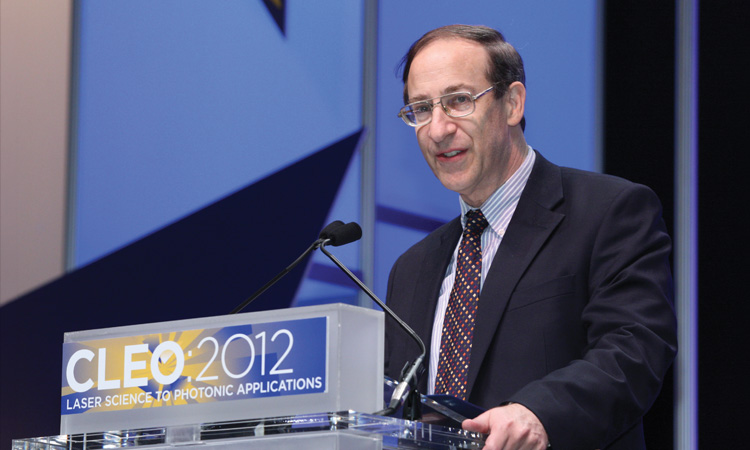
Tony F. Heinz at CLEO 2012. [Optica]
Frederic Ives Medal/Jarus W. Quinn Prize
The highest award conferred by Optica, for overall distinction in optics

Tony F. Heinz
Stanford University and SLAC National Accelerator Laboratory, USA
For pioneering discoveries in photon science, outstanding leadership, and a deep commitment to education
Heinz received a BS degree in Physics from Stanford University in 1978 and a PhD degree from the University of California at Berkeley in 1982. Heinz then joined the IBM Research Division in Yorktown Heights, NY. In 1995, he became a professor of Physics and Electrical Engineering at Columbia University. In 2015, he joined Stanford University as a Professor of Applied Physics and SLAC National Accelerator Laboratory as a Professor of Photon Science. He has served in various leadership positions, including as Associate Laboratory Director for Energy Sciences at SLAC and as Director of the E. L. Ginzton Laboratory at Stanford.
Heinz has made seminal contributions to the understanding of surfaces, interfaces, and nanoscale materials through the development and creative application of spectroscopic techniques. His early contributions to optical second‐harmonic generation helped to launch this sensitive method for probing surfaces and interfaces. Heinz has been a world leader in applying optical techniques to reveal the unique electronic and excited-state properties of 1D and 2D materials, such as carbon nanotubes, graphene, and 2D semiconductors.
Heinz is known as a dedicated educator who enjoys teaching students from introductory physics classes to specialized graduate courses. He takes particular pride in the accomplishments of his nearly 100 former graduate students and postdocs who are now expanding the frontiers of science and technology around the world.
Heinz has been active in professional societies, particularly within Optica, where he served as President in 2012. He is a Fellow of Optica, AAAS, and other professional societies, and a member of the US National Academy of Sciences. His research contributions have been recognized by the Meggers Award and other distinctions, including the Isakson and Schawlow Prizes and the Zewail Award.
Esther Hoffman Beller Medal
In recognition of outstanding contributions to education in optical science and engineering

Imrana Ashraf
Department of Physics, Quaid-i-Azam University, Islamabad, Pakistan
For her dedication to optics education at her university and at events targeting students from economically developing countries, as well as for the organization of numerous educational and outreach events in rural areas of Pakistan
Ashraf earned her PhD in quantum optics from the Department of Physics, Quaid-i-Azam University (QAU), Islamabad, where she later served as a faculty member. Her research interests span quantum, atomic, and classical optics. Following her retirement, she has remained actively engaged in academia through optics education and outreach efforts, while continuing her affiliation with her parent institution.
She is a Senior Member of Optica and SPIE, a Senior Associate of the Abdus Salam International Centre for Theoretical Physics (ICTP) (2026–2031), and the Managing Director of the International Commission for Optics (ICO) in Pakistan. Ashraf has maintained a close association with ICTP for over three decades and was selected as one of only four 2025 ICTP Institute Associates worldwide.
In 2016, Ashraf founded Active Learning in Optics (ALO), a self-funded initiative dedicated to promoting hands-on optics education among underprivileged high-school and college girls in remote regions of Pakistan. Through ALO, she successfully organized 90 optics outreach activities by December 2025. During the COVID-19 pandemic, she initiated the Pak-ICTP Alumni Society (PIAS) as an online platform for academic engagement and community building.
She has over 30 years of experience teaching optics-related courses at QAU and 14 years at the Preparatory School of the ICTP Winter College on Optics. She has also contributed to informal optics education at ICTP, particularly for African participants, and continues to engage in outreach for remote areas of Pakistan. Her honors include the ICO/ICTP Award, the Spirit of Salam Prize, and Optica’s Diversity and Inclusion Advocacy Recognition Award.
Max Born Award
In recognition of contributions to physical optics

Roberto Morandotti
INRS-Energie Mat & Tele Site Varennes, Canada
For pioneering experiments in chip-scale quantum light sources and complex entangled states, as well as for groundbreaking contributions in nonlinear, ultrafast, and terahertz optics
Morandotti is a Professor and Group Leader in the Energy Materials Telecommunications Department at the Institut National de la Recherche Scientifique (INRS-EMT), Varennes. He received his MS in physics from the University of Genova in 1993, and his PhD in electronics engineering from the University of Glasgow, under the supervision of Stewart Aitchison. He conducted postdoctoral research with Yaron Silberberg at the Weizmann Institute of Science and with Stewart Aitchison at the University of Toronto. He joined INRS-EMT in 2003, where he has since established an internationally recognized research program. His research interests span integrated photonics for quantum technologies and machine-learning applications, as well as terahertz science and its applications.
He has served as Chair and Technical Committee Member at numerous Optica-, IEEE-, and SPIE-sponsored conferences and was a Distinguished Lecturer of the IEEE Photonics Society. His contributions to graduate education and mentorship have been recognized by the Canadian Association for Graduate Studies and INRS.
Morandotti holds a Tier 1 Canada Research Chair (2016–2030) and is a Fellow of Optica, the Royal Society of Canada, the Engineering Institute of Canada, AAAS, IEEE, APS, SPIE, and IoP. His additional awards/honors include the NSERC Synergy Award, the NSERC Brockhouse Canada Prize for Interdisciplinary Research in Science and Engineering, the Prix Marie-Victorin, the Prix Urgel-Archambault, the Leadership in Research Award of the Université du Québec, the IEEE Quantum Electronics Award, and the NSERC E.W.R. Steacie Memorial Fellowship.
Stephen D. Fantone Distinguished Service Award
In recognition of outstanding service to Optica

George Bayz
Oakshire Partners, USA
For outstanding leadership as Optica Treasurer, including expertly guiding the organization through complex challenges with astute financial stewardship, steadfast integrity, and strategic vision, significantly strengthening Optica’s mission and stability
Bayz has over 25 years of senior management experience leading software and high-technology firms. He joined Synopsys as the Vice President and General Manager of the Optical Solutions Group following Synopsys’ acquisition of Optical Research Associates (ORA). Previously, he was President and CEO of ORA; President and CEO of PeoplePoint Systems, Inc., an enterprise software company; General Manager and Executive Vice President at Artemis International Solutions Corp., a provider of advanced project management solutions; President and CEO of Thinque Systems, a workforce automation solutions provider; and President and CEO of MAI Systems Corporation, a provider of information technology to the hospitality industry.
He received a BS in business administration from the University of Southern California and a JD from Loyola Marymount University. He is a Member of the California Bar and is a California Certified Public Accountant (inactive).
Bayz, an Optica Fellow, has served as Optica’s Treasurer for over a decade, demonstrating exceptional commitment, integrity, and strategic foresight. His financial and legal expertise has been invaluable to the society. He also chairs the Finance, Audit, Compensation, and Investment Councils and is a past chair of the Corporate Associates Council. He has been a regular presenter at the Optica Foundation Career Accelerator Program.
Michael S. Feld Biophotonics Award
In recognition of innovative and influential contributions to the field of biophotonics, regardless of career stage

YongKeun Park
Korea Advanced Institute of Science and Technology (KAIST), Republic of Korea
For pioneering the development of 3D quantitative phase imaging techniques and AI-enabled applications in biology and medicine, transforming label-free biophotonics into a powerful tool for fundamental discoveries and clinical translation
Park is a Professor in the Department of Physics at KAIST and serves as the Director of the Virtual 3D Biology Center. He is also the co-founder of Tomocube and TheWaveTalk. Park received his PhD in medical engineering and medical physics from the Harvard–MIT Division of Health Sciences and Technology. He is widely recognized for pioneering holotomography, a 3D quantitative phase imaging technology, and for advancing its integration with artificial intelligence for applications in biology, medicine, and materials science.
His research has resulted in over 230 peer-reviewed publications, including works in Nature Photonics, Nature Methods, Nature Cell Biology, and Nature Materials, accumulating more than 20,000 citations with an h-index of 80. He has delivered more than 100 invited lectures worldwide, including plenary talks at Photonics West and the European Conferences on Biomedical Optics.
Park is a Fellow of Optica and SPIE. His additional honors include the Asan Medical Award, the Medal of Honor in Science and Technology from the President of the Republic of Korea, and the Microscopy Today Innovation Award.
Paul F. Forman Team Engineering Excellence Award
In recognition of team technical achievements in optical engineering

TOPTICLOCK Team
TOPTICA Photonics SE & Physikalisch-Technische Bundesanstalt, Germany
For the development of a commercial single-ion optical clock by combining ultra-low-noise photonics and quantum technology providing an unprecedented level of accuracy in an industrial form factor
The TOPTICA optical ion clock team (“TOPTICLOCK” Team) developed a commercial single-ion optical quantum clock by combining ultra-low-noise photonics and quantum technology providing an unprecedented level of accuracy in an industrial form factor. The team was formed to transfer technology and know-how from the German national metrology institute (PTB) to TOPTICA Photonics SE. The PTB-TOPTICA cooperation builds on the collaborative research project “opticlock,” co-coordinated by TOPTICA and PTB, in which a research demonstrator of a rack-integrated optical frequency standard was realized by ten scientific and industrial partners.
The TOPTICLOCK Team then moved forward towards a commercial product and industrialized the clock. The team consists of the scientific advisor and optical clock expert Nils Huntemann from PTB and TOPTICA employees with backgrounds in scientific quantum technologies and engineering. Within only three years, the team developed, delivered, and qualified the commercial optical quantum clock TOPTICLOCK, and set it into operation at a lead customer site. With its relative stability and accuracy on the order of 10-17, it outperforms commercial optical clocks based on thermal vapors by approximately two orders of magnitude. Such a performance in an industrial form factor marks an important milestone towards the redefinition of the SI-second based on optical clocks. Other applications are time scales and time services, network synchronization, ground reference for satellite navigation, and fundamental scientific research.
Joseph Fraunhofer Award/ Robert M. Burley Prize
In recognition of significant research accomplishments in the field of optical engineering

Cheng-Wei Qiu
National University of Singapore, Singapore
For his pioneering works in interfacial optics of low-dimensional and van der Waals materials with photonic nanostructures, fusing multiscale symmetry, topology, and geometry from within natural crystals and meta-optics
Qiu received his BE from the University of Science and Technology of China and his PhD from NUS. He was a Postdoctoral Fellow in the MIT Physics Department prior to joining NUS, where he is currently Provost’s Chair Professor. He is well known for his research in structured light, metasurface photonics, and hybrid interface optics with van der Waals crystals and symmetry-breaking low-dimensional materials.
He has served in Associate Editor roles for various journals such as JOSA B, PhotoniX, Photonics Research, and Editor-in-Chief for eLight. He also serves on the Editorial Advisory Board for Laser and Photonics Review, Advanced Optical Materials, and ACS Photonics. He has been a Highly Cited Researcher since 2019 as rated by Web of Science and as an overseas partner, he has been awarded China’s Top 10 Optical Breakthroughs six times.
Qiu is a Fellow of Optica, APS, SPIE, Academy of Engineering Singapore, ASEAN Academy of Engineering and Technology, and the Electromagnetics Academy, and a Foreign Fellow of Chinese Optical Society. His additional awards include the Achievement in Asia Award (Robert T. Poe Prize), MIT TR35@Singapore Award, Young Scientist Award, and the President’s Science Award, the highest science distinction in Singapore.
The Joseph W. Goodman Book Writing Award
In recognition of a recent and influential book in the field of optics and photonics that has contributed significantly to research, teaching, business or industry (presented with SPIE)

Close-Range Photogrammetry and 3D Imaging, 4th Ed.
Thomas Luhmann, Stuart Robson, Stephen Kyle, Jan Boehm

Thomas Luhmann is Professor for Photogrammetry at Jade University of Applied Sciences, Oldenburg. He received his PhD from the University of Hannover in 1988. He served as project manager and head of R&D Photogrammetry at Leica, Switzerland and founded the Institute for Applied Photogrammetry and Geoinformatics. He has initiated various German-Ukrainian cooperation projects and his list of publications includes more than 20 books, 350 scientific articles and 4 patents.
Stuart Robson is Professor of Photogrammetry and Laser Scanning at University College London, and leads the 3DImpact Research Group. He is the Royal Academy of Engineering and Airbus Chair in Large Volume Metrology. He has published over 65 journal papers, 130 conference papers and made numerous presentations at academic and industry events. He is co-author of several key textbooks on photogrammetry, one of which won the inaugural ISPRS Kraus Medal in 2010 and is now in its 4th edition
Stephen Kyle is a Principal Research Fellow in Large-Volume Metrology (LVM) at University College London. He received his PhD from University College London. Previously, he worked for Leica Geosystems (now part of Hexagon AB). He has 88 publications in the related fields of large-volume metrology, industrial surveying and industrial photogrammetry. These are a mix of journal papers, conference presentations, technical articles, patents and translations which also include the joint translation into English of “Photogrammetrie” by Prof. Karl Kraus (TU Vienna).
Jan Boehm is Professor of Photogrammetry and 3D Imaging at University College London. His research focuses on 3D data acquisition and 3D data processing, including scene understanding. He is an expert in photogrammetry and LIDAR and related 3D capture technologies. His research combines geometric processing techniques and machine learning approaches to deliver automated acquisition and high-level analysis of 3D data. He has applied his expertise and collaborated in a variety of application areas including national mapping and infrastructure, automotive and aerospace manufacturing, medical and body imaging, robotics and autonomous navigation, architectural and cultural heritage recording. He has published over a hundred papers on 3D data related topics in the photogrammetric, remote sensing, computer vision and pattern recognition community.
Nick Holonyak Jr. Award
In recognition of contributions to optics based on semiconductor-based devices and optical materials, including basic science and technological applications

Steven DenBaars
Materials & ECE Departments, University of California, Santa Barbara, USA
For pioneering contributions to high-efficiency GaN LEDs and laser diodes
DenBaars is a Distinguished Professor of Materials and Electrical & Computer Engineering at UCSB, where he serves as Director of the Institute for Energy Efficiency and Co-Director of the Solid State Lighting and Energy Electronics Center (SSLEEC). He received his BS in materials and metallurgical engineering from the University of Arizona, graduating as Valedictorian of the College of Engineering, and earned his MS and PhD in engineering from the University of Southern California. He began his career at Hewlett-Packard’s Optoelectronics Division, developing high-brightness LED technologies, before joining the UCSB faculty. He has played a pivotal role in advancing GaN-based optoelectronics and strengthening academic–industry collaboration, helping shape modern semiconductor innovation.
DenBaars played a central role in establishing gallium nitride (GaN) as a viable and scalable industrial technology, delivering substantial economic and environmental benefits. His contributions enabled the widespread adoption of high-efficiency LED lighting across general illumination, automotive lighting, and display applications, accelerating the transition from energy-intensive legacy lighting to sustainable solid-state solutions while advancing fundamental understanding of GaN materials and device physics.
DenBaars co-founded SSLEEC at UCSB, now the world’s leading academic center for solid-state lighting and III-nitride research. His pioneering work on micro-LEDs and GaN lasers has further enabled breakthroughs in next-generation displays, optical data storage, projection systems, and laser-based lighting.
He is a Fellow of Optica, IEEE, and the National Academy of Inventors. His additional awards include the Aron Kressel Award, Japanese Science of Applied Physics (JSAP) Outstanding Paper Award, and the Viterbi Award for USC Distinguished Alumni.
Robert E. Hopkins Leadership Award
In recognition of significant impact on the field of optics or a significant contribution to society

Tommaso Calarco
Forschungszentrum Jülich GmbH, Germany
For key contributions in setting up a coordinated research program and for fostering international cooperation in quantum technologies
Calarco is Director of the Peter Grünberg Institute for Quantum Control (PGI-8) at Forschungszentrum Jülich and Professor of Quantum Information at the Institute of Theoretical Physics of the University of Cologne and the University of Bologna. Calarco earned his PhD at the University of Ferrara and subsequently worked as a postdoctoral researcher in the group of Peter Zoller at the University of Innsbruck. Previously, he was a Senior Researcher at the BEC Centre in Trento and Professor of Physics at the University of Ulm, where he later became Director of the Institute for Complex Quantum Systems and of the Centre for Integrated Quantum Science and Technology. He has also conducted research at the National Institute of Standards and Technology (NIST) and at Harvard University. He has pioneered the application of quantum optimal control methods to quantum computation and many-body quantum systems.
Calarco authored the Quantum Manifesto that initiated the European Commission’s Quantum Flagship, where he currently serves as Co-chair of the Quantum Community Network (QCN). He is Secretary of the European Commission expert group of Top-Level Specialists in Quantum Technologies, chaired by European Commission Vice President Henna Virkkunen, and a co-founder of the European Quantum Industry Consortium (QuIC).
Edwin Land Medal
In recognition of pioneering work empowered by scientific research to create inventions, technologies and products (presented with the Society for Imaging Science and Technology)

[Photo by S. Silver]
Paul M. Hubel
Apple Inc., USA
For pioneering novel image algorithms in digital camera research; for development of optimal software-firmware strategies compatible with both existing and new hardware; and for three decades of image quality improvements that make better photographs—instantly
Hubel is Chief Scientist of Camera Technology at Apple Inc., where he leads advancements in color and image processing and image quality for digital photography. He played a key role in developing many aspects of computational photography, including multi-image fusion, multi-prime camera systems, stabilization, and depth features (portrait mode), which led to exponential growth in photography. Hubel has contributed core color and imaging technologies to Apple products since 2008.
He earned a BS from the University of Rochester and a DPhil from Oxford University. During his studies, he spent three summers working on surface physics, holography, and color science at The Rowland Institute for Science.
Hubel began his career as a research fellow at MIT Media Lab. He spent 10 years at Hewlett-Packard Laboratories, where he focused on illumination estimation, tone correction, and color rendering for digital cameras, as well as color reproduction for scanners, copiers, and printers. He then spent six years as chief image scientist for Foveon, Inc., where he continued his work in color processing, tone mapping, image signal processing (ISP) architecture design, and sensor optical simulations.
Hubel has been actively involved in IS&T and ISO TC42 on Digital Photography for most of his career. Notable recent contributions are the invention and standardization of HDR still image formats, which are now ubiquitous in the industry. As an undergraduate at the University of Rochester, Hubel founded the society’s first student chapter and enjoyed attending the Annual Meeting.
Sang Soo Lee Award
In recognition of outstanding leadership in founding or growing the optics and photonics community locally (presented with Optical Society of Korea)

Bishnu P Pal
École Centrale School of Engineering, Mahindra University, India
For several decades of pioneering contributions and passionate leadership of several photonics initiatives in India, and nurturing of their growth through education, research, and outreach
Pal is Professor and Chair of Physics (School of Engineering) and Dean of Academics at Mahindra University. He spent much of his academic career at the Indian Institute of Technology Delhi (IITD), where he also served as Chair of Physics (2007–2011).
He has served the global optics and photonics community through several leadership positions, including the Optica Board of Directors, International Council, and Publications Council. He has also served as President of the Optical Society of India (OSI), Associate Vice-President of the IEEE Photonics Society’s Membership Council, and on the editorial advisory boards of leading international journals. As President of OSI, he established the OSI Foundation and he served as India’s nodal contact for UNESCO’s IYL Steering Committee.
He was one of the key optics faculty at IITD in creating the MTech program in Optics and Optoelectronics in the 80s, and this program has been highly successful in training generations of students in optics and photonics. After his retirement from IITD, he joined Mahindra University when it was newly established in 2014. As a result of his leadership, the institution received full-fledged university status in 2017.
Pal is a Fellow of Optica, SPIE, and the National Academy of Sciences India, a Distinguished Fellow of OSI, and a Senior Member of IEEE. He is an Alexander von Humboldt Fellow, Fulbright Scholar and Honorary Foreign Member of the Royal Norwegian Academy of Sciences and Letters. His additional awards include the Esther Hoffman Beller Medal, Maria J. Yzuel Educator Award, and Prof A. Selvarajan Award.
Emmett N. Leith Medal
In recognition of seminal contributions to the field of optical information processing

Jürgen Jahns
Fernuniversität in Hagen, Germany
For seminal contributions to novel and compact architectures for optical computing systems
Jahns received his PhD in physics from University of Erlangen-Nürnberg. His thesis advisor was Prof. Adolf Lohmann, one of the pioneers of information optics. Previously, he worked with Siemens AG on sensors for automation and on digital optical communication systems and at AT&T Bell Laboratories as a Member of the Technical Staff to work in the Optical Computing Research Department.
His research areas have included microoptics and nanooptics, optical interconnection, optical information processing and computing. During his time in industry, novel approaches for optical array-based techniques emerged such as laser beam splitting, multistage optical interconnection, and the use of lithographically fabricated diffractive optics. In particular, Jahns came up with the idea of building integrated and miniaturized optical systems in a planar configuration by folding the optical setup into a transparent substrate. This concept has been widely adopted over recent years for neural optical computing systems and for the optics of VR glasses.
Jahns has (co-)authored more than 100 journal articles and several textbooks on microoptics and photonics. He served as President of the European Optical Society from 2015 – 2017. He is a Fellow of Optica and SPIE, a member of EOS and DGaO.
Ellis R. Lippincott Award
In recognition of contributions to vibrational spectroscopy (presented with the Coblentz Society and the Society for Applied Spectroscopy)

Juergen Popp
Leibniz Institute of Photonic Technology Jena, and Institute of Physical Chemistry and Abbe Center of Photonics, Friedrich-Schiller University Jena, Germany
For pioneering work in translational clinical Raman spectroscopy, together with his leadership in establishing Raman as one of the most important analytical approaches, which has transformed the field and inspired worldwide scientific innovation
Popp is the Chair of Physical Chemistry at Friedrich Schiller University Jena and, since 2006, has served as Scientific Director of the Leibniz Institute of Photonic Technology (Leibniz-IPHT) in Jena, where he has built a globally leading research environment in photonic biomedical technologies. He studied chemistry at the Universities of Erlangen and Würzburg and received his PhD in Chemistry before undertaking postdoctoral research at Yale University and completed his habilitation at the University of Würzburg in 2002.
His research spans the full innovation pipeline—from laser-based spectroscopy and imaging fundamentals to their translation into clinically applicable diagnostic and therapeutic technologies, with particular impact in infection research, oncology, and precision medicine. Under his leadership, photonic approaches with a strong focus on Raman spectroscopic methods have been advanced into powerful tools for label-free, real-time biomedical diagnostics.
Popp is the author of more than 1,140 peer-reviewed scientific publications, cited over 44,600 times, resulting in an h-index of 88. His work has also led to 21 patents and more than 200 invited talks worldwide. He has played a central role in shaping the international photonics community, notably as organizer of major conferences such as ICORS, the world’s largest conference on Raman spectroscopy.
He is Editor-in-Chief of the Journal of Biophotonics and Journal of Raman Spectroscopy, a member of the Executive Board of Photonics21, and a frequent advisor to policymakers and media. His achievements have been recognized with numerous awards, including the Pittsburgh Spectroscopy Award and the Charles Mann Award.
Adolph Lomb Medal
In recognition of noteworthy contributions made to optics at an early career stage

Sergio Carbajo
University of California Los Angeles and SLAC National Accelerator Laboratory, Stanford University, USA
In recognition of the development of first-principles methodologies and seminal contributions to controlling ultrafast photonic and electronic wavepackets and drive processes in quantum matter with unprecedented space-time precision at elementary scales
Carbajo holds joint appointments as an Associate Professor in the Electrical & Computer Engineering and Physics & Astronomy Departments at the University of California, Los Angeles (UCLA), and is a Visiting Professor at Stanford University’s SLAC National Accelerator Laboratory. He is the Founder and Director of the Quantum Light-Matter Cooperative, a multi-institutional research consortium dedicated to advancing light-driven science and technology.
His research is focused on pioneering new methods to understand and control light-matter interactions at ultrafast and quantum scales. His work includes the development of novel approaches to visualizing quantum dynamics—often termed “quantum filmmaking”—and the creation of compact, high-brightness sources across the spectrum. These contributions have advanced fundamental science and enabled applications in quantum information, molecular imaging, and energy research. He also leads initiatives in adaptive quantum sensing and scalable photonic quantum architectures.
Carbajo is deeply engaged in advancing equity and critical interdisciplinarity in STEM as Director of Inclusive Excellence for the UCLA Electrical & Computer Engineering Department and founder of the Queered Science and Technology Center.
He has authored over 200 peer-reviewed publications, has spun off startups in the photonics, quantum, and energy spaces, holds multiple patents, and serves in advisory roles for US and international scientific agencies. Carbajo’s additional awards include the Nature LSA Rising Star Award, the Humboldt Fellowship, and Young Investigator awards from the Office of Naval Research and the Air Force Office of Scientific Research.
Leonard Mandel Quantum Optics Award
In recognition of distinguished contributions to the foundations of statistical and quantum optics, and/or applications in advanced technologies

Hoi-Kwong Lo
Department of Physics, National University of Singapore (NUS) and the Centre for Quantum Technologies (CQT), Singapore
For distinguished contributions to the applications of quantum optics, quantum information science, including the invention of decoy-state QKD, measurement-device-independent QKD, and all-photonic quantum repeater
Lo received his BA in mathematics from Trinity College, Cambridge University and PhD in physics from Caltech. After working at various institutions (the Institute for Advanced Study, Princeton, Hewlett-Packard Labs, Bristol, UK, and MagiQ Technologies, Inc, New York), he joined the University of Toronto as an Associate Professor. He was promoted to Full Professorship in 2009. Previously, he was a Research Division Director and Chair Professor at the University of Hong Kong. He co-founded Quantum Bridge Technologies, Inc, a leading quantum start-up on quantum-safe communication.
Lo has made important contributions to quantum information and quantum cryptography. He is particularly well-known for co-inventing measurement-device-independent quantum key distribution (MDI-QKD). His research group was the first to experimentally demonstrate the decoy-state protocol and to hack successfully a commercial quantum key distribution system.
He was among the first in the world to establish three fundamental results: 1) to prove the information-theoretic security of quantum key distribution (QKD), 2) to co-invent quantum secret sharing, and 3) to prove the impossibility of quantum bit commitment. In addition, he co-developed the standard GLLP (Gottesman-Lo-Lütkenhaus-Preskill) security model of QKD, and his research group proved the information-theoretic security of the decoy state protocol.
He is a Fellow of Optica, APS, and IEEE. His additional awards include the CAP-INO Medal for Outstanding Achievement in Applied Photonics, the IEEE Photonics Society Quantum Electronics Award, and the QCMC International Quantum Award.
C.E.K. Mees Medal
In recognition of an original use of optics across multiple fields

Jens Biegert
ICFO (The Institute of Photonic Sciences) and ICREA, Catalan Institution for Research and Advanced Studies, Spain
For pioneering the optical tools that unlock the soft-X-ray regime to transform how physics, chemistry, and quantum materials are explored through mid-IR-driven high-harmonic spectroscopy and element-specific attosecond measurements
Biegert received his PhD in physics from the Technische Universität München, based on research conducted at the University of New Mexico under the supervision of Jean-Claude Diels. He then pursued his habilitation at ETH Zürich, where he established a research program in attosecond science. His work focuses on the generation, control, and application of ultrashort laser pulses to probe and manipulate matter on electronic and atomic timescales.
Since joining ICFO, Biegert has been a pioneer of mid-infrared photonics and attosecond soft X-ray science, driving advances in laser technology and ultrafast measurement techniques. His research has enabled new approaches to imaging chemical reactions, tracking electron dynamics in molecules, and observing carrier motion in quantum and condensed-matter systems. He has also made key contributions to laser-induced single-electron diffraction and attoscience, providing powerful tools for resolving quantum dynamics with atomic spatial and attosecond temporal resolution.
Biegert serves in leadership roles within the international photonics community. He coordinates a European Commission FET consortium and participates in two additional FET projects, and is a Guest Professor at the Fritz Haber Institute of the Max Planck Society in Berlin. He served on Optica’s Board of Directors and as Chair of its Meetings Council, and contributed to its Strategic Planning and Finance Councils. He served as Executive Director of Laserlab-Europe, uniting 46 major laser infrastructures across 22 European countries, and as a Board Member of ARIE, representing large-scale analytical research infrastructures across Europe with 40,000 researchers.
He is a Fellow of Optica and APS. His additional distinctions include the Allen Prize, the Humboldt Foundation Bessel Prize, and an ERC Advanced Grant.
William F. Meggers Award
In recognition of outstanding work in spectroscopy

Majed Chergui
École Polytechnique Fédérale de Lausanne, Switzerland and Elettra Sincrotrone Trieste, Italy
For pioneering contributions in ultrafast linear and non-linear optical and X-ray spectroscopy and his seminal studies of the electronic and structural dynamics of (bio)chemical systems and materials, which have deeply influenced the fields of chemical physics and materials science
Chergui received his BS in physics and mathematics from the University of London, his MS in atomic and molecular physics and his PhD in physics from the University of Paris-sud (Orsay). He worked as a research associate of the Centre National de la Recherche Scientifique (CNRS) before becoming a research associate at the Free University of Berlin. Prior to joining EPFL, he was appointed Full Professor of Physics at the University of Lausanne.
Chergui’s career has been characterised by the development of novel ultrafast spectroscopic tools to address specific scientific questions. Thus, he pioneered X-ray spectroscopy and broadband deep-ultraviolet spectroscopy, with which he solved a number of scientific questions on the fundamental aspects of photo-induced dynamics of molecules, the correlated electronic, spin and structural dynamics in metal complexes, the photo-induced dynamics in retinal proteins and haem proteins in solution. Finally, he unravelled several novel types of excitons in transition metal complexes and in perovskites, and characterised their charge carrier, as well as their structural dynamics upon photoexcitation. His current interests focus on X-ray spectroscopic studies of molecular chirality in solutions.
He is a Fellow of Optica, EPS, the Royal Society of Chemistry, and several other scientific societies. He is a Foreign Correspondent of the Spanish Royal Academy of Sciences. His additional awards include the Humboldt Research Prize, the Kuwait Prize for Physics, the Earle Plyler Award, the Liversidge Award, the Ahmed Zewail Award, the Rognlie Prize, and the Great Arab Minds Award.
David Richardson Medal
In recognition of significant contributions to optical engineering, primarily in the commercial and industrial sector

[Photo by Elle Lux Studios]
William Cassarly
Keysight Technologies, USA
For a lifetime dedication to optical engineering with a substantial positive impact on the illumination optics industry
Cassarly earned his BSEE from Bucknell University and his PhD in electrical engineering at the University of Pennsylvania. He launched his career in non-imaging optics at General Electric, moving through roles in its Aerospace, Corporate R&D, and Lighting Divisions. Prior to joining Keysight Technologies, he drove algorithm development for optical software products at Optical Research Associates (ORA), which was acquired by Synopsys.
Throughout his career, Cassarly has been recognized for his efforts to create the field of computer-aided illumination engineering that spans illumination free-form design and illumination optimization. He has shared his passion and expertise for this subject through numerous papers and invited talks, educational courses, intellectual property development, and illumination engineering consulting.
His role as an optics innovator is evidenced in his 50+ US patents and well over 100 publications and conference proceedings, including book chapters in recognized references such as the Handbook of Optics. His notable technical work includes designing the TIROS lens for LED flashlights and providing key contributions to major feature developments in LightTools® and LucidShape®, such as Freeform Designer, Measured BSDF, Backlight Pattern Optimization, and the first industry introduction of a practical and effective optimization environment for illumination systems. His most recent achievements encompass the core stray light features in ImSym, which was the Laser Focus World Platinum Level Winner of the 2025 Annual Innovators Award Program. He is a Fellow of SPIE and a member of Optica.
Kevin P. Thompson Optical Design Innovator Award
In recognition of contributions to lens design, optical engineering or metrology at an early career stage

Yunfeng Nie
Vrije Universiteit Brussel, Belgium
For advancing optical design methodology through AI-driven freeform optimization and differentiable modeling, establishing end-to-end learning frameworks that redefine how high-performance freeform imaging systems are conceived and realized
Nie received her MS in optical engineering from the University of Chinese Academy of Sciences and her PhD in applied physics and photonics from Vrije Universiteit Brussel. During her doctoral training, she also conducted research visits at the Universidad Politécnica de Madrid and Friedrich Schiller University Jena. Her research focuses on advancing optical design methodology by integrating freeform optics, physical modeling, and artificial intelligence.
She has made significant contributions to freeform optical design and computational imaging. She developed multi-field direct-design strategies and differentiable ray-tracing frameworks that enable compact, high-performance imaging systems beyond classical paraxial assumptions. Building on these foundations, she introduced AI-assisted and end-to-end optical design approaches that incorporate imaging performance and manufacturability constraints directly into trainable models, transforming traditional trial-and-error workflows into predictive and reproducible processes. Her methods have been experimentally demonstrated in a wide range of systems, including miniature microscopes, spectrometers, projection and near-eye systems, and biomedical imaging platforms, with successful translation through collaborations with academic and industrial partners.
She is active in the optics community and has supervised more than 10 PhD and Master’s students. Her additional awards/honors include the Michael Kidger Memorial Scholarship and the Chinese Academy of Sciences President’s Award.
Edgar D. Tillyer Award
In recognition of distinguished work in the field of vision

Eero Simoncelli
Flatiron Institute and New York University, USA
For fundamental discoveries and development of important mathematical tools in the areas of visual perception, visual neuroscience, computer vision, and image processing
Simoncelli is a Silver Professor of Neural Science, Mathematics, Data Science, and Psychology at New York University, and the Inaugural Scientific Director of the Center for Computational Neuroscience at the Flatiron Institute of the Simons Foundation. Previously, he was on the faculty of the Computer and Information Science Department at the University of Pennsylvania, part of the Sloan Center for Theoretical Visual Neuroscience at NYU, and a Howard Hughes Medical Institute Investigator. He received a BA in physics from Harvard University, studied mathematics at Cambridge University on a Knox Fellowship, and received his PhD in electrical engineering and computer science from the Massachusetts Institute of Technology.
His group studies the representation and analysis of visual images, in machine and biological vision systems. This includes empirical study of the structural and statistical properties of visual images, construction of theories and algorithms for representing and processing for those structures, and physiological or perceptual investigations designed to test or validate predictions of these theories.
Simoncelli is a Fellow of IEEE, a member of the AAAS, and an associate member of the Canadian Institute for Advanced Research. His additional awards and honors include the Swartz Prize for Theoretical and Computational Neuroscience, the Golden Brain Award, an NSF CAREER award, an Alfred P. Sloan Research Fellowship, an Emmy Award for work on perceptual quality metrics, Outstanding Faculty awards from the NYU GSAS Graduate Student Council, and IEEE Best Journal Article awards.
Charles Hard Townes Medal
In recognition of contributions to quantum electronics

Yoshihisa Yamamoto
G-QuAT, National Institute of Advanced Industrial Science and Technology (AIST), Japan
For his influential work on networks of degenerate optical parametric oscillators, coherent Ising machines, and their applications
Yamamoto joined G-QuAT in 2026, previously he was the Director of Physics & Informatics (PHI) Laboratories at NTT Research, Inc., in Sunnyvale, California. He is also Professor Emeritus at Stanford University, and at the National Institute of Informatics, Tokyo. He received his BS from the Institute of Science Tokyo, and his MS and PhD from the University of Tokyo.
He pioneered the research of coherent optical communications and optical amplifier repeaters in the late 1970s and early 1980s. In the late 1980s, he demonstrated squeezed-state generation in constant-current-driven semiconductor lasers and quantum non-demolition (QND) measurements using optical-fiber soliton collisions. Later, his research focus shifted to semiconductor cavity quantum electrodynamics and quantum transport in mesoscopic systems. He developed microcavity quantum dots for indistinguishable single-photon generation, spin–photon entanglement, and violation of Bell’s inequality. Another major contribution was the prediction and experimental demonstration of exciton–polariton condensation and superfluidity in semiconductor microcavities.
Yamamoto pioneered the research of a special-purpose optical computer, known as coherent Ising machines (CIM), designed to solve NP-hard Ising problems and related combinatorial optimization problems. The CIM concept was subsequently extended to coherent SAT solvers and coherent XY machines.
He is a Fellow of Optica, APS, and JSAP. His additional honors include the Achievement Award of the IEICE, Nishina Prize, Carl Zeiss Award, IEEE PS Quantum Electronics Award, Matsuo Science Prize, Medal of Honor with Purple Ribbon from the Government of Japan, Hermann Anton Haus Lecturer at MIT, Okawa Prize, and Willis E. Lamb Award.
Optica Treasurer’s Award
In recognition of an Optica employee who contributes significantly to organizational excellence, promotes and enacts innovative solutions, or exemplifies inspirational leadership

Jennifer Mayfield
Optica, USA
For her sustained role as one of the most innovative forces in the organization, and for her ingenuity and execution in managing the Optica Publishing Group platform and the Express journals team, reflecting her enterprising and ethical approach, and her exceptional ability to serve as a bridge between the Publishing and IT teams
Mayfield is the Deputy Senior Director of Electronic Publishing at Optica, where she leads the development and management of the society’s digital library platform. She oversees publishing workflows, platform technologies, content dissemination, metadata governance, and semantic enrichment across journals, conference proceedings, and co-published titles. She received her BA in English from West Virginia University and MA in linguistics from George Mason University.
Throughout her career, Mayfield has advanced digital scholarly publishing, including supporting the growth of Optics Express, the first all-electronic journal in the physical sciences. She has served on Crossref and National Information Standards Organization working groups and is a Past Chair of the Stephen D. Fantone Distinguished Service Award Selection Committee.
John Tyndall Award
In recognition of contributions to fiber optic technology (presented with the IEEE Photonics Society)

Graham Trevor Reed
University of Southampton, UK
For ground-breaking contributions to silicon photonics, notably through pioneering research, advocacy, and the establishment of a widely accessible foundry platform
Reed is Professor of Silicon Photonics and Director of the Optoelectronics Research Centre (ORC) at the University of Southampton. Previously, he was Professor of Optoelectronics and Chair of the Department of Electronic Engineering at the University of Surrey. He has also been a consultant to numerous companies in the field of silicon photonics, including Intel, Bookham Technology, Kotura, Rockley Photonics, Optic2Connect, and CompoundTek.
Reed is one of the earliest pioneers in the field of silicon photonics. He established the Silicon Photonics Research Group at the University of Surrey. He is the founder of the UK Silicon Photonics Foundry, CORNERSTONE, and the silicon photonics LiDAR company, Pointcloud, with operations in the USA and Switzerland. He is also leading several European research programs.
He has published almost 700 journal and conference papers in the field of silicon photonics and is a frequent invited and contributing author at major conferences worldwide, including 192 invited/keynote/plenary talks. Reed is the lead author of the first silicon photonics textbook, Silicon Photonics: An Introduction.
A Fellow of Optica, APS, EOS, Royal Academy of Engineering, Royal Society, and SPIE, he has received several awards, including the Crompton Medal for Achievement in Energy, Wolfson Merit Award, SPIE Gold Medal, and the Sir Frank Whittle Medal.
Herbert Walther Award
In recognition of distinguished contributions in quantum optics and atomic physics as well as leadership in the international scientific community (presented with Deutsche Physikalische Gesellschaft)

[Photo © Innovaxiom]
Antoine Browaeys
Institut d’Optique, CNRS, France
For the realization of arrays of single neutral atoms held in optical tweezers as a platform for exquisitely controlled quantum simulation of many-body physics, and their development as a candidate platform for scalable quantum computation
Browaeys is a research director at the Institut d’Optique’s Laboratoire Charles Fabry. He received his PhD from the Institut d’Optique and completed a post-doc at the National Institute of Standards and Technology. He is an experimentalist whose work covers atomic physics, quantum optics, quantum many-body physics, and quantum information science.
He is widely known for his groundbreaking work on neutral atom arrays. Browaeys’ innovative approach included an ensemble of individual atoms, each trapped in optical tweezers, arranged in arbitrary 2D geometries. This platform allows for the exploration of quantum many-body physics. His work is advancing the field of quantum science and holds great promise for the future.
He was elected to the French Academy of Sciences and received the Aimé Cotton Prize of the French Physical Society, “La Recherche” Prize in Physics, CNRS Silver Medal, and French Academy of Science Alfred-Verdaguer Prize.
R.W. Wood Prize
In recognition of an outstanding discovery, scientific or technological achievement or invention

[Photo courtesy of Stanford School of Engineering]
Jelena Vuckovic
Stanford University, USA
For pioneering contributions to integrated photonics, foundational work in quantum photonics, and the breakthrough development of a practical photonic inverse design
Vuckovic is the Jensen Huang Professor of Global Leadership, Professor of Electrical Engineering and, by courtesy, of Applied Physics at Stanford, where she leads the Nanoscale and Quantum Photonics Lab in the Ginzton Laboratory. She also served as the Fortinet Founders Chair of the Electrical Engineering Department and was the inaugural director of QFARM, the Stanford-SLAC Quantum Initiative. She received her PhD in electrical engineering from Caltech.
Vukovic is the lead editor of Physical Review Applied, a member of the PNAS Editorial Board, and a co-founder and a lead scientific advisor of SPINS Photonics. Her research interests are broadly in the areas of photonics and quantum science and engineering, and her current projects include semiconductor quantum systems, heterogeneously integrated, inverse designed photonics, and on-chip integrated laser systems, such as Ti:sapphire lasers. She has graduated 33 PhD students and 25 postdocs so far.
She is a Fellow of Optica, APS, and IEEE, and a member of the National Academy of Sciences and an External Scientific Member of the Max Planck Institute for Quantum Optics. Her additional awards and honors include the James Gordon Memorial Speakership, the Zeiss Research Award, the Vannevar Bush Faculty Fellowship, Geoffrey Frew Fellowship, the IET A. F. Harvey Engineering Research Prize, Distinguished Scholarship of the Max Planck Institute for Quantum Optics in Munich, Hans Fischer Senior Fellowship, Marko V. Jaric Award, Humboldt Prize, Presidential Early Career Award for Scientists and Engineers, DARPA Young Faculty Award, and the Office of Naval Research Young Investigator Award.
Thank You, 2026 Award Selection Committee Members!
Many thanks to these volunteers who served on the award selection committees. We greatly appreciate your time, effort and expertise.
Frederic Ives Medal/Jarus W. Quinn Prize
Juerg Leuthold, Chair
Saša Bajt, Past Chair
Claudio Mazzali
Aref Chowdhury
Alan Willner
Naomi Halas
Franz Kaertner
Esther Hoffman Beller Medal
Nataliia Mysko-Krutik, Chair
Danka Sampson, Past Chair
Julio Gutierrez-Vega
Katarzyna Komolibus
Gavrielle Untracht
Rick Trebino
Max Born Award
Demetrios Christodoulides, Chair
Angela Dudley
Paulina Kuo
Saswatee Banerjee
Jean Dalibard
Christopher Cotton
Stephen D. Fantone Distinguished Service Award
Anderson S. Gomes, Chair
Melanie Campbell
Anthony Johnson
Maryna Meretska
Laura Spencer
Claus Roll
Sarah Moore
Hannah Lanford
Michael S. Feld Biophotonics Award
Rebecca Richards-Kortum, Chair
Arjun Yodh, Past Chair
Steven Neale
Nimi Ramanujam
Peter Reece
Francesca Bragheri
Santosh Kumar
Paul F. Forman Team Engineering Excellence Award
Kristy Dalzell, Chair
Franklin Schellenberg
David Chen
Toshio Morioka
Rim Cherif
Joseph Fraunhofer Award/Robert M. Burley Prize
Esteban Vera, Chair
Demetri Psaltis, Past Chair
Michel Meunier
Jyrki Saarinen
Shobha Shukla
Beate Sauter
Tristan Kremp
Joseph W. Goodman Book Writing Award
(Joint with SPIE)
*Paul McManamon, Chair
*Sejeong Kim
*Anca Sala
Shanti Bhattacharya
Raúl Jose Martín Palma
Jon Ellis
Nick Holonyak Jr. Award
Andrea Blanco-Redondo, Chair
Lluis Torner, Past Chair
Evelyn Hu
Wei Li
Martin D. Dawson
Monica Allen
William Green
Robert E. Hopkins Leadership Award
Anna Consortini, Chair
Cristina Masoller, Past Chair
Amy Eskilson
Carlos Lopez-Mariscal
Joachim Sacher
Anna Sytchkova
Jungwon Kim
Edwin Land Medal
(Joint with Society for Imaging Science and Technology)
*Bettina Heise, Chair
*Pablo Artal
*David Gerwe
*Ann Elsner
Scott Silence
Graham Finlayson
Elaine Jin
Ricardo Motta
Sang Soo Lee Award
(Joint with Optical Society of Korea)
*Ajoy Ghatak, Chair
*John Healy
*Marija Strojnik
Chi-Kuang Sun
Young Uk Jeong
Emmett N. Leith Medal
Lenore McMackin, Chair
Wolfgang Osten, Past Chair
Kristina Johnson
Elisabet Perez Cabre
Min Gu
Abdul Awwal
Joseph Marron
Ellis Lippincott Award
(Joint with Coblentz Society and the Society for Applied Spectroscopy)
Igor Lednev, Chair
*Peter Hamm
*Banafshe Zakeri
Karl Booksh
Zac Schultz
James Rydzak
Adolph Lomb Medal
Neda Baktash, Chair
Felipe Beltran-Mejia, Past Chair
Vyas Akondi
Aleksandra Radenovic
Arnan Mitchell
Myoung-Gyun Suh
Laura Waller
Margaret Dominguez
Kathleen Adelsberger
R. Uma Maheswari
Rodrigo da Silva Benevides
Leonard Mandel Quantum Optics Award
David Andrews, Chair
Irina Novikova, Past Chair
Michael Raymer
Margaret Reid
Amirhossein Ghazisaeidi
Juan Torres
Urbasi Sinha
C.E.K. Mees Medal
Young-Kai Chen, Chair
Halina Rubinsztein-Dunlop, Past Chair
Konstantin Bliokh
Daniel Blumenthal
Gabrielle Thomas
Jennifer Kruschwitz
Venu Gopal Achanta
William F. Meggers Award
Tatiana Novikova, Chair
Anne Kelley, Past Chair
Sune Svanberg
Xi-Cheng Zhang
Dan Zhu
Chris Manning
Madhavi Martin
David Richardson Medal
Katherine Creath, Chair
John Canning, Past Chair
Fetah Benabid
Ravi Jain
Ben Cromey
Paul Westbrook
Henning Rehn
Kevin P. Thompson Optical Design Innovator Award
Heejoo Choi, Chair
Paul Manhart, Past Chair
Yakov Soskind
Perla Viera Gonzalez
Samuel Steven
Sarah Lukes
Kristina Uhlendorf
Edgar Tillyer Award
David Brainard, Chair
Manuel Spitschan, Past Chair
Alberto de Castro
Mary Johnson
Marco Lombardo
Shoji Tominaga
Maria Millan
Charles Hard Townes Medal
Olga Kocharovskaya, Chair
Peter Fritschel, Past Chair
Valdas Pasiskevicius
Laura Lechuga
Seunghoon Han
Hui Cao
Optica Treasurer’s Award
George Bayz, Chair
Sean Bagshaw
Genaro Montanez
Elizabeth Nolan
Lauren Parr
Jose Pozo
Alison Taylor
John Tyndall Award
(Joint with IEEE Photonics Society)
*Ming-Jun Li, Chair
*Vittorio Passaro
*Fotini Karinou
*Sophie Lange
*Sangsik Kim
Roel G. Baets
Keren Bergman
Carmen Menoni
David Richardson
Herbert Walther Award
(Joint with Deutsche Physikalische Gesellschaft)
Amy Mullin, Chair
Massimo Inguscio
Sara Ducci
R.W. Wood Prize
David Novoa, Chair
Felicie Albert, Past Chair
Yi-Hsin Lin
Peter Nordlander
Craig Siders
Tatiana Alieva
*Denotes Optica representative on joint society committees