

 Conceptual illustration of a quantum-fiber network. [Vertigo3d / Getty Images]
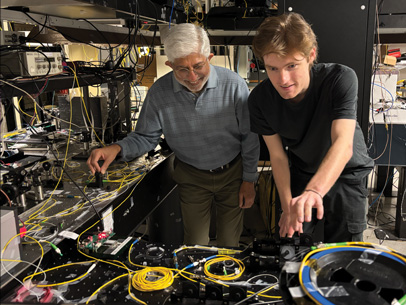 Prem Kumar (left) and Jordan M. Thomas in the Northwestern University lab. [Courtesy of Northwestern University]
There have been tremendous advances in quantum computing technologies over the past decade, from noisy intermediate-scale machines to the emergence of fault-tolerant ones. A growing number of vendors are now commercializing small-scale quantum computers built on a variety of qubit platforms. Many have plans to scale them to what is referred to as “utility scale”—devices capable of tackling problems beyond the reach of classical high-performance computing. These scaling strategies often rely on the notion of modularity, wherein quantum hardware units of manageable size are mass produced and interconnected via a quantum network. This trajectory is reminiscent of the evolution of classical communications and networking, which ultimately led to the distributed computing that is so ubiquitous today.
The advances in quantum networks, however, have so far been motivated by the security concerns arising from developments in quantum computing. A sufficiently large quantum computer running Shor’s algorithm, a quantum computing method developed by Peter Shor in 1994 that enables the factorization of large integers exponentially faster than classical algorithms, would pose a direct threat to the current public-key cryptographic infrastructure if alternative solutions are not implemented.
Quantum key distribution (QKD) is one such technology that can potentially update encryption keys at a faster rate than a quantum computer could compromise them via Shor’s algorithm, thus providing an additional layer of security at the physical layer of the network. Embedding QKD technology into modern optical communications and networking infrastructure is challenging, but significant progress has been made through the development of techniques for “quantum-classical coexistence.” Similar techniques are now being extended to support more advanced quantum protocols within the existing fiber optic communications infrastructure.
The study of quantum-classical coexistence is nearly as old as experimental quantum communication itself, having been immediately identified as a central engineering challenge for real-world use and dictating a reality of large-scale deployment. With the broader quantum information research community pushing toward this goal and with the development of more advanced technology, increasing attention has turned to the unique challenges underlying integration of applications utilizing entanglement, teleportation and entanglement swapping. This article traces the interwoven story of integrating quantum and classical communications in fiber optics, culminating with the state-of-the-art advances and where the future of quantum and classical technology may lead.
Early coexistence: QKD and first fiber experiments
In the early to mid-1990s, the prospect of quantum communication over optical fiber emerged as both technically feasible and conceptually compelling, driven largely by the development of QKD protocols using attenuated laser sources, formally referred to as “weak coherent states.” These implementations, inspired by the original BB84 (or Bennett-Brassard) protocol—a QKD method that enables two parties to share a secret key over an insecure channel while ensuring its security and authenticity—aligned naturally with existing fiber optic infrastructure, making them an attractive pathway toward real-world deployment.
As QKD systems matured, it became clear that coexistence was not only a constraint but also a lens through which to understand realistic deployment.
A defining milestone came in 1997, when Paul D. Townsend, then at BT Laboratories, UK, demonstrated QKD over installed fiber while co-propagating classical communication signals using wavelength-division multiplexing (WDM), a common technique in telecommunications engineering where different wavelengths of light can be combined into or separated from a single fiber. This result established coexistence as a central engineering challenge and catalyzed a new line of inquiry focused on how fragile quantum signals behave in the presence of intense classical communications traffic.
As QKD systems matured, it became clear that coexistence was not only a constraint but also a lens through which to understand realistic deployment. Early demonstrations revealed that integration with classical infrastructure could do more than enable compatibility: It could also aid quantum network functionality such as stabilization, synchronization and control by leveraging the more mature technologies underlying our current classical internet orchestration.
This period marked the emergence of coexistence-aware system design, in which quantum communication was no longer treated as isolated from classical infrastructure but as something that must be engineered within it.
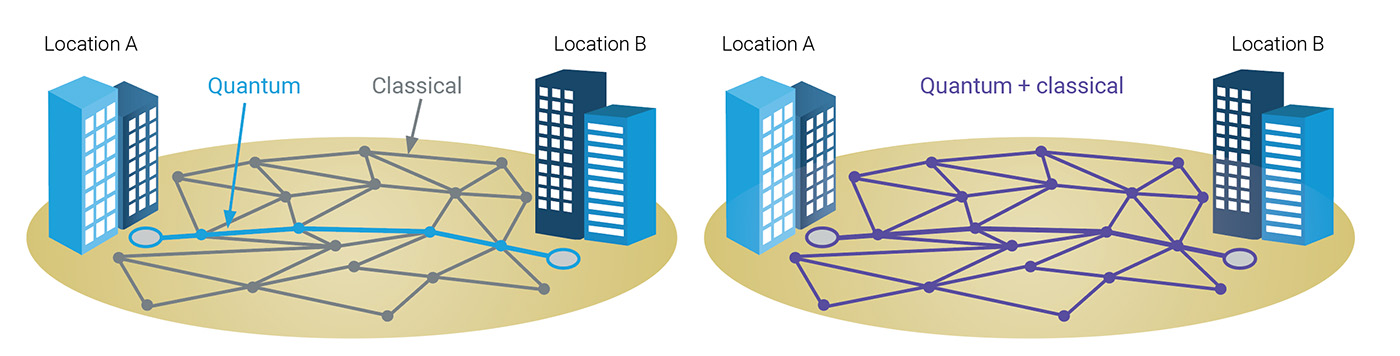 [Enlarge image]Quantum and classical signals sharing deployed fiber infrastructure. [Courtesy of the authors]
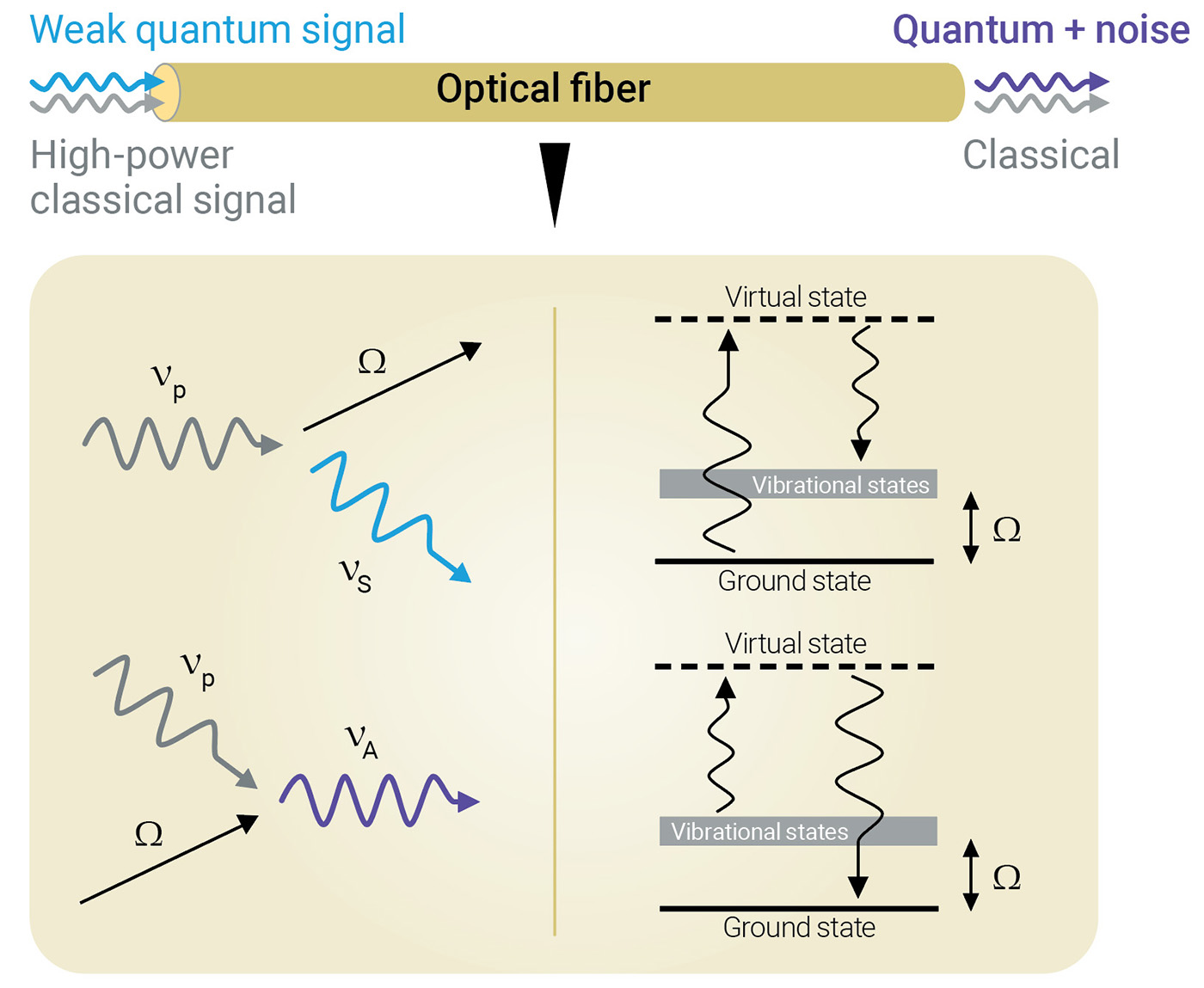 [Enlarge image]Classical signals can generate noise photons through spontaneous Raman scattering. If these noise photons fall within the quantum channel, they can mask weak single-photon-level signals used for QKD, entanglement distribution or teleportation. [Courtesy of the authors]
Managing noise: Raman scattering and WDM design
Quantum and classical signals can readily share a single fiber via WDM. In fact, although classical communications typically use many orders of magnitude more photons—often milliwatts of optical power in a single wavelength channel—these signals can be separated relatively easily from neighboring single-photon quantum channels with minimal cross-talk.
However, inelastic scattering processes (especially Raman scattering) generate noise photons outside the intended bandwidth of classical light and into quantum wavelength channels. Without careful engineering designs and knowledge of these mechanisms, such noise can easily obscure detection of weak quantum signals.
Beginning in the late 1990s and early 2000s and continuing into recent years, researchers systematically explored noise processes induced by classical channels in fiber. Spontaneous Raman scattering (SpRS) was identified as the dominant impairment mechanism. These studies led to careful wavelength engineering strategies, such as placing quantum signals in the O-band (around 1310 nm) while classical data occupied the C-band (near 1550 nm), the standard long-distance choice for current classical communications infrastructure. Experimental efforts across several research groups mapped out trade-offs among attenuation, noise and filtering, establishing design principles that still underpin many coexistence experiments. One notable milestone was the demonstration of 1310 nm QKD over 66 km of commercial backbone fiber in China, operated alongside 3.2 Tbps of classical traffic across the C-band. This result established wavelength allocation as an enabling feature for coexisting over inter-city fiber links carrying substantially higher data rates and optical power.
Entanglement in classical infrastructure
However, QKD with attenuated lasers has a rather trivial quantum description compared with the more ambitious goals of distributed quantum information processing. In recent years, this push has driven the exploration of more complex quantum tasks, such as entanglement distribution, teleportation and others. As such, by the late 2000s, the motivation for integrating quantum and classical communication had expanded beyond weak laser QKD.
A broader vision began to take shape, often referred to as the “quantum internet,” a concept articulated in influential work in the mid-2000s and beyond. At its core, the quantum internet refers to a network capable of distributing entanglement between distant nodes to enable tasks such as secure communication, distributed sensing and networked quantum computing.
This represents a much loftier goal than attenuated laser quantum communication, and technology has still not quite caught up to all of the proposed conceptual ambitions. This vision shifted the field’s focus from point-to-point QKD to more complex network operations, including entanglement distribution, entanglement swapping and quantum teleportation. At the same time, it highlighted that any realistic implementation would need to coexist with and leverage classical communications infrastructure.
This shift naturally led to an ongoing major thread in the evolution of quantum-classical integration, namely the push toward more complex quantum applications. Prem Kumar’s group at Northwestern University, USA, was among the first to extend coexistence studies beyond weak laser QKD to entangled photon pairs. Entanglement refers to quantum correlations between particles that cannot be described in classical probabilistic terms and is a key resource for advanced quantum protocols. Demonstrating entanglement distribution alongside classical data traffic represented a significant step forward. These experiments were the first to point to and pave the road ahead—coexistence as a challenge not just for distributing simple quantum states between two nodes, but requiring investigation of the unique physics underlying the full range of resources required by the emerging quantum internet.
Since then, state-of-the-art entanglement distribution studies with coexisting classical light have continued to push these boundaries. Efforts at institutions such as Northwestern University; the National Institute of Standards and Technology (NIST), USA; University of Science and Technology of China; University of Bristol, UK; and Fermilab, USA; have demonstrated these capabilities alongside more complex classical and quantum systems, highlighting the critical role of classical infrastructure in supporting quantum operations needed for a broader quantum internet.
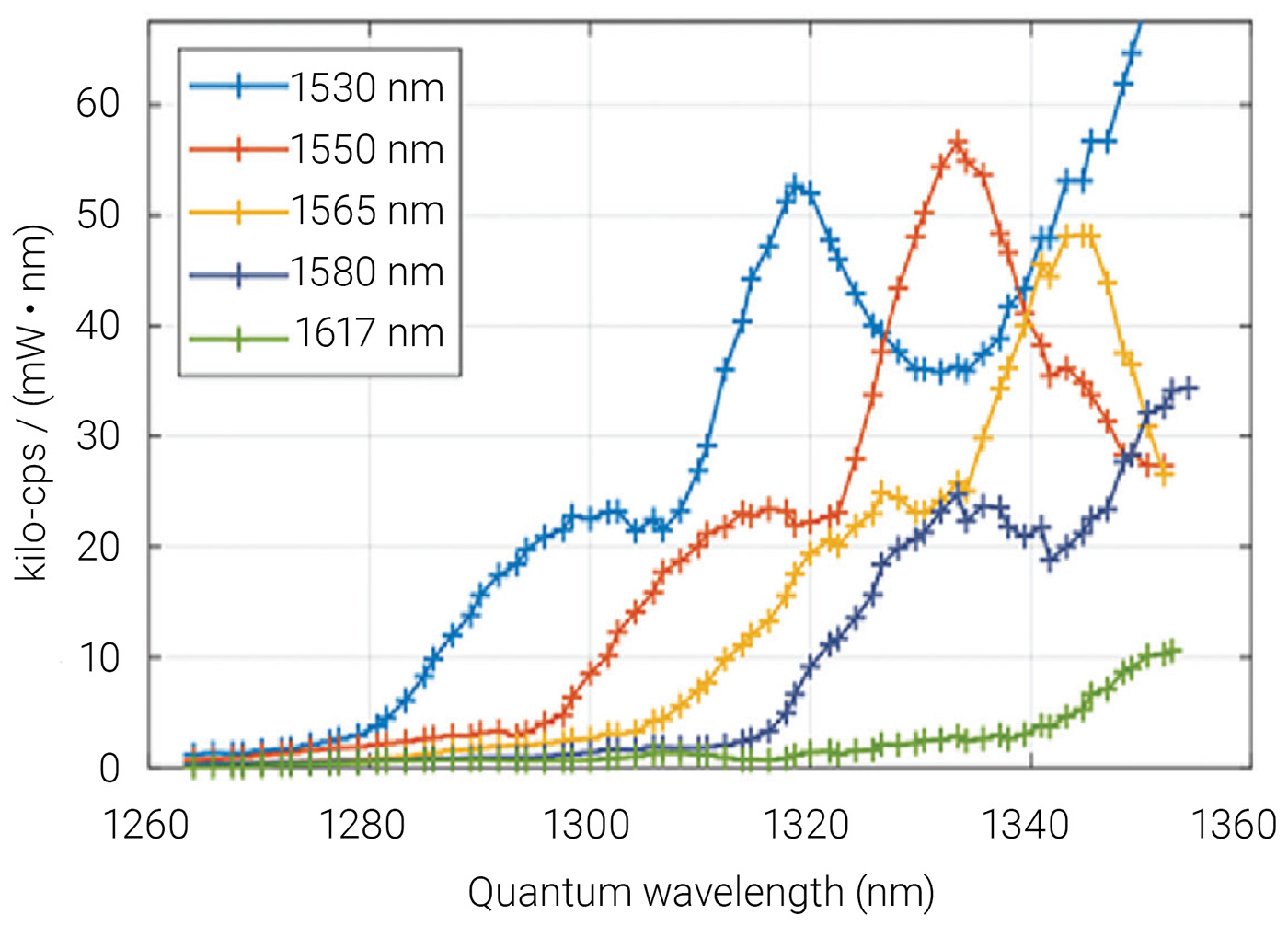 [Enlarge image]Measured spontaneous Raman scattering spectrum across the O-band from C- and L-band classical pumps. [J.M. Thomas et al. Opt. Express 31, 43035 (2023)]
As quantum networks evolve, the ability to perform WDM network connectivity is becoming more important, requiring an understanding of how to engineer entanglement-based quantum and classical WDM systems. An investigation by Jordan M. Thomas and collaborators in 2023 explored this using broadband entanglement sources integrated with high-bandwidth classical WDM signals. The experiments showed that quantum channels spanning more than 40 nm across the O-band can co-propagate alongside high-power classical signals in the C-band while maintaining fidelity. The study also found new methods for optimizing quantum WDM channel placement to minimize contamination due to SpRS.
Recent efforts in 2026 have expanded well beyond this. One experiment demonstrates deployed-fiber entangled-photon distribution over metropolitan-scale distances (e.g. a distance of about 25 km from Evanston, IL, where Northwestern University is located, to Chicago). It included synchronization between the quantum nodes alongside fully loaded C-band classical communications—two 800 Gbps data channels and amplified spontaneous emission covering the remaining C-band, with data capacity exceeding 30 Tbps—and simultaneous integration of classical signals for quantum node synchronization.
At NIST, parallel experiments on using classical signals for synchronization while distributing entanglement over distances of more than 100 km have been conducted. The focus was on selecting optimal wavelength channels with the lowest possible noise and on the use of high-performance classical transmitters to achieve low-power operation, while keeping the SpRS as low as possible. Fundamentally, this is an engineering challenge, best suited to situations where quantum engineers have control over the classical infrastructure, since limiting power or the placement of classical channels is not a universal solution.
Another important advance came in 2019 in the form of measurement-device-independent QKD, which requires Bell state measurements between independent sources. In such measurements, two incoming quantum states are jointly measured to determine whether they share one of a set of maximally entangled Bell states, effectively revealing correlations between photons without directly reading out the encoded key information. Typically, these “time-reversed” protocols represent an early example of coexistence involving joint quantum measurements, a crucial step for more advanced quantum networking applications.
The evolution of coexistence experiments closely tracked the broader trajectory of quantum networking research, which has gained substantial scientific and public interest in the past decade.
Teleportation and entanglement swapping in the field
As entanglement-based technologies matured, coexistence experiments also progressed. Improvements in photon sources as well as the development of high-efficiency superconducting nanowire detectors enabled higher-fidelity experiments under realistic conditions. Coexistence studies during this period increasingly served as a diagnostic tool, revealing how classical noise impacts more-sophisticated quantum operations. In this sense, the evolution of coexistence experiments closely tracked the broader trajectory of quantum networking research, which has clearly gained substantial scientific and public interest in the past decade.
A key milestone in coexistence came in the mid-2010s, with demonstrations of quantum teleportation over deployed fiber networks. Quantum teleportation is a protocol that transfers a quantum state from one location to another using entanglement and classical communication. Building on foundational work by Nobel Prize winner Anton Zeilinger; independent experiments led by Raju Valivarthi and his group at the University of Calgary, Canada; and Q.-C. Sun and team at the University of Science and Technology of China, Hefei, China, around 2016 showed that teleportation could be achieved outside laboratory settings, marking an important step toward practical quantum networks. Although these experiments did not yet fully integrate high-power classical coexistence, they demonstrated that the underlying quantum operations required for a network were becoming feasible in real-world environments.
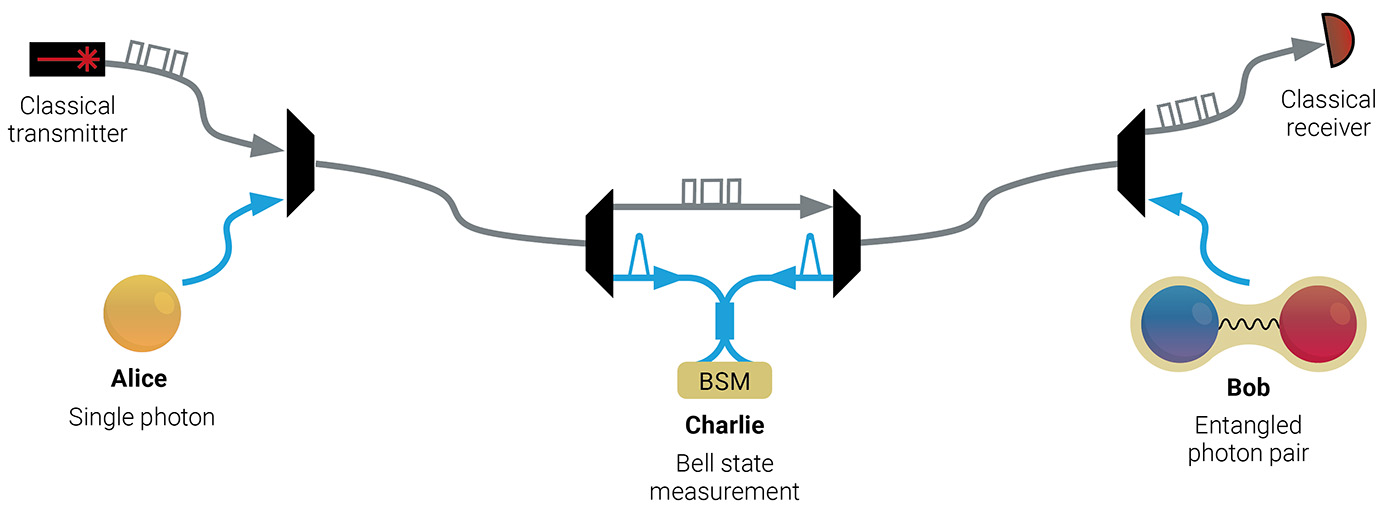 [Enlarge image]Recent experiments have shown that quantum teleportation can be performed over deployed fiber while high-power classical data traffic are also present. These results move beyond point-to-point QKD and test whether more demanding quantum-network protocols can operate in realistic fiber environments. [Adapted from J.M. Thomas et al. Optica 11, 1700 (2024)]
Teleportation alongside classical data traffic
More recent efforts have combined complex quantum protocols with coexistence in a single platform. Experiments such as those by Thomas and collaborators demonstrated quantum state teleportation alongside high-power classical traffic over deployed fiber. Teleportation is a cornerstone protocol underlying applications beyond just QKD, meaning this first-of-its-kind experiment in 2024 showed that one of the most critical ingredients for a quantum internet can coexist in the wider classical infrastructure, even alongside terabits of classical data streaming through the optical fiber.
Beyond teleportation, experiments have also demonstrated “entanglement swapping,” creating entanglement between particles that never interacted directly, which is an enabling operation for long-distance quantum networks and more. Researchers at Fermilab and Northwestern University have shown entanglement swapping over four optical fibers with co-propagating classical communications. These results are a proof-of-principle foundation for more advanced applications reaching beyond quantum dedicated fibers and making wider-scale deployment more feasible.
These results represent a convergence of two decades of progress, showing that both quantum operations and coexistence engineering have matured to the point where they can operate simultaneously. They also highlight the increasing realism of experimental platforms, which now resemble the conditions expected in future quantum networks.
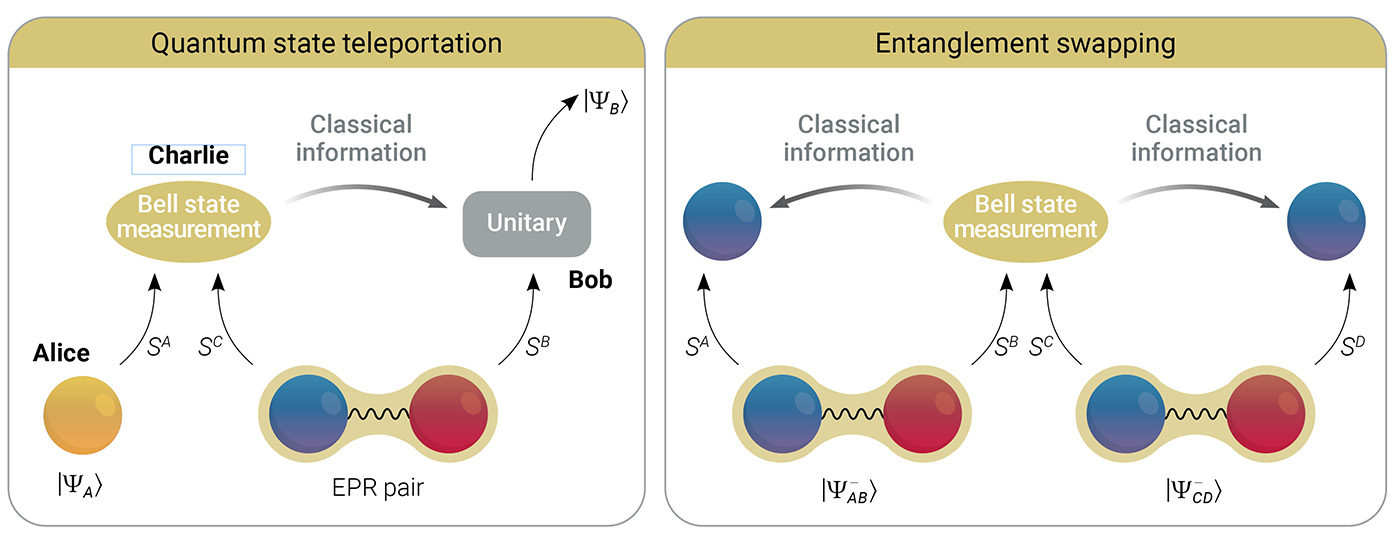 [Enlarge image]Conceptual view of teleportation and entanglement swapping. Teleportation transfers an unknown quantum state using shared entanglement and a classical communication channel. Entanglement swapping extends this idea by creating entanglement between particles that have never interacted directly, a key capability for future long-distance quantum networks. [Adapted from X.-M. Hu et al. Nat. Rev. Phys. 5, 339 (2023)]
Classical channels as enablers
Alongside the push toward more complex quantum applications, a second major thread has emerged: treating quantum-classical integration as an enabling architecture rather than a constraint. In large-scale quantum networks, classical systems are essential for synchronization, stabilization and control. For example, distributing precise timing signals allows distant nodes to coordinate measurements and source synchronization with picosecond-level precision, which is necessary for high-rate sources and interference-based protocols such as teleportation. Similarly, phase stabilization ensures that independent lasers maintain a well-defined relative phase, enabling high-visibility interference across the network.
Alongside the push toward more complex quantum applications, a second major thread has emerged: treating quantum-classical integration as an enabling architecture rather than a constraint.
In addition to synchronization, there is growing interest in network-layer integration through so-called “quantum wrappers”—classical information layers that help coordinate quantum signals without directly measuring them. These are classical communication protocols that accompany quantum signals, providing metadata such as routing information, timing markers and diagnostic data without disturbing the quantum state. In essence, they act as an informant to a control plane for quantum networks, analogous to how classical internet protocols manage data packets but without needing to measure the quantum states themselves, which would be highly disruptive. This approach allows quantum channels to be monitored and optimized indirectly, which is crucial given that direct measurement would destroy the quantum information.
A future intertwined
The vision of the quantum internet has also continued to evolve since its original formulation. While early discussions focused on secure communication and entanglement distribution, more recent efforts have begun to explore distributed quantum computing. This refers to linking multiple quantum processors through entanglement to perform computations that exceed the capabilities of any single device. Although still in its infancy, this direction further emphasizes the need for robust quantum-classical integration, as coordinating distributed quantum operations requires extensive classical communication and control.
Global investment in quantum technologies has accelerated significantly in recent years, with national initiatives and industrial participation driving progress. Major technology companies and telecommunications providers are actively exploring how quantum communication can be integrated into existing infrastructure. This reflects a recognition that quantum networks, if realized, will not operate in isolation but will instead be layered onto, and interwoven with, the classical internet.
Looking ahead, it is increasingly clear that the original vision of a standalone quantum internet is unlikely to be realized without substantial coexistence with classical systems. Instead, future networks will likely consist of tightly integrated quantum and classical layers, with classical channels providing the control and coordination needed to support quantum operations. At the same time, many open questions remain. Technologies such as quantum repeaters and distributed quantum computing are only beginning to emerge in experimental demonstrations, and how they can be integrated into coexistence frameworks is still largely unexplored.
Despite these challenges, the trajectory of the field suggests steady progress toward increasingly realistic and scalable systems. Each new demonstration of advanced quantum functionality, whether in entanglement distribution, teleportation or early forms of networking, pushes the vision of large-scale quantum systems closer to reality. In parallel, advances in classical integration continue to enable these experiments, reinforcing the idea that quantum and classical communication must evolve together. While a full quantum internet remains a long-term goal, the ongoing convergence of these technologies suggests that its foundational elements are already taking shape.
Prem Kumar (kumarp@northwestern.edu) and Jordan M. Thomas are researchers at Northwestern University, USA.
References and Resources
-
Y. Zhang et al. Science 389, 940 (2025).
-
A.Rahmouni et al. J. Opt. Commun. Netw. 16, 781 (2024).
-
S.J. Ben Yoo et al. Comm. Mag. 62(3), 76 (2024).
-
J.M. Thomas et al. Optica 11, 1700 (2024).
-
J.M. Thomas et al. Opt. Express 31, 43035 (2023).
-
R.C. Berrevoets et al. Commun. Phys. 5, 186 (2022).
-
S. DiAdamo et al. Phys. Rev. Research 4, 043064 (2022).
-
R. Valivarthi et al. Quantum Sci. Technol. 4, 045002 (2019).
-
Y. Mao et al. Opt. Express 26, 6010 (2018).
-
R. Valivarthi et al. Nat. Photon. 10, 676 (2016).
-
Q.-C. Sun et al. Nat. Photon. 10, 671 (2016).
-
I. Lucio-Martinez et al. New J. Phys. 11, 095001 (2009).
-
H.J. Kimble. Nature 453, 1023 (2008).
-
C. Chuang et al. 2006 Optical Fiber Communication Conference and the National Fiber Optic Engineers Conference. IEEE, 2006.
-
S. Lloyd et al. ACM SIGCOMM Comput. Commun. Rev. 34, 9 (2004).
-
P.D. Townsend. Electron. Lett. 33, 188 (1997).
-
D. Bouwmeester et al. Nature 390, 575 (1997).
