

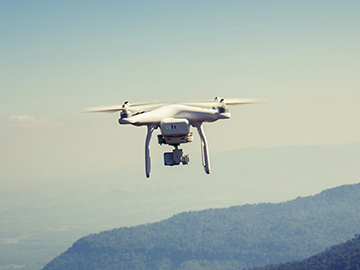
A prototype receiver fitted underneath the wing of a model drone converts energy from a green laser into electricity. [Image: Getty / prakasit khuansuwan / 500px]
Researchers in China have engineered a lightweight receiver that can be fitted to a drone to convert laser light into usable power (Matter & Light, doi: 10.1016/j.matlit.2026.100066). With a proof-of-concept system showing that a green laser can drive the propeller of a model drone, the technology could enable these flying machines to travel farther without needing regular pit stops to replenish their batteries.
Charging with laser light
Inside the receiver is a tandem device that operates in a similar way to a solar cell. A perovskite material absorbs most of the incoming light, generating a current that is collected by a carbon electrode. The rest of the laser’s energy is absorbed as heat, some of which can be converted into electricity by a thermoelectric material that forms the second part of the device.
This tandem design improves the overall efficiency and helps to prevent excess heat from affecting the light-conversion performance of the perovskite material. However, prolonged exposure to laser light still causes heat to build up. “When we tested the device under a high-power laser, the thermal camera showed temperatures of 80 – 90°C,” says Jianhua Han of the Civil Aviation University of China. “That was much higher than we expected and made us realize that heat buildup was a far more serious problem than we had imagined."”
To reduce the risk of overheating, the researchers embedded nanorods made from an inorganic semiconductor, antimony selenide, into the upper part of the perovskite layer. These nanorods enhance the photovoltaic performance of the perovskite while their poor thermal conductivity creates an internal heat shield that lowers the steady-state temperature of the perovskite material. The thermal properties of the nanorods also raise the temperature at the inner surface of the thermoelectric, creating a larger temperature gradient between the hot and cold sides of the layer that boosts its ability to generate electricity.
The device takes flight
As a proof of concept, the team integrated the device into the wing of a model drone. They carved out air channels through the wing to improve airflow, further increasing the temperature gradient across the thermoelectric. Shining a green laser on the device successfully powered the model’s propellor blade, with the system converting 38.5% of the incoming energy into electricity.
“Previous studies largely focused on the materials or the device, but we wanted to think about how the system could actually be integrated into an aircraft,” says Han. The researchers now plan to install the device on a real drone to check that it can perform reliably outdoors.
