

 Long thought of as less useful than coherent light, partially coherent light is demonstrating useful features for optical signal processing. [CREOL, The College of Optics & Photonics, University of Central Florida]
 Structured coherence refers to partially coherent light spanned by a finite modal basis. [CREOL, The College of Optics & Photonics, University of Central Florida]
All natural sources of light are partially coherent, whether it be solar or stellar light, fire, electroluminescence, chemiluminescence or bioluminescence. The invention of the laser in 1960 revolutionized optics by adding a convenient source of coherent light to the optics arsenal. Despite the broad impact of lasers across optics and photonics, there are nevertheless applications in which incoherent or partially coherent light is either necessary or preferable to coherent light. For example, in wide-field microscopy and imaging, coherent light produces unwanted speckles that are absent when partially coherent light is used. Likewise, lighting and optical display applications remain dominated by partially coherent sources.
By contrast, coherent lasers are the mainstay of long-haul optical communications, and it is generally thought that partially coherent light is less useful in this context. Although LEDs are commonly used in short links (e.g., Light Fidelity or Li-Fi) for ease of deployment and low cost, the partial coherence itself plays no role in the communications scheme. It is therefore all the more surprising that recent reports are unveiling aspects of optical communications in which partially coherent light can outperform fully coherent light.
Despite the broad impact of lasers across optics and photonics, there are nevertheless applications in which incoherent or partially coherent light is either necessary or preferable to coherent light.
Structured coherence
The partial coherence of light stems from underlying random fluctuations, which reduce the potential for observing interference between optical waves. Although the double-slit interference observed by T. Young in 1801 yielded powerful support for the wave theory of light, it did not help extract any novel quantitative measure until A.M. Michelson defined fringe visibility in 1891 and F. Zernike connected that visibility to the degree of coherence of the field in the 1930s. In the 1950s, Emil Wolf, then located at the University of Manchester, UK, established the study of optical coherence on a sturdy foundation of continuous correlation functions in space and time. In this formulation, the mutual correlation between any pair of points is related to the random fluctuations underpinning the field.
However, there are many scenarios in which the field is best viewed as a collection of stable, fixed modes. This occurs in optical waveguides and fibers, where the field is constrained to be a superposition of guided modes, and in integrated photonic circuits, where the field is confined to on-chip waveguides. In such scenarios, the modes themselves are deterministic and typically invariant on propagation. Nevertheless, partial coherence can arise in such cases from randomness introduced into the complex relative amplitudes associated with these stable modes rather than randomness introduced into the structure of the modes themselves.
It is then more useful to represent the field coherence in the form of a matrix that tabulates the correlations between modal amplitudes rather than as a continuous correlation function. We refer to this configuration as “structured coherence.” Although this notion is common in optical coherence when describing polarization—an intrinsically discrete degree of freedom (DoF)—it is less commonly applied to the spatial or temporal/spectral DoFs of the field. Despite early studies by H. Gamo in the 1960s on large-sized coherence matrices, the traditional treatment based on continuous correlation functions has remained dominant.
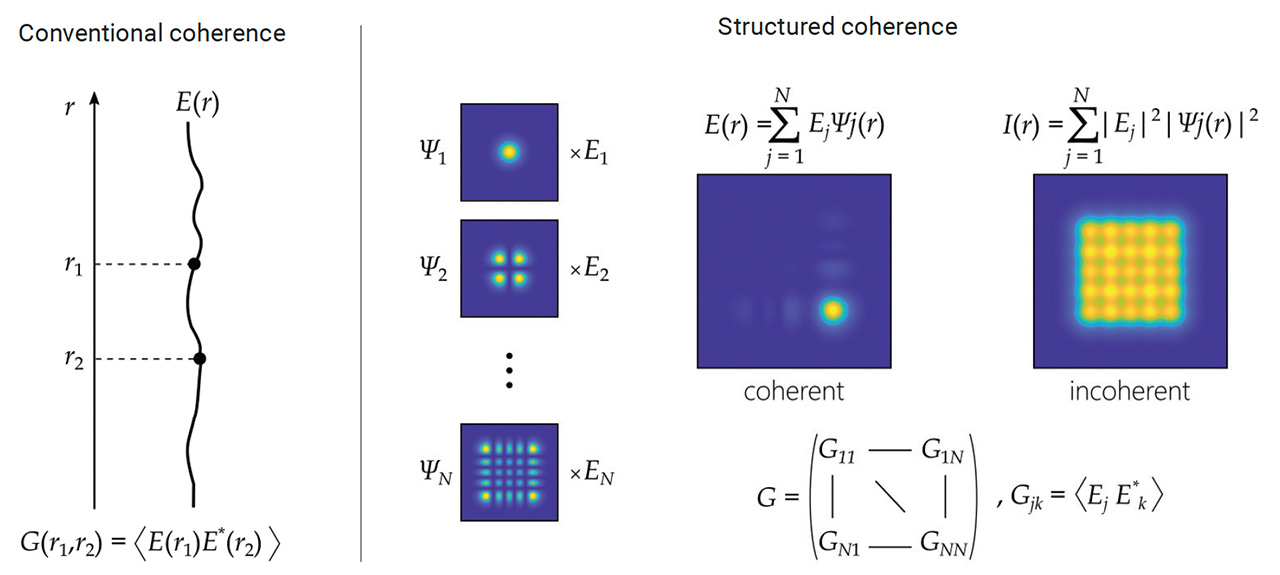 [Enlarge image]Concept of structured optical coherence: Left: In conventional coherence theory, a continuous correlation function G(r1, r2) captures the correlation between the fields at r1 and r2. One thinks of the field at each point as a random variable. Right: In structured coherence, the field is a superposition of a set of stable, fixed, deterministic modes, each weighted by a complex number. Rather than a continuous correlation function for pairs of points, an N × N coherence matrix instead tabulates the correlations between the modal coefficients (see “Coherence rank,” below). [Courtesy of the authors]
Can partial coherence improve optical communications?
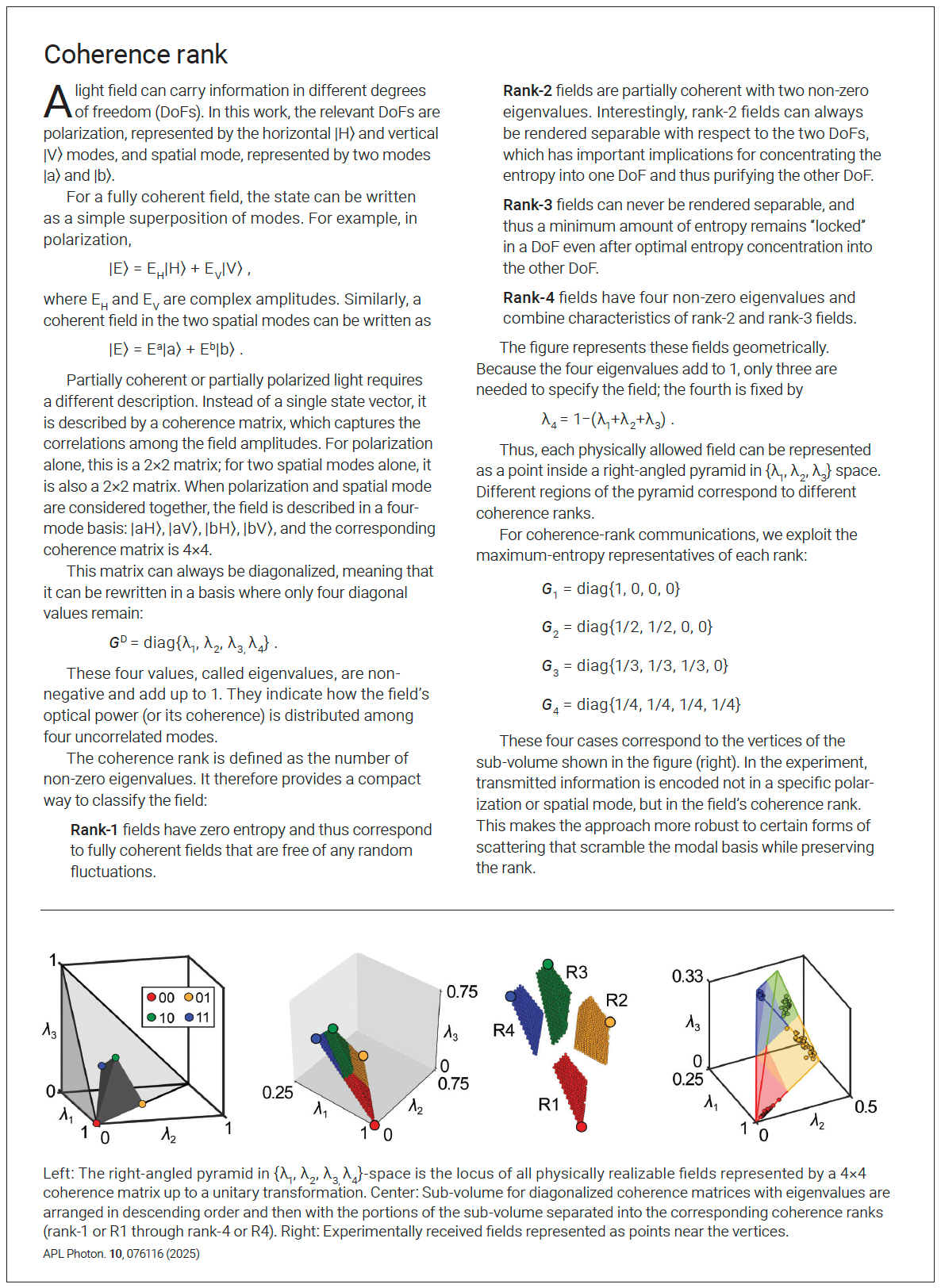
In optical communications and information processing, it is natural to consider discrete variables; e.g., on-off amplitude switching, time bins, discrete codes and spectral and spatial modes. Partially coherent light has not contributed in a significant way to such applications. This is somewhat paradoxical because the representation of partially coherent light using a matrix has recently been shown to be a rich playground for conceptual developments and novel applications. Consider an optical field spanned by modes. A coherent field is represented by an N × 1 complex vector that requires 2N - 2 real parameters for its identification, whereas a partially coherent field supported by the same modes is represented by an N × N coherence matrix requiring N2 - 1 independent real parameters (see “Coherence rank,” above). In that sense, partially coherent light is “richer” than its coherent counterpart, at least in terms of the number of available free parameters.
The question remains: What utility can be extracted from these additional free parameters in a partially coherent optical field? Put differently, what can partially coherent light do that coherent light cannot with regards to optical information processing? Is there a “coherence advantage” that can be harnessed?
One recent suggestion, put forward by Lukas Novotny at ETH Zurich (Swiss Federal Institute of Technology) in Switzerland and colleagues in 2022, is to exploit these extra free parameters as independent communications channels. In this conception, ½ N (N - 1) communications channels can be sent over N optical modes, rather than ~N channels using coherent light, yielding a dramatic increase in communications capacity for large N. This proposal has not been implemented experimentally to date.
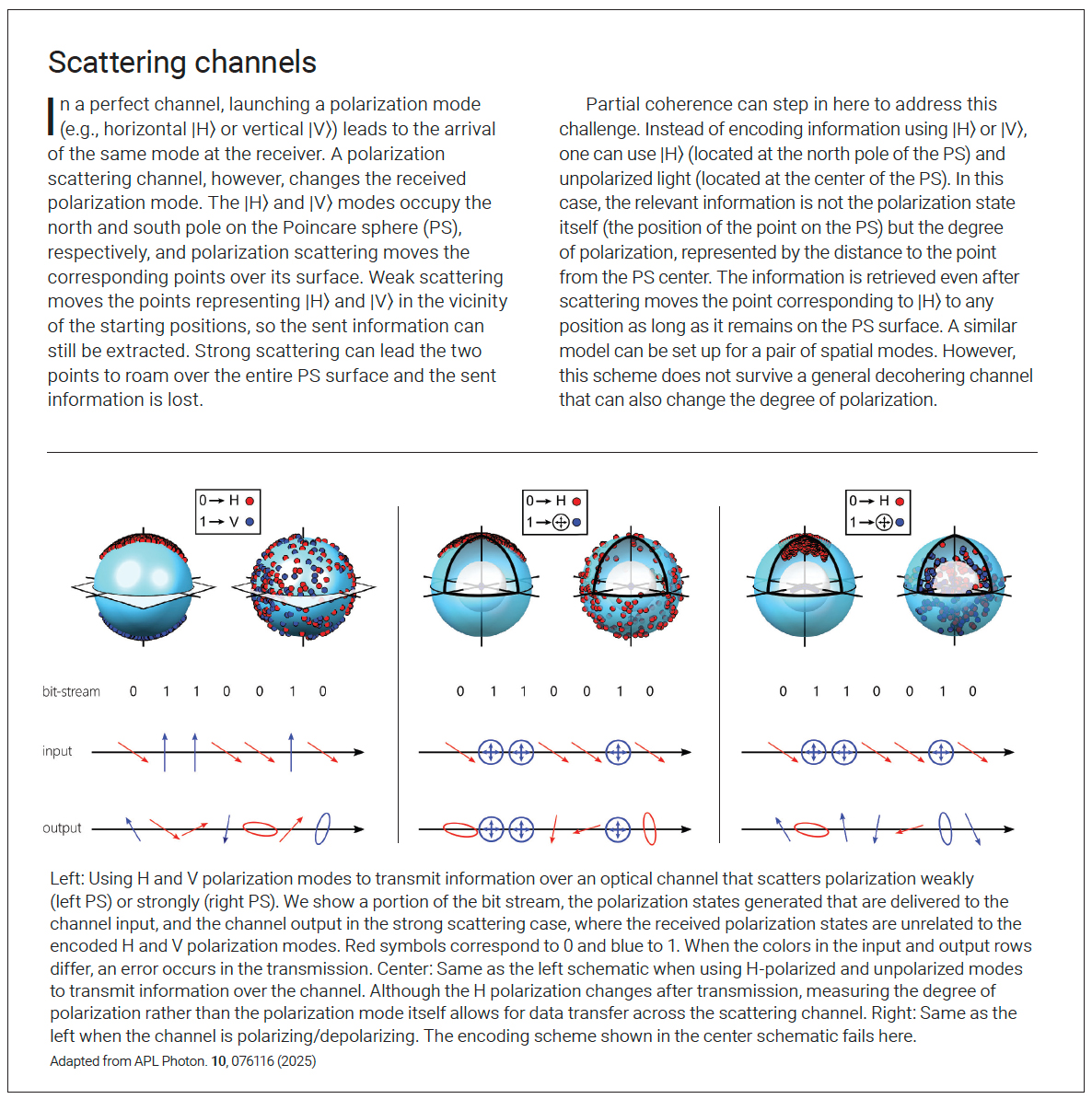
We have recently demonstrated experimentally a different kind of coherence advantage in optical communications: scattering-free transmission over a rapidly varying, strongly scattering channel. Consider encoding information in the polarization DoF, where bits 0 and 1 correspond to the H (horizontal) and V (vertical) polarization modes (see “Scattering channels,” below). The orthogonality of these modes optimizes the distinguishability between the received fields, as long as scattering in the channel is weak. However, if the channel strongly scatters the polarization DoF, the sent and received fields may be completely unrelated. In such cases, it is customary to rely on adaptive optics, which utilizes a model of the channel to introduce pre-compensation into the field. However, if the channel changes rapidly, standard adaptive techniques are precluded.
At first glance, this challenge appears insurmountable. Nevertheless, partially coherent light offers an intriguing solution. Rather than relying on purely polarized fields (whether linear, circular or elliptical) that will inevitably change upon arrival, one may instead use optical fields with different degrees of polarization. For example, bits 0 and 1 may be encoded in H-polarized and unpolarized fields, respectively. The H polarization will change to a different polarization upon arrival at the receiver, whereas the unpolarized field remains unaffected. However, as long as the channel scatters but does not depolarize the field, data transmission is preserved. The receiver is designed to measure the degree of polarization rather than the specific state of polarization, and partially coherent light consequently transfers information across a rapidly varying channel that strongly scatters polarization.
Coherence-rank communications
But what about a depolarizing or non-unitary channel, in which the degree of polarization itself may decrease or increase? In many cases, the decoherence is a result of coupling introduced by the scattering between the polarization DoF and some other unused optical DoF, such as the spatial modes. Can partial coherence still overcome this challenge?
We have recently shown experimentally that expanding the encoding scheme to encompass all the channel’s relevant DoFs allows scattering-free communication across a worst-case scenario channel having the following deleterious characteristics:
(1) The channel strongly scatters both the polarization and spatial DoFs.
(2) The channel may also strongly couple or decouple the polarization and spatial DoFs.
(3) The channel state can change from bit to bit, precluding the use of adaptive optics.
(4) The change in the channel at any moment is uncorrelated to that at any other moment; in other words, the channel has no memory.
We assume only that the channel is unitary and any losses are global; that is, they are not modally dependent.
As the number of available modes increases, a new feature of the partially coherent field emerges, which we refer to as the “coherence rank.”
As the number of available modes increases, a new feature of the partially coherent field emerges, which we refer to as the “coherence rank” (see “Coherence rank,” above). For a total of N modes, the coherence matrix has dimensions N × N. We define the coherence rank as the number of non-zero eigenvalues of the coherence matrix, which can vary from 1 (a fully coherent field free of random fluctuations) to N. If we use two polarization modes and two spatial modes, the resulting 4 × 4 coherence matrix may be rank-1, 2, 3 or 4.
Changing the coherence rank can have surprising consequences for the characteristics of the field—consequences that have only been recently examined and do not appear in the traditional formalism of continuous correlation functions. In the context of communications, the salient point is that the coherence rank is invariant under arbitrary unitary transformations of the field. For example, polarization scattering may change the state of polarization, and spatial scattering can change the modal structure of the field. Neither event changes the coherence rank. Even if a scattering event couples the spatial and polarization DoFs to each other, significantly changing the field structure, the coherence rank remains unchanged. This makes the coherence rank a resilient carrier of information across harsh communications channels.
In an experimental example, an image is digitized, pairs of bits are encoded in the coherence rank (00 → rank-1, 01 → rank-2, 10 → rank-3, and 11 → rank-4), and a strongly scattering channel is traversed (see below). The channel has no memory, so scattering at any bit is uncorrelated with scattering at any other bit. Moreover, the channel strongly scatters polarization, strongly scatters the spatial modes, and strongly couples or decouples the polarization and spatial DoFs. Nevertheless, the coherence rank is invariant and the data stream is recovered.
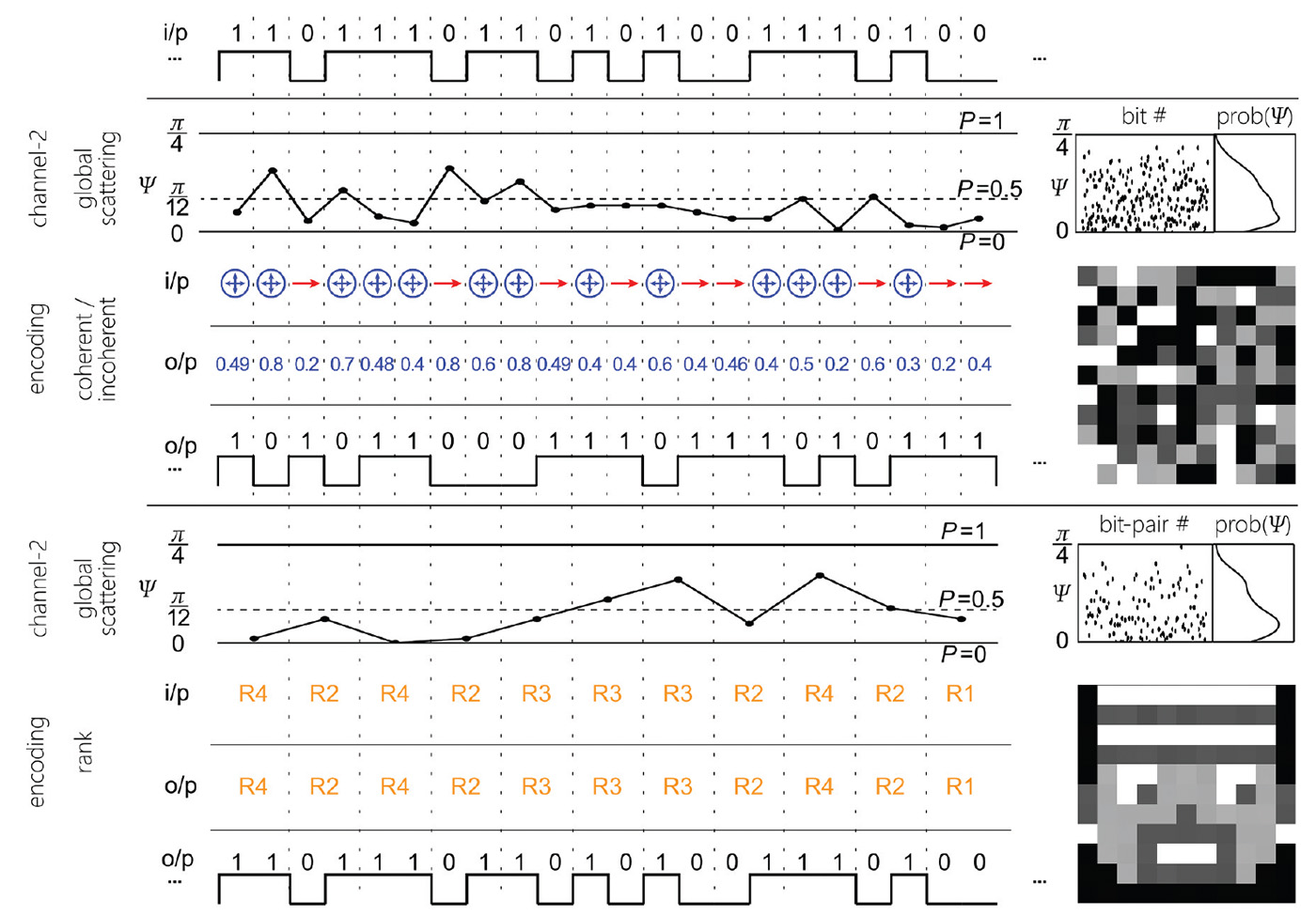 [Enlarge image]Demonstration of coherence-rank communications over a strongly scattering channel: Top: A portion of the data stream (representing an image) transmitted over a polarizing/depolarizing channel that scatters both the polarization and spatial DoFs and also couples/decouples them. Center: Using H-polarized and unpolarized light to transfer data fails because the degree of polarization changes at the channel output with respect to its input, and the transmitted image is corrupted. Bottom: When encoding the data in the coherence rank of the 4 × 4 coherence matrix describing both the polarization and spatial modes, the data are uncorrupted and the transmitted figure is recovered. [APL Photon. 10, 076116 (2025)]
Can partially coherent light outperform coherent light in applications involving optical information processing? Recent developments indicate that the answer is yes.
Future directions
A general question now being asked can be formulated as follows: Can partially coherent light outperform coherent light in applications involving optical information processing? Recent developments indicate that the answer is yes: There are scenarios in which partially coherent light offers a genuine “coherence advantage,” with performance that cannot be matched by coherent light. The examples explored so far include increasing communications capacity via mutual-coherence multiplexing, and scattering-immune coherence-rank communications. Other emerging effects stemming from partial coherence are also being reported, including optical computing in integrated photonic platforms and optical cryptography. More examples of the coherence advantage are likely to be discovered.
However, a technical hurdle must be overcome before the coherence advantage can be translated into useful applications. This hurdle lies in the fact that the manipulation of structured coherence necessitates cascading interferometers, the number of which increases rapidly with the number of modes involved. It is not feasible to realize such systems with bulk optics in free space, except for a small number of modes. Very recent progress in utilizing integrated photonic platforms to implement a variety of computational tasks with multimode partially coherent light, however, points to a potential game changer. Large on-chip meshes of Mach-Zehnder interferometers, for example, have the potential to revolutionize the utility of structured coherence in optical information processing. We anticipate that on-chip manipulation of structured coherence will be a fruitful avenue for research over the next few years.
Ayman F. Abouraddy (raddy@creol.ucf.edu) and Abbas Shiri are with CREOL, University of Central Florida, USA. Mitchell Harling and Kimani C. Toussaint Jr. are with Brown University, USA.
For references and resources, visit: optica-opn.org/link/structured_coherence.
