

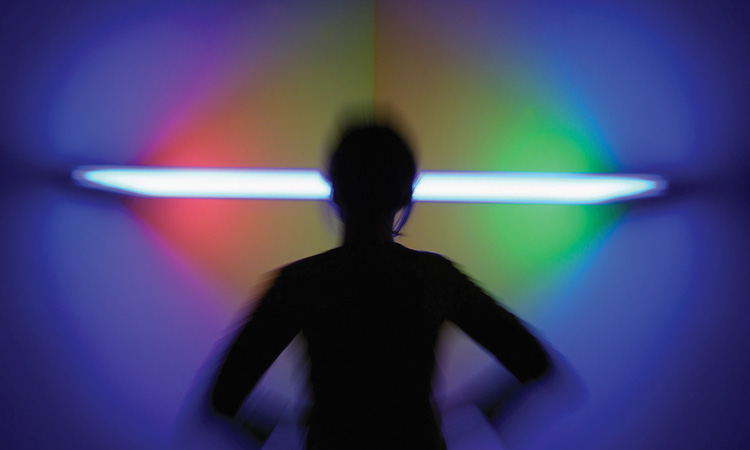
 Untitled (to Virginia Dawn) 2, 1971, Dan Flavin, Hayward Gallery, London. [© Stephen Flavin / Artists Rights Society (ARS), NY / P. Macdiarmid / Getty Images]
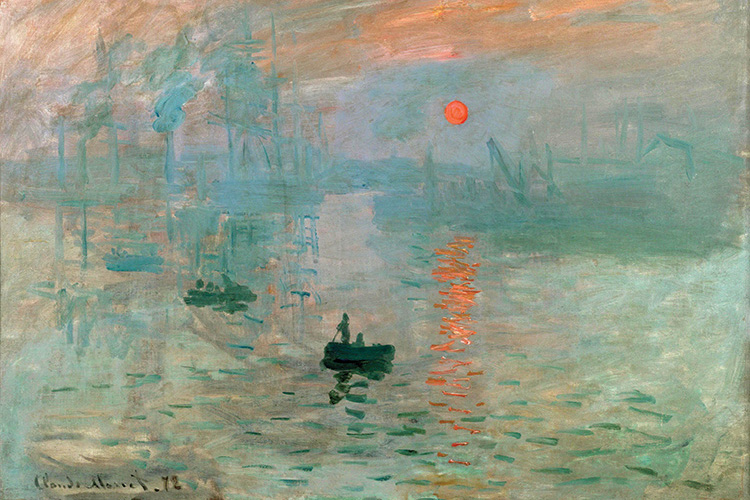 Impression, Soleil Levant (Impression, Sunrise), 1872, Claude Monet, Musée Marmottan, Paris. [Musée Marmottan Monet; CC-PD-Mark]
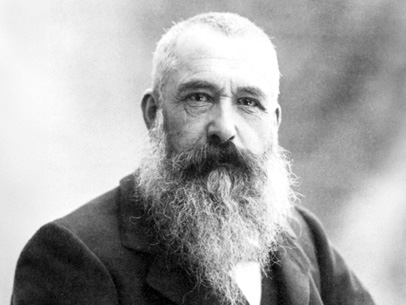 Claude Monet [Portrait by Nadar, c. 1899; CC-PD-Mark]
“A landscape does not exist in its own right ... the surrounding atmosphere brings it to life—the light and the air which vary continually.” —Claude Monet
Claude Monet
Claude Monet (1840 – 1926) was a French painter and founder of impressionism. Throughout his long career as an artist, he explored the impressionist philosophy of capturing only what is purely visible, often painting outdoors, surrounded by nature.
INSPIRATION: Monet frequently painted the same scene at varying times of the day and the year to capture the changing light and illustrate how light influences color and our perception of reality. He used short, layered brush strokes that blurred boundaries and created an effect of light reflection. Monet believed that “a landscape does not exist in its own right, since its appearance changes at every moment; but the surrounding atmosphere brings it to life—the light and the air which vary continually.”
FEATURED ARTWORK: In 1872, Monet created a series of paintings of the port in his hometown of Le Havre, in the northwest of France. The most well-known of the series, Impression, Sunrise, inspired the name for the impressionist movement. In the painting, the orange sun and gray-blue clouds at the center have nearly identical luminance levels, creating a pulsating effect as the viewer tries to distinguish them. In addition, the short, quick strokes of warm color for the sun rays, brushed over the cool tones of the water, capture how rippling water distorts light. The blurred shapes of ships and cranes receding into the background further emphasize light and atmosphere as the true focus of the painting.
WHERE TO VIEW: The Musée Marmottan Monet in Paris houses more than one hundred of Monet’s works, including Impression, Sunrise.
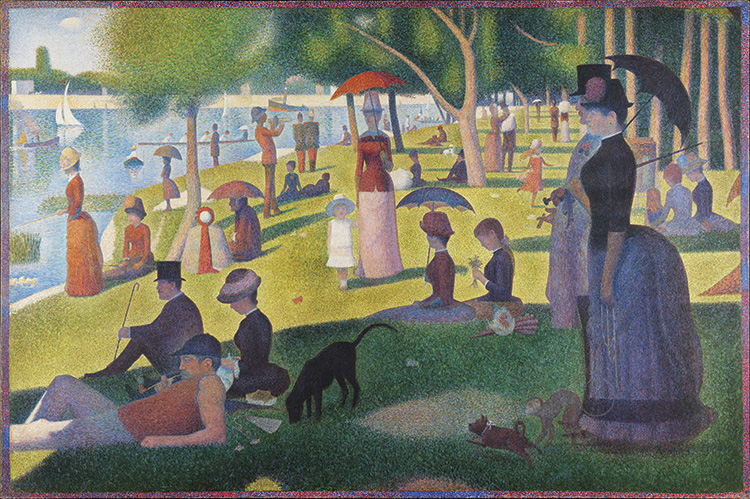 Un dimanche après-midi à l’Île de la Grande Jatte (A Sunday Afternoon on the Island of La Grande Jatte), 1884, Georges Seurat, Art Institute of Chicago, USA. [Art Institute of Chicago; CC-PD-Mark]
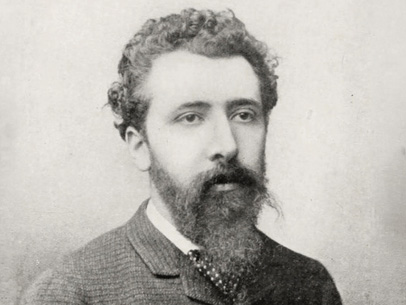 Georges Seurat [Portrait by L. Cousturier, 1888; CC-PD-Mark]
“Some say they see poetry in my paintings; I see only science.” —Georges Seurat
Georges Seurat
Georges Seurat (1859 – 1891) was a French painter and a pioneer of the neo-impressionist movement, which employed the color theory techniques of pointillism (or divisionism) and chromoluminarism to painting.
INSPIRATION: Seurat was inspired by the optical effects and perception in 19th- century light and color theories. Instead of mixing pigments on a palette, he placed small, distinct dots of pure color directly onto the canvas to create more luminous, vibrant and intense color harmonies, often selecting complementary colors to further increase the light on the canvas. The individual dots of color, once unified optically in the viewer’s eye, were perceived as a single shade or hue. For Seurat, painting was primarily about the mathematical process; he explained, “some say they see poetry in my paintings; I see only science.”
FEATURED ARTWORK: A Sunday Afternoon on the Island of La Grande Jatte is recognized as a leading example of the pointillist technique and as a founding work of neo-impressionism. Seurat worked on the painting for two years, completing numerous preliminary drawings and oil sketches, concentrating on issues of color, light and form. In the final painting, he placed individual dots of complementary colors in close proximity to optically enhance one another. And to better contrast the light of the sunny day with the deep shade, Seurat separated the different areas into their component colors.
WHERE TO VIEW: The Musée d’Orsay in Paris houses several artworks by Seurat, including studies for A Sunday on La Grande Jatte. The finished painting is on display at the Art Institute of Chicago, USA.
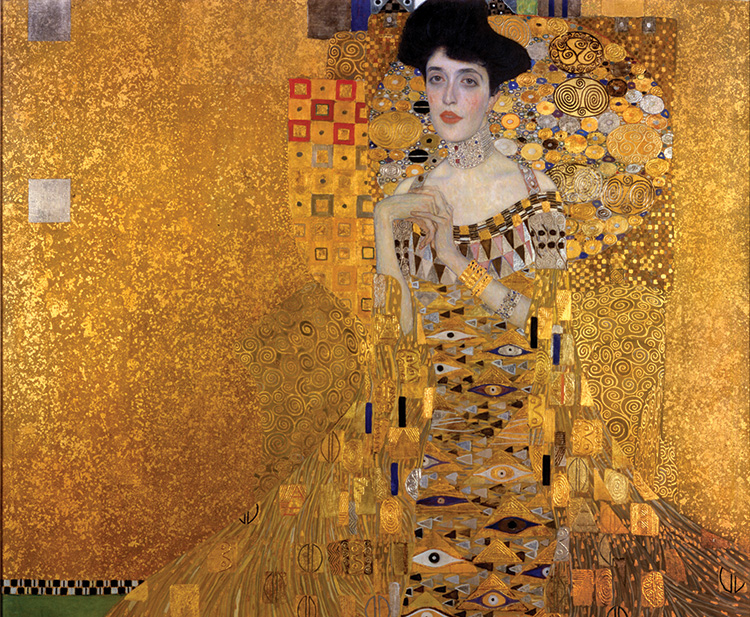 Portrait of Adele Bloch-Bauer I, The Woman in Gold, 1907, Gustav Klimt, Neue Galerie New York, USA. [Neue Galerie New York; CC-PD-Mark]
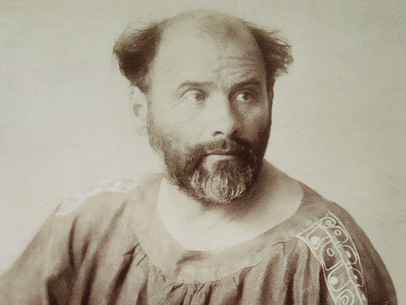 Gustav Klimt [Portrait by A.J. Trčka, 1914; CC-PD-Mark]
“Look carefully at my pictures and try to see in them what I am and what I want to do.” —Gustav Klimt
Gustav Klimt
Gustav Klimt (1862 – 1918) was an Austrian symbolist painter, muralist and founding member of the Vienna Secession movement. His unique approach, combining elaborate ornamentation with intricate patterns and a hyperrealism, helped define the art nouveau style in Europe.
INSPIRATION: Klimt did not share a lot about himself or his creative process, saying viewers “ought to look carefully at my pictures and try to see in them what I am and what I want to do.” In Klimt’s art, there is an appreciation for Japanese art aesthetics. His work references the flat planes, decorative framing and bright, unblended pigments of ukiyo-e woodblock prints and the geometric and floral mosaics of katagami fabrics. In addition, he incorporates reflective gold to make his subjects glow from within, as in Japanese screen painting.
FEATURED ARTWORK: Klimt painted the Portrait of Adele Bloch-Bauer I, The Woman in Gold at the height of his “golden phase.” During this period, Klimt developed a technique of applying real gold leaf, combined with oils and bronze paint, to his canvas. This turned the artwork into a light-reflecting object. The light didn’t just illuminate the painting, it emanated from it, changing based on the room’s ambient light and the viewer’s angle. Klimt’s technique challenged standard single-plane perspective—forcing the viewer to constantly adjust their perception between the three-dimensional faces and two-dimensional decorative surfaces.
WHERE TO VIEW: The Belvedere in Vienna, Austria, has the largest collection of Klimt paintings in the world. Klimt’s Portrait of Adele Bloch Bauer I is permanently on view at Neue Galerie New York, USA.
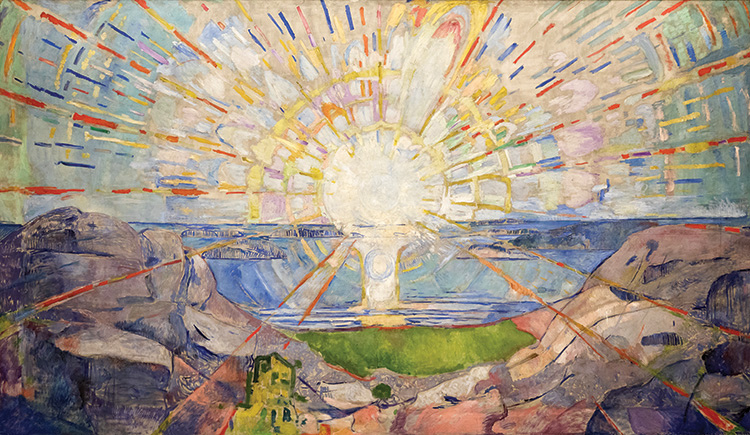 Solen (The Sun), 1911, Edvard Munch, Hall of Ceremonies, University of Oslo, Norway. [University of Oslo; CC-PD-Mark]
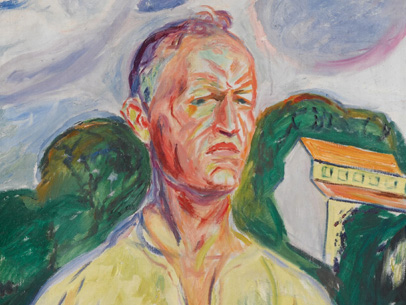 Edvard Munch, Self Portrait, 1926 [Kunsthalle Mannheim; CC-PD-Mark]
“I saw the sun rise up above the cliffs—I painted the sun.” —Edvard Munch
Edvard Munch
Edvard Munch (1863 – 1944) was a Norwegian artist whose pioneering style blended symbolism and expressionism. Over a career that spanned more than 60 years, he experimented with painting, graphic art, drawing, sculpture, photo and film.
INSPIRATION: Munch found inspiration in current technological developments. He incorporated the prominent foregrounds and strong diagonals from cinema and photographic lenses, giving the illusion of subjects looming out toward the viewer. And he referenced the visual effect of dramatic shadows created by early electric stage lighting to add drama. Throughout his life, Munch never stopped embracing new techniques and experimenting to improve his motifs, writing “all of my pictures are studies and preparations for new works.”
FEATURED ARTWORK: The Sun is one of 11 large works Munch created for the University of Oslo’s centenary celebrations in 1911. In the painting, the sun in the center emits strong, thick strokes of light that radiate energy out across the entire canvas. The light is depicted as a physical force that washes over the sea and the land. It also represents a cosmic connection and spiritual centering. The composition is highly symmetrical and designed to make the light appear all-pervasive and directly engaged with the viewer. Munch said simply about the dramatic image, “I saw the sun rise up above the cliffs—I painted the sun.”
WHERE TO VIEW: The MUNCH museum in Oslo, Norway, has the world’s largest collection of Munch artworks, with more than 26,000. Munch’s The Sun is displayed in the Hall of Ceremonies at the University of Oslo, Norway.
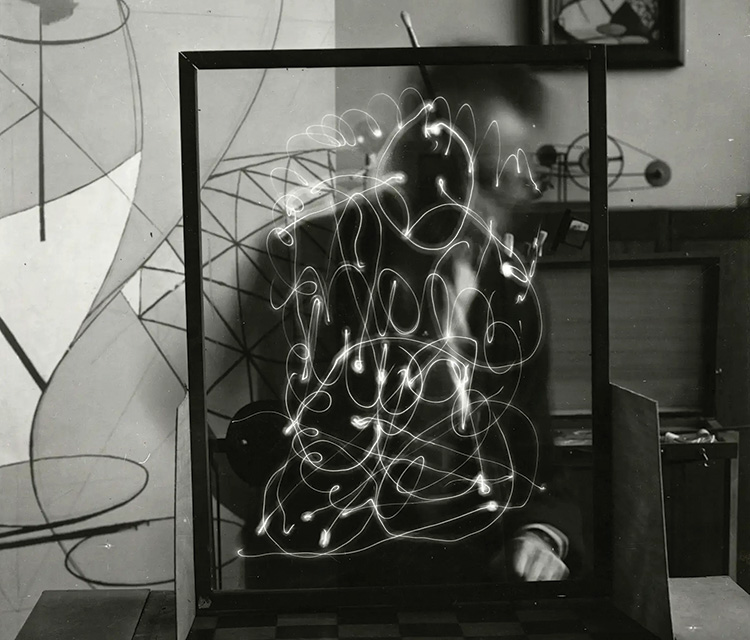 Space Writing, Self Portrait, 1935, Man Ray, Bowdoin College Museum of Art, Brunswick, ME, USA. [© Man Ray 2015 Trust / Artists Rights Society (ARS), NY / ADAGP, Paris 2026]
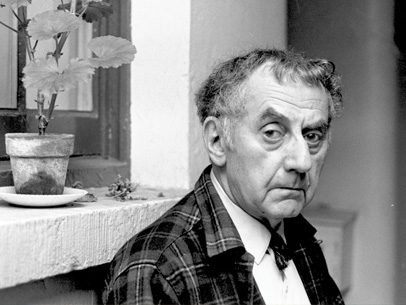 Man Ray [© Man Ray 2015 Trust / Artists Rights Society (ARS), NY / ADAGP, Paris 2026 / McKeown / Getty Images]
“I have finally freed myself from the sticky medium of paint, and am working directly with light itself.” —Man Ray
Man Ray
Man Ray (born Emmanuel Radnitzky, 1890 – 1976), was an American-French painter, photographer, inventor, sculptor and filmmaker, and a significant contributor to the dada and surrealist movements.
INSPIRATION: Ray found inspiration in transitioning among the creative possibilities of different media and in the discovery of accidental compositions. In 1922, he first experimented with camera-less photography, inventing what he called “rayographs.” By placing everyday objects directly on light-sensitive paper and exposing them to light, he created ethereal, abstract and dreamlike images. Speaking about his rayographs, Ray said, “I have finally freed myself from the sticky medium of paint, and am working directly with light itself.”
FEATURED ARTWORK: In 1935, Ray set up a camera to produce a self-portrait. He opened the shutter of his camera and used a small penlight to create a series of swirls and lines in the air, which were later confirmed to be his signature. The resulting artwork, Space Writing, Self Portrait, is considered one of the earliest examples of light painting. The process is inherently surreal because it bends the way we perceive reality, time and space. As lights are brought in and through the frame, the effect creates the optical illusion of movement. In addition, the photograph disturbs normal spatial relationships and creates depth with a series of two-dimensional planes, preventing the viewer from visualizing a realistic three-dimensional space.
WHERE TO VIEW: The Museum of Modern Art (MoMA) in New York, USA, houses a large collection of Ray’s photographs, paintings and surrealist objects.
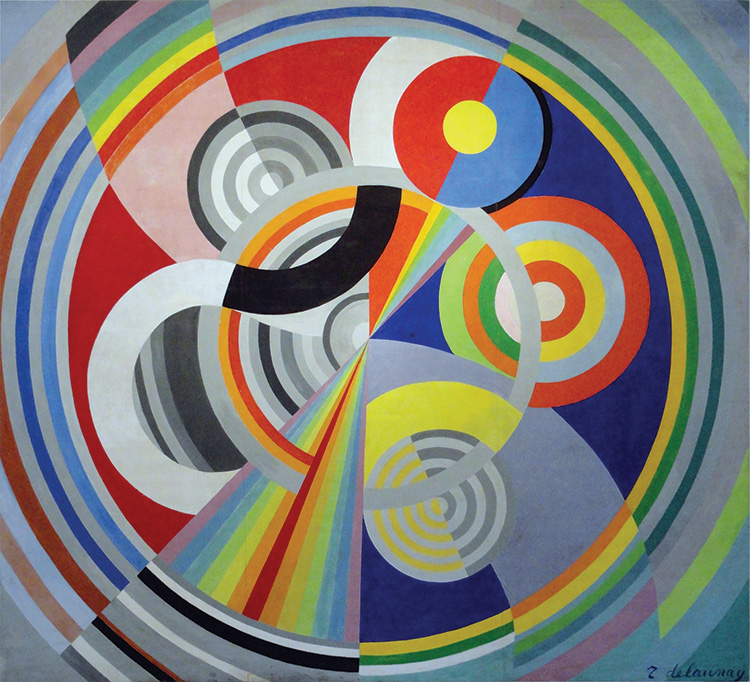 Rythme n°1, décoration pour le Salon des Tuileries, 1938, Robert Delaunay, Musée d’Art Moderne de Paris. [Musée d’Art Moderne; CC-PD-Mark]
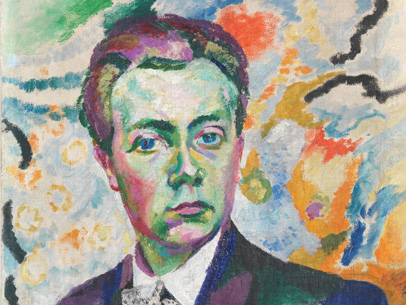 Robert Delaunay, Self Portrait, 1905 [MNAM; CC-PD-Mark]
“Painting is by nature a luminous language ... but what I attach great importance to is observation of the movement of colors.” —Robert Delaunay
Robert Delaunay
Robert Delaunay (1885 – 1941) was a French artist and a founder of the orphism art movement, an offshoot of cubism. Through bright, contrasting colors and geometric shapes, orphism aimed to bring the harmony, rhythm and emotion of music to painting.
INSPIRATION: Inspired by the abstract qualities of music, Delaunay believed color was a thing unto itself, with its own powers of expression and form; that painting was a purely visual art dependent on intellectual elements; and that perception was in the impact of colored light on the eye. “Painting is by nature a luminous language,” said Delaunay. “But what I attach great importance to is observation of the movement of colors.”
FEATURED ARTWORK: Rythme n°1 was part of a commission Delaunay received in 1938, along with fellow orphism artists, to paint a series of large murals for the Salon des Tuileries in Paris. In Rythme n°1, the arrangement and spatial relationships of the color determine the rhythms of the shapes. The sweeping, concentric circles and geometric curves convey dynamic movement and luminous abstraction. The viewer’s eye is activated by an interplay of curves and counter-curves, discs with concentric circles of various thicknesses that act against each other, and contrasting complementary and discordant colors. For Delaunay, “The movement is provided by relationships of uneven measures, of color contrasts among themselves, and constitutes reality.”
WHERE TO VIEW: Rythme n°1, décoration pour le Salon des Tuileries, is part of the permanent collection at the Musée d’Art Moderne de Paris.
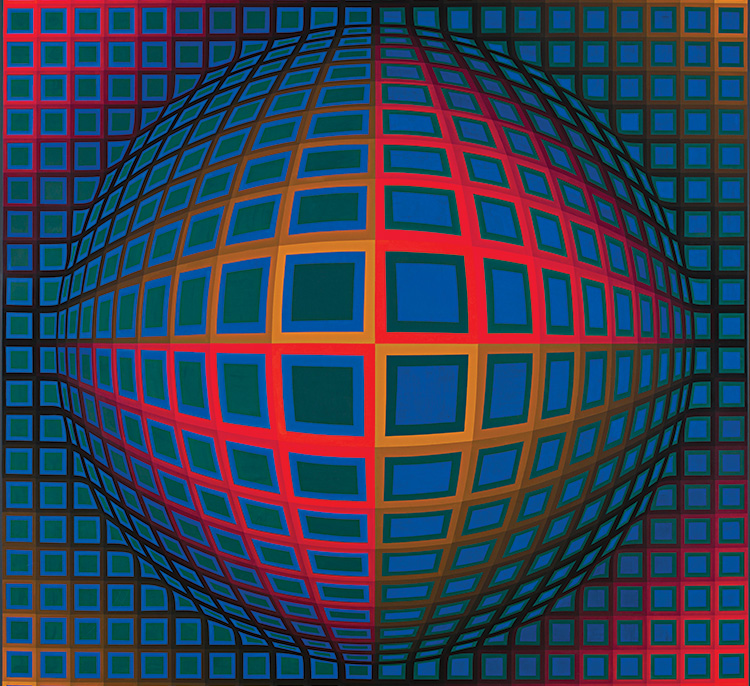 Vega-Nor, 1969, Victor Vasarely, Buffalo AKG Art Museum, Buffalo, NY, USA. [© 2026 Artists Rights Society (ARS), NY / ADAGP, Paris]
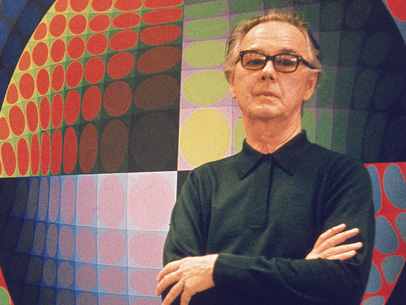 Victor Vasarely [© 2026 Artists Rights Society (ARS), NY / ADAGP, Paris / Interfoto MTI / Getty Images]
“Never can the eye identify to what a given shadow or strip of wall belongs: Solids and voids merge into one another.” —Victor Vasarely
Victor Vasarely
Victor Vasarely (1906 – 1997) was a Hungarian-French artist who is often considered the father of the op art movement. In his work, he explored the boundaries between pattern and art, frequently using kinetic effects to create three-dimensional illusions on two-dimensional surfaces.
INSPIRATION: Vasarely was fascinated by the geometry, color relationships and mathematical systems of abstract forms found in both nature and urban settings. Through a framework of Gestalt psychology, which states that the whole is different from the sum of its parts, he manipulated visual perception to create mind-bending optical illusions with the abstract forms. When discussing the movement in his artwork, he said “never can the eye identify to what a given shadow or strip of wall belongs: Solids and voids merge into one another.”
FEATURED ARTWORK: Vega-Nor is one of a number of paintings Vasarely created in which an orderly grid seemingly swells and protrudes off the picture plane. The warm colors surrounding the larger center squares appear to advance in space, while the progressively smaller and thinner squares toward the edges of the canvas appear to recede into space. Vasarely named the series after Vega, one of the brightest stars in the night sky, explaining, “this composition expresses the extension, the expansion of the Universe: the extreme of the great infinities of nature.”
WHERE TO VIEW: Vega-Nor is housed at the Buffalo AKG Art Museum in Buffalo, NY, USA. In addition, the Museum of Fine Arts, Budapest, Hungary, holds the largest collection of Vasarely’s art in the world.
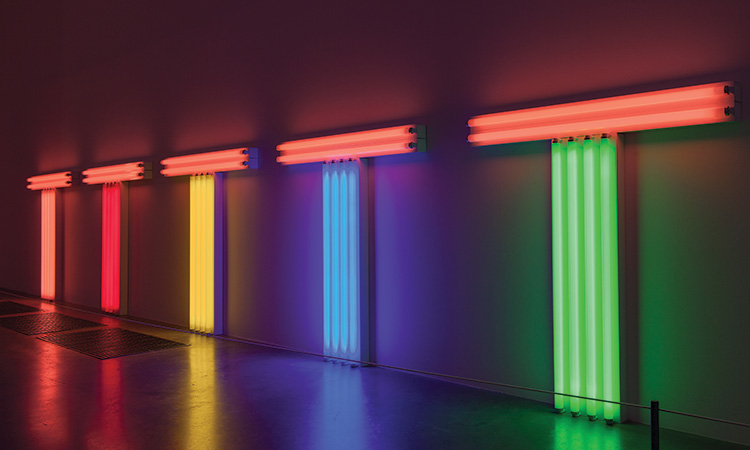 Untitled (to Don Judd, Colorist) 1–5, 1987, Dan Flavin, Tate Modern, London. [© 2026 Stephen Flavin / Artists Rights Society (ARS), NY]
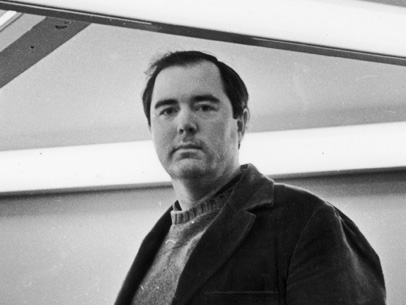 Dan Flavin [© 2026 Stephen Flavin / Artists Rights Society (ARS), NY / F.W. McDarrah / Getty Images]
“One might not think of light as a matter of fact, but I do. And it is, as I said, as plain and open and direct an art as you will ever find.” —Dan Flavin
Dan Flavin
Daniel Nicholas Flavin Jr. (1933 – 1996) was an American minimalist artist best known for creating sculptural objects and installations from commercially available fluorescent light fixtures.
INSPIRATION: Light and color remained central to Flavin’s art throughout his life. Through large, immersive fluorescent tube installations, Flavin explored the effects of light and color on the surrounding space. By using light that exceeded the physical limits of the tubes, he directly engaged the viewer’s perception, bringing them into the artwork. In describing his relationship with light, Flavin stated, “One might not think of light as a matter of fact, but I do. And it is, as I said, as plain and open and direct an art as you will ever find.”
FEATURED ARTWORK: Originally part of a larger group of 10 artworks, Flavin created Untitled (to Don Judd, Colorist) 1–5 as tribute to his close friend and fellow minimalist artist, Donald Judd. The work highlights Judd’s focus on color and form. Flavin then extends the concept, allowing adjacent fluorescent colors to mix and bleed into the surrounding space. According to Flavin, the “brilliance” of the light can “somewhat betray its physical presence into approximate invisibility”—encompassing the viewer and immersing them in the artwork.
WHERE TO VIEW: The Dan Flavin Art Institute at Dia Bridgehampton, NY, USA, was designed by Flavin in the 1980s to permanently house nine of his fluorescent light works, alongside temporary exhibitions highlighting works by local artists.
Alessia H. Kirkland is OPN's creative director.
