

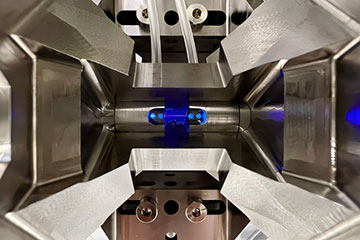
Researchers have generated previously unobtainable X-ray harmonics by firing intense ultraviolet laser pulses at helium gas in a hollow-core waveguide. [Image: TU Wien]
Scientists in the United States, Austria and Spain have shown how to extend the X-ray energy spectrum from high-harmonic generation significantly beyond a well-established hard limit (Nat. Photonics, doi: 10.1038/s41566-026-01976-2). They found they could more than double the energy of photons associated with single-electron interactions in helium atoms by exploiting intense ultraviolet laser pulses. The team concluded that the higher frequencies were due to the simultaneous re-absorption of correlated electrons by the helium ion.
From one to two electrons
Back in the 1990s, physicists showed how to create harmonics in the X-ray region by firing lower-frequency laser light at certain gases. This “high-harmonic generation” involved electrons being ripped from atoms by the laser beam, undergoing acceleration thanks to the laser’s electric field recombining with the parent ion and in the process, giving off light with a much higher frequency than that of the laser. Recognized by the 2023 Nobel Prize in Physics, the work allowed exceptionally brief attosecond laser pulses to be produced thanks to the combination of separate light waves spanning a very wide spectrum.
This creation of harmonics involved single electrons and came with a strict upper limit to the energy of photons that could be produced for a given driving wavelength, laser intensity and gas. Theorists have since worked out that it should be possible to go beyond this limit if two electrons can be accelerated and then re-combined with the ion at the same time. What’s more, experimentalists have observed the effect of electron correlations in the case of double ionization within helium atoms. But when it comes to harmonic generation itself, the dominant single-electron spectrum has until now masked the observation of any higher harmonics from collective electron dynamics.
Boosted energy
In the latest work, researchers led by Tenio Popmintchev, University of California San Diego, USA, and the Vienna University of Technology, Austria, have shown how this problem can be overcome by directing very intense light from a pulsed ultraviolet laser at helium gas in a hollow-core waveguide. They measured the energy spectrum of the harmonics produced in the gas using a very efficient conical diffraction spectrometer.
The researchers found that at fairly low intensities they could yield bright harmonics up to photon energies of about 120 electronvolts (eV), as expected from single-photon processes for ultraviolet driving lasers. But once they ramped up the laser intensity to above 2 × 10¹⁵ Wcm-2, they found an additional “plateau” in the harmonic energy spectrum that lay well beyond the usual upper limit for single electrons. Thanks to their very low-noise detector, they were able to record emissions as high as 280 eV—the edge of the so-called water window. They found that the secondary plateau follows a new cut-off scaling; the laser acceleration boosted the energy of the re-scattering electrons by up to a factor of 5.5, which is well above the conventional factor of 3.2.
Popmintchev explains that the team’s decision to use intense light at ultraviolet (rather than infrared) wavelengths allowed it to overcome two hurdles that had previously obscured the dual absorption process. One of these, he says, occurred at the level of individual atoms—quantum diffusion of the electron wave packets—while the other was a macroscopic phenomenon: the ability to properly synchronize the X-ray harmonic fields.
Looking to check the role of dual absorption in their experiment, Popmintchev and colleagues compared their results with a model of harmonic generation that uses a time-dependent Schrödinger equation to describe correlated electrons. The simulation involves the two electrons being continually entangled such that the laser field directs them along distinct quantum paths—minimizing their mutual Coulomb repulsion and making it more likely that they recombine simultaneously. That recombination yields a single soft X-ray photon and can only happen because the electrons are correlated.
Mismatched theory and experiment
The researchers found that the model agreed with their results when it came to the energy range of the emitted photons. In contrast, theory and experiment were at odds with one another regarding the relative intensities of the single- and double-electron spectra. The model predicted that the latter should be about 10 orders of magnitude less intense than the single-electron equivalent, but the experiment revealed a disparity of only four orders of magnitude.
The researchers reckon that this mismatch can be explained by a couple of factors. For one thing, they say, the very intense driving laser induces significant plasma that weakens single-electron recombination but boosts the twin-electron process as a result of ionizing more electrons. They also argue that the model could be in error by failing to properly reproduce computationally demanding macroscopic phase-matching effects.
Moreover, they say that support for the idea of electron correlation as responsible for the observed higher-energy plateau comes by comparing the behavior of helium with that of argon and neon. Replacing the former gas in their experiment with either of the latter, they found no harmonic generation above the standard energy cut-off. This, they argue, is likely due to the additional electrons in these atoms obscuring the three-body dynamics that are unique to helium.
Popmintchev and colleagues believe that their research could enable a new form of attosecond correlation spectroscopy, with the shape, range and laser-polarization dependence of the measured spectra revealing attosecond-scale details of electron–electron interactions. Looking further ahead, the team suggests that the same principle could be used to probe systems in which quantum information is itself carried by electron correlations.
