

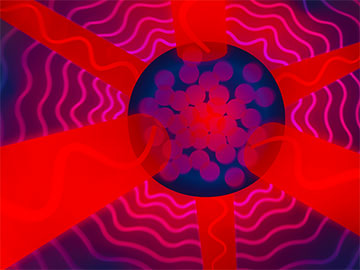
This artist’s impression shows lasers involved in direct-drive fusion magnetizing a plasma. [Image: Kyle Palmer / PPPL Communications Department]
Physicists in the United States have shown how a laser-compressed plasma of the type that might in future provide a new source of baseload energy generates magnetic fields as it re-expands—no matter how perfect the beam (Phys. Rev. Lett., doi: 10.1103/stmq-c433). Using computer simulations, the researchers found that such fields are triggered at a threshold light intensity very similar to those employed in fusion experiments today.
Toward direct-drive fusion
So-called direct-drive (inertial-confinement) fusion involves firing very intense laser pulses from all directions at a tiny pellet of fuel. The pulses rip off material from the surface of the pellet, driving the rest of the object inward at immense speed thanks to the conservation of momentum. If the temperature and pressure inside the imploded capsule become high enough, nuclei in the resulting plasma can fuse and give off alpha particles to generate further fusion, sparking a chain reaction that in principle yields enormous amounts of energy.
To date, scientists have not been able to achieve such self-sustaining reactions in direct-drive experiments. To do so, they must overcome a number of fairly formidable obstacles, including the sapping of energy by sound waves set up from interactions between the laser pulses and plasma, as well as electrons in the plasma heating the fuel prematurely, impeding compression. What’s more, they have to contend with the magnetic fields created as the plasma re-expands, which can alter the way heat moves through the plasma, potentially interfering with the process of energy generation. (Self-heating reactions have been achieved at the National Ignition Facility in California via “indirect drive” crushing of pellets with laser-induced X-rays, but this approach faces its own set of problems.)
Modeling magnetic fields
In the latest work, Kirill Lezhnin and William Fox at the Princeton Plasma Physics Laboratory, working with colleagues in Princeton and elsewhere, have carried out computer simulations to model the formation of these fields, which have been observed many times in laser experiments but are still not fully understood. The researchers used two-dimensional particle-in-cell simulations to follow the expansion of the plasma created by firing intense laser pulses from all sides at a tiny pellet of aluminum (the expanding plasma providing the pressure that drives the pellet’s implosion).
The researchers used two-dimensional particle-in-cell simulations to follow the expansion of the plasma created by firing intense laser pulses from all sides at a tiny pellet of aluminum.
As they explain, magnetic fields can be generated near the point where the laser hits the capsule because of certain variations in the temperature and density of electrons within the plasma. The researchers suppressed these fields in their simulations by assuming that the laser had an entirely uniform intensity profile, which allowed them to study the effect of what is known as a Weibel instability. This occurs due to the plasma cooling more sharply along the line of its expansion than it does in other directions, creating temperature anisotropies that in turn lead to filaments of electric current leading to magnetic fields.
Such anisotropies can be eliminated before significant fields form, thanks to collisions between particles in the plasma redistributing heat. But in their simulations, the researchers found that at sufficient laser intensities this process of re-establishing equilibrium cannot get a foothold, and the plasma rapidly magnetizes—regardless of how symmetrical the laser irradiation may be. Simulating a beam with an intensity of 1013 Wcm2, they found that the magnetization increased only slightly as the plasma expanded. Instead, by stepping up the intensity to 1014 Wcm-2, they saw the magnetization shoot up several orders of magnitude more.
A new formula
Lezhnin and colleagues have devised a formula stipulating what combination of experimental conditions should produce such magnetic fields—the only parameters involved being laser intensity and wavelength plus the properties of the capsule material. They calculate that for intensities approaching 1015 Wcm-2, the magnetization will occur in capsules made from gold and carbon, which, as they point out, are used in current fusion experiments (at similar intensities).
According to Fox, physicists have not included the Weibel instability and associated magnetic fields in their standard design tools for inertial fusion. Instead, he explains, they have made ad hoc adjustments to bring their simulations in line with experimental results. “Our biggest hope is that by including the magnetic fields and Weibel processes in inertial fusion design simulations,” he says, “we can do a better job in designing implosions.”
