

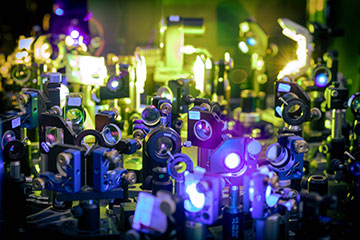
Ultrashort pulses of light have been used to perform logical operations in a two-dimensional material. [Image: Politecnico di Milano]
Researchers in Europe and Israel have shown that ultrashort pulses of laser light can be used to process digital information at speeds some 100 times faster than state-of-the-art electronic devices. By using the oscillations of a light field to manipulate quantum states within a two-dimensional semiconductor, their proof-of-principle experiments show that logical operations can be performed at speeds beyond 10 THz (Nat. Photon., doi: 10.1038/s41566-025-01823-w).
Manipulating valley polarization
The scheme devised by the researchers exploits the quantum properties of an atomically thin layer of tungsten disulfide. In this two-dimensional material, electrons and holes bind together to form excitons, which can be coherently excited into two distinct quantum states known as “valleys.” These valley states provide a mechanism for representing the ones and zeros needed for digital signal processing, but previous efforts to achieve light-controlled operation have been frustrated by the extremely short time periods for which the excitons remain in the valley states.
In this study, the researchers sought to manipulate the quantum behavior of the material using precise sequences of weak laser pulses spanning just a few optical cycles. To start with, two identical pump pulses with orthogonal polarizations were used to drive coherent excitations of the excitons. By controlling the time delay between the two pulses with sub-femtosecond precision, the researchers were able to selectively inject the excitons into one of the valley states. This generates an imbalance between the number of excitons in the two valley states, which is called the valley polarization.
To perform logical operations, the researchers used sequences of four pump pulses and a time-delayed probe pulse to manipulate the valley polarization and measure the response. One sequence enabled the valley polarization to be switched on and off, while another achieved amplification by increasing the exciton population in one of the valleys by 50%. Both operations could be performed while excitons remained within the valley states, although some effects of decoherence could be observed in the experimental response at room temperature.
Greater processing speeds
These proof-of-principle results demonstrate a processing speed higher than 10 THz, compared with an intrinsic limit of around 800 MHz for conventional transistors. “With the use of ultrashort laser pulses, we can control the quantum states of matter at speeds previously unknown in electronics,” said Giulio Cerullo of the Politecnico di Milano in Italy.
The researchers also believe that the switching rate could be pushed into the petahertz regime by implementing all-optical control with attosecond precision. However, the realization of a new generation of “valleytronic” devices presents significant technical challenges, such as increasing the number of switchable bits and creating more complex sequences of pulses to perform other logical functions.
