

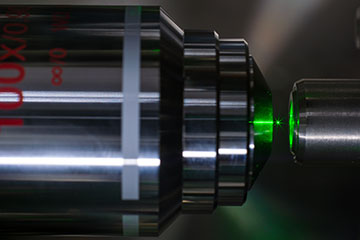
A phonon laser that offers the low-noise characteristics of a squeezed source has been created by using a polarized laser beam to manipulate the quantized oscillations of a levitating nanoparticle. [Image: University of Rochester / J.A. Fenster]
Researchers at the University of Rochester, USA, have engineered a phonon laser that achieves the low-noise operation needed to make accurate measurements of nanoscale processes and quantum phenomena (Nat. Commun., doi: 10.1038/s41467-026-70564-3). The laser, which exploits the quantized mechanical oscillations of a nanoparticle trapped inside an optical tweezer, could provide a uniquely sensitive probe for studying the interplay between classical and quantum behavior in small-scale systems.
Squeezing phonons
The Rochester team first showed in 2019 that a single nanoparticle suspended within an optical tweezer could be manipulated with light to emit phonons that behave like a laser. This experimental approach isolates the particle from external disturbances, providing a more stable system for precision measurements, but the intrinsic thermal fluctuations in the vibrational quanta have so far prevented the practical use of the system.
To overcome that problem the researchers sought to “squeeze” the phonons produced by the laser, reducing the noise in one physical quantity of the quantum system at the expense of another. “By pushing and pulling on a phonon laser with light in the right way, we can reduce that phonon laser fluctuation significantly,” says team leader Nick Vamivakas.
In practice, that meant updating the initial scheme to create a phonon laser with two orthogonal modes. The team used a linearly polarized laser beam to elongate the optical trap, which causes the nanoparticle to oscillate at two different frequencies in the vertical and horizontal directions. These two distinct modes can be coupled together by modulating the angle of polarization, driving a periodic rotation of the trapping potential at a frequency that matches the sum of the two oscillation frequencies.
In this mode-coupled regime, coherent phonons are generated at each of the two oscillation frequencies, with experiments confirming that laser gain is achieved for both modes when the strength of the coupling reaches a certain threshold. The thermal fluctuations of the two oscillation modes also become correlated in this regime, which makes it possible to achieve squeezing across the two modes.
A low-noise phonon laser
The researchers demonstrate this squeezing effect by comparing two parameters: the sum of the two oscillation amplitudes and the difference between them. In the mode-coupled regime the noise in the amplitude sum increases, while the noise in the amplitude difference falls. This two-mode squeezing is most pronounced at the lasing threshold, becoming less strong as the coupling increases.
“Our device combines the coherence and intensity of a laser with the low-noise properties of a squeezed source,” the researchers conclude. Vamivakas believes that this new phonon emitter could offer unique insights into the thermodynamic behavior of small-scale systems and enable more precise measurements of the particle accelerations caused by gravity.
