

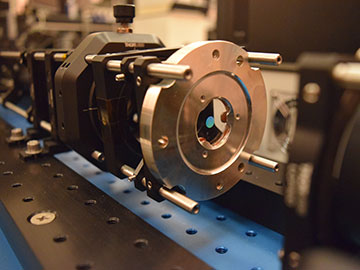
The metasurface integrated into the custom-built telescope. [Image: Noah Rubin]
Metasurfaces—artificial 2D planar surfaces that consist of subwavelength metallic or dielectric nanostructures—offer better, more efficient light control than conventional optical devices. Although researchers have successfully created ultrathin optical components like flat mirrors, lenses and waveplates using metasurfaces, most work remains in the proof-of-concept stage.
Now, researchers in the United States have leveraged recent advancements in metasurface optics to improve astronomical instrumentation to make quantitative observations of the sun’s magnetic field (Sci. Adv., doi: 10.1126/sciadv.aee8035). The Solar Imaging Metasurface Polarimeter (SIMPol) is a first-of-its-kind refractive telescope for snapshot imaging polarimetry of the sun enabled by a high-performance metasurface polarization-analyzing grating.
“We believe this is one of the first times that metasurface optics—which have been a subject of intense interest in both academic research and industry for about a decade—have been used to improve scientific instrumentation of any kind outside of a lab proof-of-concept,” said Noah Rubin, University of California San Diego.
Splitting polarized light
Metasurfaces are able to manipulate light in new ways while offering significant advantages in terms of size, weight and the ability to combine the functions of many optical components. Astronomical instrumentation, given its strict performance requirements, is often cited as a possible application area. But real-world examples have been limited to simple demonstrations, such as the use of a metalens-like element to image the surface of the moon.
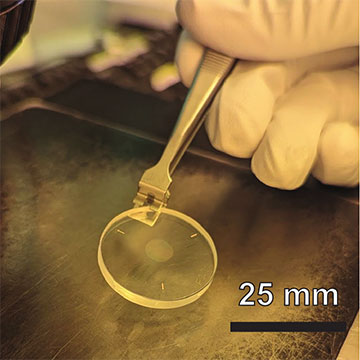
The metasurface is the 6-mm-sized circle at the center of the disk that’s held by tweezers. [Image: Noah Rubin]
Rubin and his colleagues aimed to take a unique feature of metasurface optics—the ability to spatially manipulate polarized light—and use it to solve a real, practical problem that astronomers face.
“Measuring light’s polarization state inherently requires multiple measurements. Typical instruments for this purpose—including several which have been launched into space previously—do this as a polarization element mechanically rotates,” he said. “This not only presents a mechanical element, which serves as a single point of failure, but in the space context, the satellite itself can be moving while this component reorients, causing a highly undesirable blurring effect.”
Instead, the researchers used a metasurface polarization grating (MPG), an optical component that can “split” incident light into diffraction orders to analyze specific polarization states. By measuring at least four of these orders, the polarization state of the incident light can be determined, effectively condensing what would ordinarily require a complex assembly of optics into a single, flat surface.
Simultaneous capture
With industry partners at BAE Systems Space & Mission Systems, Rubin and his colleagues fabricated and tested a large-area, high-performance MPG. Next, they integrated the metasurface into a custom-built telescope and deployed it at the Dunn Solar Telescope in New Mexico. With the metasurface, the system could capture simultaneous polarization images of sunspots and quantitatively map their embedded magnetic fields.
“These results were shown to be comparable to those obtained by a state-of-the-art NASA mission in-orbit,” said Rubin. “We are currently exploring opportunities to possibly integrate this technology into future NASA solar-observing space missions.”
