

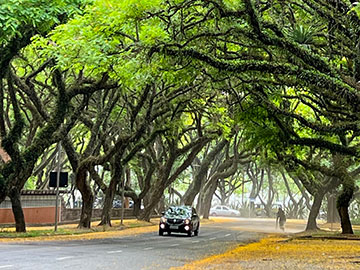
Scientists at the University of São Paulo, Brazil, have been conducting various experiments on trees on their campus. They are assessing the health of the trees and the danger that falling trees and limbs pose to humans. [Image: Herton Escobar, Agência FAPESP]
As aging trees cope with stresses from weather conditions and urban environments, they become increasingly prone to dropping large limbs or falling over completely. Now, scientists in Brazil are applying lidar and computational technology to assess trees’ risk of mechanical failure and develop a pruning strategy for preserving tree lifespans (Tree. Struct. Funct., doi:10.1007/s00468-026-02744-z).
Researchers generated a point cloud based on laser pulses to define the precise structure of an urban tree and modeled the physical forces acting on the tree using finite element modeling. They used their results to build an algorithm that can suggest ways the tree could be pruned to resist falling in future storms.
Falling trees
More than 2,000 trees fall each year in São Paulo, a Brazilian city of about 12 million people. Strong storms in each of the last three years knocked down hundreds of trees, causing widespread power outages in the urban region. “Improper pruning leaves trees vulnerable to wind, which can uproot or break trunks and branches, especially in isolated trees, at high speeds,” said Marcos Silveira Buckeridge, University of São Paulo (USP). “The problem is exacerbated by wind tunnels, known as urban canyons. Gusts of wind, rain, and temperature fluctuations during the rainy season increase the risk of trees falling, especially in the case of poorly managed or diseased trees.”
Researchers at USP became curious about the mechanical stresses that urban trees face from severe weather, pollution and drought. To explore these issues, the scientists needed to create a model of a tree that takes into account its unique branch shapes and the mechanical properties of the wood inside its trunk and branches.
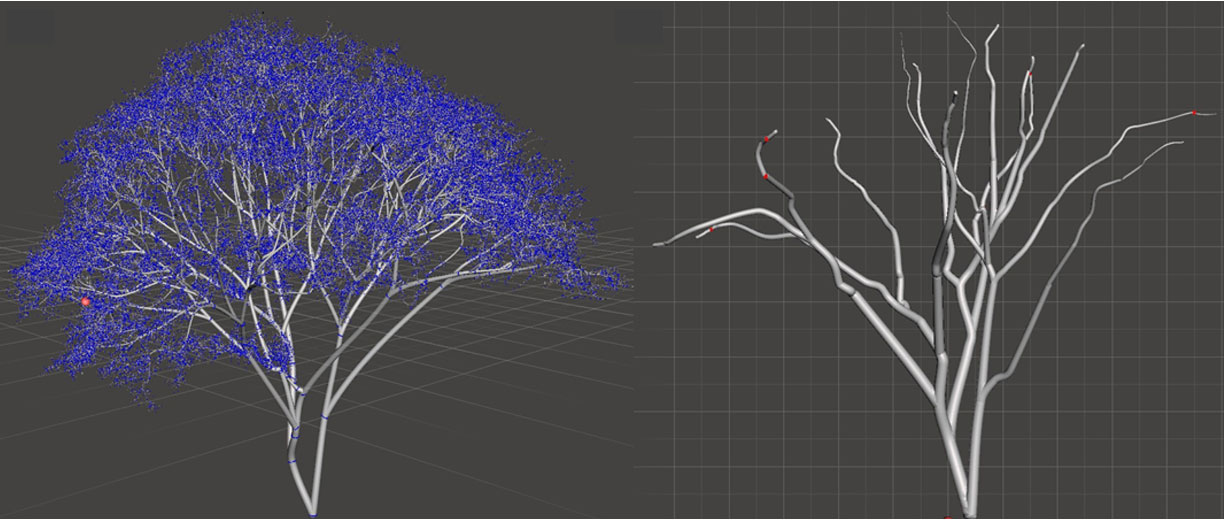
Laser sensing technology creates a “point cloud” that reproduces in the computer the exact architecture of the plant. [Image: LAFIECO]
From lidar to models
Using a commercial lidar scanner mounted on a tripod, the team scanned a single specimen of Tipuana tipu, a common South American tree also known as tipa or rosewood. “The scanner is mounted on a tripod near the base of the tree, which must be well lit. Weather conditions must be favorable,” Buckeridge said. “After completing the scan at the first point, the scanner must be moved to another position near the tree, and this process is repeated until enough perspectives have been captured to generate a complete point cloud of the object.”.
After amassing 30 million raw data points from the isolated tree, the researchers built a 3D model of the tree. They removed the leaves from the model to better show its trunk and branches. Next, the group used finite element modeling (FEM), with the assumption that the tree’s surface area was much greater than its volume, to study the effects of simulated wind and driving rain.
Optimizing pruning
The results from the modeling indicate that removing a branch creates topological asymmetry, making the tree more susceptible to wind damage. Based on these results, the researchers created their own “topology optimization” algorithm to suggest ways in which the anisotropic branches could be pruned to improve the tree’s resistance to wind without compromising its ability to feed itself through photosynthesis.
“This article is important because it’s a proof of concept, using mathematical equations to demonstrate that it’s possible to use [lidar] for this purpose,” said Buckeridge. “The problem is that scanning a single tree with the level of detail used in this paper takes 40 minutes.”
The USP researchers say that their method is not restricted to the species of tree or even a single tree. However, since lidar-scanning trees and creating FEM models from point clouds takes a lot of effort, future machine-learning tools could speed up the process and make the process into a true tool for urban tree management.
