

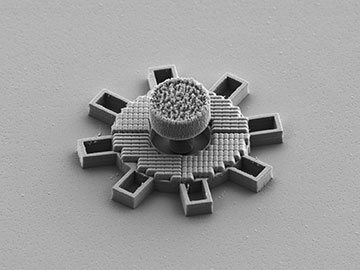
A microscale gear with metamaterial that reacts to light. [Image: Gan Wang, University of Gothenburg]
For three decades, scientists working on microscale mechanical machines have been stuck because they could not create gears smaller than 0.1 mm. Now, researchers in Sweden have constructed tiny gears almost 10 times smaller, powered by laser light impinging on an optical metasurface (Nat. Commun., doi:10.1038/s41467-025-62869-6). “This is a fundamentally new way of thinking about mechanics on a microscale,” says study author Gan Wang. “By replacing bulky couplings with light, we can finally overcome the size barrier.”.
The team built the proof-of-concept gear train out of silicon with traditional photolithography techniques already used in chip fabrication. The researchers also demonstrated that the intensity of the laser beam controls the angular velocity of the metamaterial-powered gear and that changing the polarization of the beam changes the direction of the turning gear.
No need for electric connectors
One reason why progress on shrinking motors stalled: Electrostatically driven microgears required comparatively bulky electric connectors, which limited their miniaturization. Other problems arose with attempts to drive tiny mechanical systems with alternating-current fields or light-driven chemical reactions.
Building on recent studies on microscale vehicles propelled by light falling on plasmonic or dielectric metasurfaces, the group based at the University of Gothenburg devised a gear-shaped rotating micromotor consisting of a metamaterial-topped rotor anchored to a silicon chip with a central pillar that allows it to turn freely. Optimized for illumination at a wavelength of 1064 nm, the unit cells of the silicon metasurface measured no more than 460 nm in any direction.
The metasurface of the rotor was divided into four segments. In each segment, the unit cells were arranged parallel to each other, but the cell grids were rotated 90 degrees relative to their neighbors. Unsurprisingly, the more unit cells on a rotor’s surface, the higher its angular velocity. At low intensities of the impinging light, the angular velocity increased linearly. At higher intensities, however, the velocity change became nonlinear because the unit cells absorbed more light.
Optimized for illumination at a wavelength of 1064 nm, the unit cells of the silicon metasurface measured no more than 460 nm in any direction.
In further experiments, the Gothenburg team created a “metagear,” similar to the rotor but with gear teeth around the outer edge. The group fabricated other silicon gears without the metamaterial and put them together with the metagear to create a gear train. Right and left circular polarization of the light beam caused the metagear to spin in opposite directions.
Finally, the researchers built a tiny rack-and-pinion system out of silicon to convert the metagear’s rotational movement to linear movement. They also experimented with adding a small metasurface to the rack to make the device move back and forth under constant linearly polarized light.
Potential applications
The Gothenburg scientists say their designs are CMOS-compatible, and biological tissues don’t absorb much of the 1064-nm laser light. Since the tiny gears are on the size scale of biological cells, they could be easily incorporated into lab-on-a-chip systems.
“We can use the new micromotors as pumps inside the human body, for example to regulate various flows,” says Wang. “I am also looking at how they function as valves that open and close.”
