

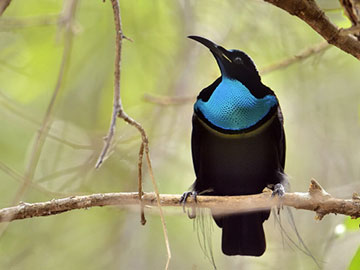
The striking black plumage of the magnificent riflebird inspired the design of the darkest fabric yet reported. [Image: Paul Maury/Cornell Lab of Ornithology]
Researchers at Cornell University, USA, have devised a simple and scalable technique to create an ultrablack fabric that absorbs almost all incident light over a wide viewing angle (Nat. Commun., doi:10.1038/s41467-025-65649-4). Inspired by the striking black plumage of the riflebird, the two-step processing method produces the darkest fabric yet reported without compromising on its natural comfort and strength.
Toward ultrablack
Ultrablack materials have previously been developed for applications in cameras, solar panels and telescopes, but the darkest versions are fragile and toxic while also being difficult to fabricate. Textiles with an ultrablack appearance are widely used as backdrops in photography, but these composite materials lack the breathability and flexibility needed for everyday clothing.
In this study, the researchers analyzed samples of the riflebird’s feathers to uncover the small-scale structures that generate the intense blackness of the plumage. Internal nanostructures are colored by a dark melanin pigment, while tightly interlocking barbules along the feather contain microscopic grooves and cavities that capture the light. The combined effect is to make the bird appear extraordinarily black when viewed straight on, becoming shinier when seen from the side.
To replicate this design the researchers first dyed a white merino wool fabric with a synthetic equivalent of melanin, ensuring that the color penetrated the yarn rather than just coating the surface. They then etched the surface of the wool in a plasma chamber, creating bundles of hair-like nanofibrils that mimic the light-trapping structures found on the riflebird’s feathers. “The light bounces back and forth between the fibrils instead of reflecting back out,” explains lead author Hansadi Jayamaha.
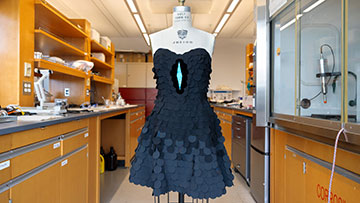
This dress showcases the difference between the ultrablack fabric, which has been used for the dots around the blue centerpiece, and conventional black materials [Image: Ryan Young/Cornell University]
An effective and comfortable fabric
After this surface treatment the fabric had an average total reflectance of just 0.13%, lower than that measured for the textiles used in photography, and unlike these commercial materials, the wool maintained its ultrablack appearance over a viewing angle of 120°. The natural material is also comfortable to wear and has already been incorporated into a dress to confirm that it retains its ultrablack properties under different lighting conditions. Further tests show that the extreme darkness of the fabric is not affected by washing or exposure to light.
The researchers are confident that the same process can be used with any natural material, including wool, silk and cotton. As well as providing a dramatic aesthetic for the fashion industry, such ultrablack materials could be used for thermo-regulating camouflage that converts absorbed light into thermal energy.
