

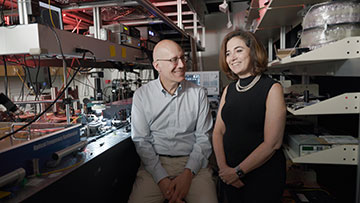
Alexander Gaeta (left) and Michal Lipson, pictured in the Gaeta lab at Columbia University. [Image: Columbia Engineering]
A group of physicists in the United States demonstrated a high-power frequency comb made from a silicon-nitride microresonator coupled to a low-coherence pump laser (Nat. Photon., doi: 10.1038/s41566-025-01769-z). They say it may soon be possible to replace the numerous individual lasers currently needed to transfer optical signals across data centers with a single chip-based multi-wavelength light source.
Toward streamlined light sources
The ever-growing use of artificial intelligence (AI) and other data-intensive applications is placing increasing demands on the optical channels used for communicating between and within data centers. Wavelength-division multiplexing allows multiple data streams to be transferred simultaneously in a single optical fiber, but each stream is usually generated in a separate laser, increasing the costs and space needed for networking.
In the latest work, Michal Lipson, Alexander Gaeta, Andres Gil-Molina and colleagues at Columbia University show how such lasers might be replaced by a single chip-based frequency comb. Such “microcombs” enhance the nonlinearities created via the Kerr effect by confining laser light inside tiny resonators. The nonlinearities create sidebands symmetrically arranged around the laser frequency, which, with a high enough Q factor, themselves generate symmetric sidebands, and so on. The result is a light pulse consisting of dozens and dozens of equally spaced, narrow spikes across the spectrum—a frequency comb.
Although researchers have been developing microcombs for nearly two decades, they have yet to produce them at high enough powers to satisfy the demands of data centers, whose state-of-the-art optical links require tens of channels, each with a power of at least 100 microwatts. Various groups have used external high-coherence bench-top lasers to put up to 100 milliwatts on microcomb chips but did so with wall-plug efficiencies below 1%.
The Columbia researchers have now shown how this problem could be overcome by exploiting the greater power levels of a low-coherence laser, which allows them to generate Kerr-frequency combs with both high powers and narrow linewidths.
Achieving record power
Their experiment involved hooking up an off-the-shelf III-V multimode laser diode to a high-Q silicon nitride ring resonator, forming an electrically pumped device measuring just a few millimeters across. The laser provided up to a few watts of power (and a wall-plug efficiency of 30%). They were able to transfer up to a third of the power to the resonator by precisely overlapping the spectra of one of the lasing modes and one of the ring resonances.
Lipson and coworkers found they could transfer as much as 158 mW to the chip, which they say is an order of magnitude higher than that of previously electrically pumped mircocombs.
Achieving this overlap involved a number of technical innovations. Besides fabricating microrings with intrinsic Q-values of around 3 million, the researchers minimized losses by tapping the laser light via a horn taper. They also integrated platinum heaters into the silicon nitride chip in order to finely tune the laser feedback and resonator phases.
Lipson and coworkers found they could transfer as much as 158 mW to the chip, which they say is an order of magnitude higher than that of previously electrically pumped mircocombs. This record power involved as many as 27 teeth in the frequency comb having above 100 microwatts, and they were able to space the teeth as far as 800 gigahertz apart. As they explain, the precise power levels and frequency spacings depend on the heater-induced phase and the pumping conditions.
Demonstrated potential
The researchers performed another couple of tests that they say demonstrated their system’s potential for use in optical links. For a wide range of frequencies they achieved an upper bound on the intrinsic linewidth of just 200 kHz, which they point out is comparable to that of the external cavity lasers often deployed in both long-distance communications and data centers. The team also detected minimal distortion when using a commercial electro-optic modulator to send data at 12.5 gigabits per second on a comb line located close to the 1550 nanometer wavelength characteristic of optical fibers.
They argue that their device could enable “a significant reduction in footprint, power consumption and cost of wavelength-division multiplexing optical transceivers.” But they also reckon it might be exploited in applications requiring remote operation, such as geolocalization, spectroscopy and distance ranging. They also suggest it could be used to miniaturize certain quantum technologies that rely on precise and stable optical frequency references, such as chip-scale optical clocks and quantum key distribution systems.
Lipson and colleagues still have to overcome a number of technical hurdles, such as improving the mode matching between III-V semiconductor and silicon nitride as well as tapping more of the power from the laser diode. But given the maturity of the relevant fabrication techniques, they believe their device could be manufactured at wafer scale “allowing the mass production of high-power frequency comb sources.”
