

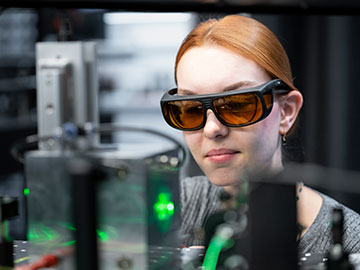
Andrea Stöllner (pictured) and colleagues have investigated how two tightly focused laser beams can trap and also charge micrometer-sized particles of amorphous silica. They reckon that a closer look at the process could help explain how ice crystals contribute to electrification inside storm clouds. [Image: ISTA]
An Austrian-led collaboration has used optical tweezers to trap and charge tiny particles of silica. Having concluded that the charging process involves two-photon absorption, the researchers say that their technique could be used to probe electronic states as well as perhaps help explain the currently mysterious phenomenon of lightning formation (Phys. Rev. Lett., doi: 10.1103/5xd9-4tjj).
A trap for silica
Optical tweezers are tightly focused laser beams that can hold microscopic objects and sense tiny forces, including electrical ones. Back in 1976, scientists at Bell Labs in New Jersey, USA, used lasers to optically levitate glass particles and measure their charge—but also found that the lasers themselves could charge the particles.
Scott Waitukaitis, Andrea Stoellner and colleagues at the Institute of Science and Technology Austria in Klosterneuburg, together with researchers in Austria, Japan, Switzerland, Denmark and the United Kingdom, sought to build on this largely overlooked research by using lasers to explore the electrical behaviour of 0.7-micrometer-diameter particles of amorphous silica. They sent two halves of a green laser beam into a small air-filled chamber from opposite directions, focusing the beams using a pair of lenses to create a trap for a silica particle contained within an aerosol sprayed into the chamber.
The researchers surrounded each lens with a copper ring electrode, generating an alternating 2-kHz electric field along the beam axis—which as they point out, should cause the particle to oscillate back and forth along the axis at the driving frequency if it is charged. By directing the laser light scattered from the particle at a photodetector, they were able to measure the particle’s movement back and forth and from that calculate its charge at any given moment in time. This calculation involved subtracting the particle's thermal motion from its electrically driven motion.
Pointing to two-photon absorption
Waitukaitis and colleagues first studied the particle's oscillation spectrum, observing, as expected, a peak at a frequency of 2 kHz. They then measured the particle's accumulating charge over time at different laser powers and discovered that higher powers speed up charge generation. Although the total charge in each case began to flatten off after an hour or so, they plotted the early (linear) charging rate against the laser intensity and found the former to vary neatly with the intensity squared.
They say that this square-law dependence is a clear signature of the particle being ionized via two-photon absorption. However, they also point out that at first sight, such a process appears at odds with the band structure of silica, as the roughly 10 electronvolt (eV) difference between the material's valence band and the vacuum level is apparently unbridgeable by the 4.66 eV of energy provided by two of the laser's green photons.
The researchers suggest that this apparent discrepancy could be explained by the presence of in-gap states above the valence band brought about by the disorder in very slightly amorphous silica. One possible scenario, they say, would involve electrons being excited from an initial state within the band gap to the conduction band and from there via thermal agitation out of the molecule. Alternatively, they speculate, there could be a wide variety of states within the band gap, and some of these might be sufficiently near the conduction band to enable direct liberation of electrons.
They explain that both possible explanations have shortcomings. The thermal hypothesis, they say, is hard to square with theory, since it requires one particular coefficient to be 10 times greater than observed. Direct emission, on the other hand, involves a distribution of states within the band gap that has no confirmed physical foundation.
One way to put the competing hypotheses to the test, they say, would be to heat the particle using an additional laser at deep infrared wavelengths. As they point out, the thermal scenario would cause emission to vary with temperature in a clearly defined way, whereas there would be no such variation in the case of direct emission.
Exploring lightning
As to future applications of their work, Waitukaitis and colleagues argue it could be used in particular to try and better understand lightning. Scientists agree that lightning formation requires both an electric field within a storm cloud and an initial spark. However, the fields measured inside clouds seem to be too small to enable this process.
Waitukaitis points out that electric fields near the surface of an ice crystal—a particle—can can be much larger than those in a cloud's bulk. According to Stoellner, the new work should help them better understand exactly how ice crystals enhance fields. "It lets us investigate the microphysics of electrical charging and discharging which could help in understanding what exactly is happening at the surface of those particles," she says.
