

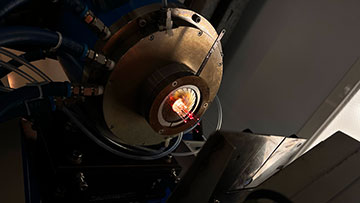
Researchers in the United Kingdom have developed robust optical fiber by spinning the glass preform as they feed it into a 2000°C furnace. This image shows that the fiber guides light even while it is being drawn. [Image: Nathan Roberts]
Scientists in the United Kingdom have created a new kind of topological insulator in the form of an optical fiber that can transmit light even in the face of major structural defects (Nat. Photonics, doi: 10.1038/s41566-026-01848-9). They reckon that such fiber, which is given a twist during fabrication, could prove ideal for zapping data around a computer chip or even improving certain types of quantum technology.
Optical fiber to topological insulator
Topological insulators have the curious characteristic of being insulators on the inside but conductors on the outside. Relying on a kind of knot in the wave function of the electrons that flow through them, these unusual materials have been demonstrated in both two- and three-dimensional varieties—the former featuring electric currents that travel around the edge of an insulating plane, while the latter involve multi-directional current flow on the surfaces of bulk insulators.
In the latest work, Nathan Roberts of the University of Bath and a team of researchers at Bath and Cambridge universities have demonstrated the equivalent phenomenon using electromagnetic waves at optical frequencies—in other words, light. They have shown it is possible to turn ordinary telecom-grade optical fiber materials into a topological insulator by giving the fiber a (literal) twist.
A little over three years ago, a part of the current collaboration reported stabilizing light propagation along a length of photonic crystal fiber by introducing what are known as topological supermodes. However, the researchers did so without breaking time-reversal symmetry and as such were only able to protect transmission against certain limited types of structural damage or distortion.
They now show how to overcome this limitation by twisting a single optical fiber containing numerous germanium-doped cores with a honeycomb-shaped cross section, doing so to break propagation symmetry, which, they say, “is mathematically analogous to time-reversal symmetry in the Schrödinger equation.” The trick was to strike just the right balance between the degree of twisting and the coupling between the different cores—since too much of one compared with the other prevents the topological state from forming.
Twisting and testing
The researchers first carried out computer simulations to settle on twisting and coupling values of 133 turns per meter and 4,135 per meter, respectively. They then made a fiber with these characteristics by spinning an optical fiber preform—made of very pure glass containing the honeycomb arrangement of germanium-doped cores—as they fed the glass into a furnace. They also created a sizeable notch in the fiber cross section to serve as a suitable defect, which would usually scatter light out of or back along the fiber.
They have shown it is possible to turn ordinary telecom-grade optical fiber materials into a topological insulator by giving the fiber a (literal) twist.
To examine the performance of the new light transmitter, Roberts and colleagues injected near-infrared laser light into just one core on the edge of a 24-mm length of their fiber and measured the intensity of radiation emitted by each of the cores at the other end. They observed, as predicted, that the cores located around the fiber’s perimeter transmitted light in a pattern that rotated in one direction, while most of those on the inside remained dark—the signature of an “edge-localized supermode.”
Conversely, they found that two other types of fiber with a similar defect only transmitted light through those cores nearest the one that was coupled to the input light. One of these fibers was an untwisted ring of cores with nothing on the inside, while the other was a honeycomb set of fibers with too great a twist.
This contrast in transmission characteristics, say the researchers, demonstrates “how topology protects light in fiber against fabrication disorder.” As such, they argue, topological fiber holds promise for a range of applications, including improving signal transmission in large data centers, protecting delicate quantum states and even building new types of fiber laser that deliver very stable, high-power light pulses.
First, however, they would like to develop a topological fiber that doesn’t require so many twists per meter. As team member Peter Mosley explains, a lower twist rate would mean the fiber could be drawn more quickly, making it better suited for deployment on larger scales. “Perhaps this would be achievable in a modified fiber design,” he says.
