

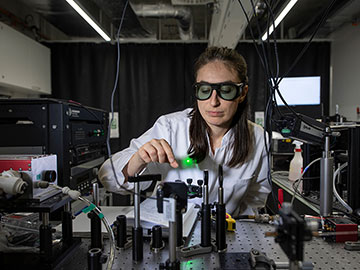
Ferda Canbaz demonstrates the depth of cuts that can be achieved by changing the energy profile of a laser beam. [Image: University of Basel, Catherine Weyer]
Researchers in Switzerland have shown that altering the energy profile of a surgical laser allows deeper cuts to be made into bone without damaging the tissue (Sci. Rep., doi: 10.1038/s41598-026-37117-6). This modification to the design, which also removes bone material more efficiently than other laser-cutting devices, could lead to more precise surgical procedures that avoid the microcracks commonly caused by mechanical tools such as saws and drills.
The need for efficiency
Surgical lasers are already used to make clean and accurate incisions in soft tissue, but existing systems are ineffectual for bone surgery because they are unable to cut such hard material to the required depth or with enough speed. Previous studies have shown that erbium lasers are best suited to the task, but their maximum penetration depth—typically around two to three centimeters—is not enough for common procedures such as the insertion of joint implants.
The researchers wondered if they could improve the cutting efficiency by altering the distribution of energy in the laser beam. “Increasing the power of the laser would not be a good solution,” explains team leader Ferda Canbaz of the University of Basel. “That could char the bone and have a negative impact on the healing process.”
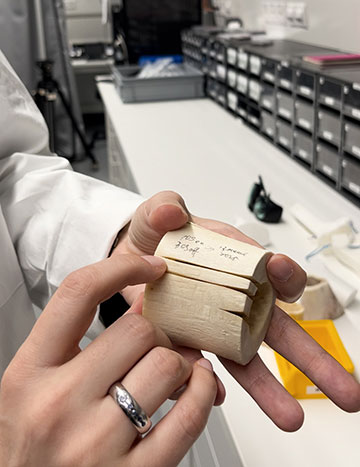
A new laser cutting technique can cut bone deeper than previous methods. [Image: University of Basel, Catherine Weyer]
Erbium-doped lasers have an intensity distribution similar to a Gaussian profile, with sidelobes that heat the surrounding tissue but do not contribute to the ablation process. The team conjectured that the cutting performance could be improved by shaping the beam into a top-hat profile, distributing the energy more evenly to prevent absorption and direct more optical power into the base of the cut.
Cutting bone deeper
The team tested their theory by using the two types of laser beam to make incisions in bovine bones. The normal Gaussian profile achieved a maximum depth of about 26 mm when the bone was irrigated and cooled during the cutting process, which would be needed in a clinical setting to prevent heat damage and keep the cut clear. In contrast, the beam with the top-hat profile penetrated the bone to 44 mm, and it was also able to remove material around 70% faster than the conventional beam.
The new technique does not yet provide the cutting performance needed for bone surgery, but the researchers believe that both the depth and speed requirements could be achieved by optimizing other beam parameters. They are also keen to investigate how the ablation process might be affected by a more realistic physiological environment, in which the bones would be perfused with blood, and how the optical apparatus could be integrated into a robotic delivery system for clinical use.
