

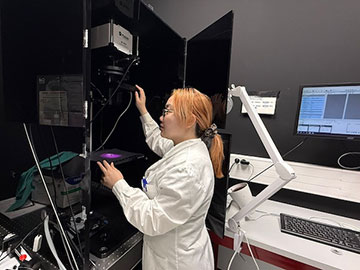
Student Liyan Ming setting up a fluorescence imaging experiment as part of work on AI-powered temperature mapping. [Image: Riccardo Marin]
Scientists in Italy and Spain have combined artificial intelligence (AI) with infrared-emitting nanoparticles to map the temperature of living tissues in three dimensions (Nat. Commun., doi: 10.1038/s41467-025-59681-7). They say that their new scheme could be cheaper, safer and more portable than existing bioimaging systems.
Overcoming limitations with AI
Luminescence nanothermometry—which interrogates nanometer-scale particles with light and records their emission—can be used to monitor everything from heat dissipation in microelectronics to cell metabolism. However, the technique is largely confined to two dimensions. One group has shown how to create 3D images using luminescence by stacking multiple 2D cross sections on top of one another, but this approach is time consuming, limiting temporal resolution.
In the latest work, Riccardo Marin, Erving Ximendes and colleagues at Universidad Autónoma de Madrid, Spain, and Ca’ Foscari University of Venice, Italy, show how such limitations can be overcome by using AI to extract both temperature and depth information from the infrared emissions of nanoparticles. They achieve this using hyperspectral imaging, which records a separate intensity spectrum across a range of near-infrared wavelengths at each pixel. The idea is to identify distortions to such spectra generated both by variations in temperature and the thickness of tissue above any given nanoparticle.
The researchers use nanoparticles made of silver sulfide (Ag₂S). They say that these particles are minimally toxic to cells, are easily excited by light in the infrared spectrum and display significant spectral changes at biologically relevant temperatures. What's more, the particles’ near-infrared emissions are partially absorbed by water—meaning their spectra change according to the thickness of tissue traversed by the emitted radiation.
Marin and colleagues point out that the relationship between tissue thickness and spectral distortion depends on numerous factors, such as the tissue's water content, its layering and the effect of light scattering. This, they say, makes mathematical modeling of the distortion very tricky. Instead, they combine convolutional and dense neural networks to tie very precise spectra to specific values of temperature and tissue depth.
Testing and validation
Marin and colleagues point out that the relationship between tissue thickness and spectral distortion depends on numerous factors, such as the tissue's water content, its layering and the effect of light scattering.
The researchers demonstrated their technique using both hydrogels that mimic biological tissue and real animal tissue, such as chicken legs and cow livers. They placed a dispersion of silver nitride nanoparticles underneath the samples then exposed them to light from an 800-nm laser while heating them from below and using a near-infrared camera to record hyperspectral images with hundreds of pixels. Each pixel contains multiple intensity values across a spectrum spanning 1000 nm to 1400 nm.
They used 80% of their spectral data points to train the system, presenting it with specific combinations of temperature and depth while labeling the dense neural network’s output as such, then using the remaining 20% to test the algorithm’s predictive capacity. They found that they could nominally predict temperature to within about 0.5°C of its true value while getting to within 0.25 mm of the correct tissue depth.
The researchers went on to validate their approach by inserting glass capillaries containing nanoparticle dispersions into phantoms and ex vivo tissues, as if they were injecting the particles into a living organism’s blood stream. Placing the capillaries at various depths within the samples and heating them from below, their system was again very accurate at shallow depths, although it lost some accuracy at greater depths—remaining within about 1°C and 0.5 mm of the true values.
Finally, the collaboration used the technique to image blood vessels in an anaesthetized mouse. After injecting a dispersion of nanoparticles behind the mouse’s eye, they combined the data from several hyperspectral images to create a 3D thermal map showing the vessels’ average temperature to be 36°C (with a margin of error of a degree) compared to the anticipated value of 36.6°C.
Although AI-powered nanothermometry is still at an early stage, Marin reckons that it could yield imaging systems at least an order of magnitude cheaper than those of existing techniques, such as functional MRI or PET scanning, while potentially being small enough to fit next to a patient’s bed at home. He and his colleagues argue that by tailoring the nanoparticles’ optical properties, it should also be possible to use their scheme to measure parameters besides temperature, such as oxygen concentration or pH values. They acknowledge that temporal resolution remains limited with their technique too but are confident this problem can be overcome by using brighter nanoemitters and more sensitive detectors.
