

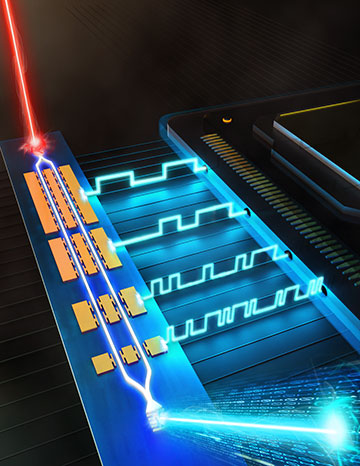
An artist’s illustration of the electro-optic digital-to-analog converter, depicting high-speed information transfer between electronics and optics. [Image: Second Bay Studios]
In recent years, the explosion of artificial intelligence—particularly large language models—has led to an increased demand for photonic technologies in data centers. Photonics is ideally suited to handle the exponential growth in data volumes since it offers higher capacity and throughput than electronic approaches. However, the lack of an efficient interface between conventional digital electronics and analog photonics has hindered progress.
Now, researchers based in the United States and Singapore have developed a novel architecture for an electro-optic digital-to-analog link that can address this bottleneck (Nat. Photon., doi: 10.1038/s41566-025-01719-9). The device, built on chips made out of lithium niobate, can bridge digital electronic signals and analog light signals in a single step.
“Our architecture simplifies this process dramatically,” said study author Yunxiang Song, Harvard University, USA. “Such kinds of electro-optic conversion are instrumental to a variety of applications such as optical computing and microwave signal processing, which photonics shows the potential to accelerate.”
Digital-to-analog link
The EO-DiAL can generate both analog optical and electronic waveforms at an effective data rate of 186 gigabits per second—an order of magnitude faster than typical home internet speeds—with an ultralow power consumption of 0.058 pJ b−1.
The conversion of massive amounts of data between the digital electronic domain (used for information storage) and the analog photonics domain (used for data transfer) requires a high-speed, energy-efficient interface. The conventional two-step process involves digital-to-analog converters to convert binary words into analog electrical signals, which are then used to drive electro-optic modulators.
The current study demonstrates an electro-optic digital-to-analog link (EO-DiAL) device based on a multi-electrode Mach–Zehnder interferometer (MZI) design that achieves electro-optic conversion without the electronic digital-to-analog conversion step. The EO-DiAL can generate both analog optical and electronic waveforms at an effective data rate of 186 gigabits per second—an order of magnitude faster than typical home internet speeds—with an ultralow power consumption of 0.058 pJ b−1.
“By applying digital on/off voltages to the segments, we can achieve analog light waves through phase interference within the MZI, effectively combining the electronic bits,” said Song.
An emerging platform
The EO-DiAL device was fabricated using a lithium niobate foundry process developed by Harvard startup HyperLight Corporation. Thin-film lithium niobate photonics, an emerging platform for integrated electro-optics, promises to make revolutionary impact in areas such as optical communications, microwave photonic processing, integrated laser control and optical computing.
“Our device seamlessly interfaces digital electronics with the analog domain of light, thus enabling effective higher-order modulation format communications with binary signaling, microwave arbitrary waveform synthesis using an optical-electronic-optical loop, digital CMOS tuning integrated lasers, and electro-optic conversion of complex data for machine learning tasks,” said Song.
