

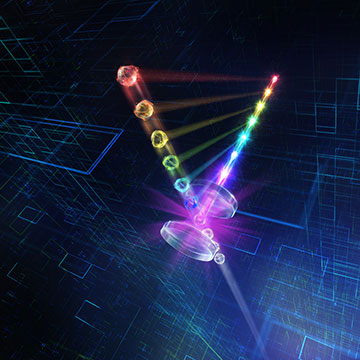
One by one, each ion–qubit is moved into an optical cavity, where mirrors efficiently collect the photons emitted. Each photon emerges entangled with its ion–qubit, forming a deep quantum link. [Image: University of Innsbruck/Harald Ritsch]
Every communication network consists of nodes, and the quantum networks of the future will be no different. Researchers in Austria have developed a quantum node using 10 “ion-qubits,” photons entangled with trapped calcium ions.
In the new technique, the electrically trapped ions encode qubits, and when the ions move sequentially into the focus of an optical cavity, each ion emits a photon that remains entangled with the ion–qubit pair (Phys. Rev. Lett., doi:10.1103/v5k1-whwz). The researchers believe their method could be scaled up to larger applications, such as quantum sensing arrays and linked optical atomic clocks.
The experimental system
To build their proof-of-concept device, Ben Lanyon, Marco Canteri and their colleagues at the University of Innsbruck leveraged 40Ca+ ions, which is the species employed in many other quantum-computing setups. Specifically, they used 49-μm-long strings of 10 40Ca+ atoms in a linear Paul trap with an integrated optical cavity for photon collection.
Results from 54,000 sequences completed over 45 minutes showed that the entangled pairs of ions and photons maintained a fidelity of 92%.
In the experiment, the 10-atom string is fed into the focus of a cavity field. One at a time, each ion entangles itself with an 854-nm photon. A 393-nm Raman laser pulse drives this event, which is called a bichromatic cavity-mediated Raman transition. The 854-nm standing waves of the cavity are at an 85.9-degree angle to the ion train. From the cavity, photons move into an optical fiber, where their polarizations are carefully measured.
A scalable and robust method
After each of the ions has generated an entangled photon and moved on, the atoms return to their initial positions for ion–qubit measurements. Results from 54,000 sequences completed over 45 minutes showed that the entangled pairs of ions and photons maintained a fidelity of 92%, indicating that the method is robust enough for more complex quantum networks across laboratories or between cities.
“One of the key strengths of this technique is its scalability,” says Lanyon. “While earlier experiments managed to link only two or three ion–qubits to individual photons, the Innsbruck setup can be extended to much larger registers, potentially containing hundreds of ions or more.”
The researchers say an important next step is to combine their method with techniques that extend ion–qubit coherence times to stabilize photon generation efficiency. This will aid in establishing remote entanglement, which takes many repeated attempts.
