

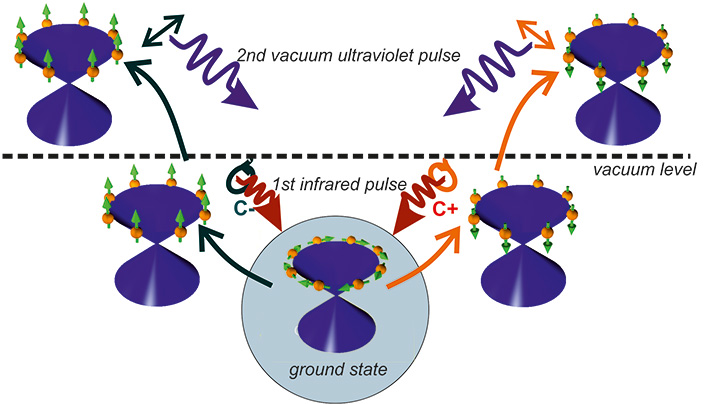
A circularly polarized infrared laser pulse (bottom) is used to control the spins of electrons in a topological insulator. Linearly polarized UV pulses read out the spin information. [Image: HZB] [Enlarge image]
Physicists and information technologists have long coveted memory and other devices that exploit not just the electron’s charge, but its quantum spin—the continually emergent field known as spintronics. An international team of scientists has now used circularly polarized, femtosecond laser pulses to control spin-polarized currents within the intriguing new class of materials known as topological insulators, (Phys. Rev. B, doi: 10.1103/PhysRevB.93.155426). The combination of these exotic materials and tight, ultrafast control by laser light could, in the view of the team, open up some intriguing possibilities for low-energy exploitation of spintronics in future I.T.
An energy edge for topological insulators
The idea of using circularly polarized laser light to shape electron spin dynamics has gained steam in the last ten years, and “optomagnetic” control has been shown to work in a number of experimental setups involving conventional ferromagnetic materials. But such setups commonly require that a fair amount of energy be invested up front to manipulate spins.
Topological insulators, which are special materials that behave as insulators in bulk but are conductive on their surfaces, offer a potentially much lower-energy route to spintronic devices. That’s because, on the surface of such materials, electrons are extremely mobile—indeed, they behave like massless, relativistic Dirac fermions, with a zero band gap and a linear dispersion profile analogous to those found in certain 2-D materials such as graphene.
The unusual electronic structure of these materials protects, among other things, from backscattering of electronic states—which, in turn, opens up the possibility for ultrafast spintronic devices with very high efficiency and low energy dissipation. For the scheme to become practical, however, it requires a method of controlling electron spins on ultrafast, sub-ps timescales. That’s where the lasers come in.
Pump and probe
To get to spin control, the research team—led by Jaime Sánchez-Barriga and Oliver Rader of the Helmholz-Zentrum Berlin (HZB), along with other scientists from the Universität München, Moscow State University, the Max Born Institute in Berlin, and the University of West Bohemia in the Czech Republic—started out with a known and well-studied topological insulator, antimony telluride (Sb2Te3). Then, they used time- and angle-resolved photoemission spectroscopy (tr-ARPES) to measure the effect of circularly polarized light on the spin states of the Sb2Te3 surface electrons.
In the team’s tr-ARPES setup, a circularly polarized infrared pump pulse optically excites the surface electrons in the Sb2Te3 sample. That pulse is followed, after a short, tunable time delay, by a linearly polarized ultraviolet probe pulse, which kicks the excited photoelectrons out above the vacuum level and allows their properties, including spin, to be analyzed.
Flipping the spins
The team found that it was able to use the laser light to initiate and direct spin currents in the topological insulator. What’s more, by varying the circular polarization of the pump laser, the researchers were able to flip the electron spin directions on demand, on timescales of around half a picosecond.
The demonstration of the feasibility of all-optical control of topological surface states should, in the research team’s view, “pave the way for optospintronic applications at ultimate speeds.” Among those applications could be new forms of information storage. In a press release on the work, HZB scientist Rader noted that “if you were to utilize magnetically doped topological insulators, you could also probably store this spin information.” But investigating that possibility further, Rader said, will require additional experiments in the soft-X-ray region.
