

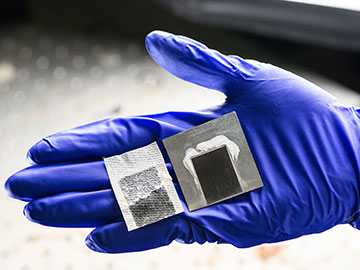
Researchers have developed a solar-powered desalination device featuring laser-etched super-wicking black metal (right). Unlike existing solar desalination systems (left), Chunlei Guo’s design prevents salt and mineral buildup from clogging the surface. [Image: J. Adam Fenster, University of Rochester]
Converting salty ocean water to freshwater helps meet the growing human and agricultural demand for the latter, but the desalination process has harmful byproducts: carbon dioxide and highly condensed brine. One of the most common desalination technologies, reverse osmosis, converts less than half of the salt water input into fresh water—and consumes a lot of energy.
Now, researchers at a US laboratory have created laser-patterned black metal panels that reportedly eliminate these drawbacks (Light Sci. Appl., doi:10.1038/s41377-026-02315-4 ). The solar-thermal panels grab virtually all salts from ocean water and leave solid salts that contain valuable minerals such as lithium.
Improving solar-thermal desalination panels
Some solar-powered desalination panels already exist; they employ various materials for absorbing sunlight and wicking fresh water away from the salt water input. However, when using real ocean water instead of simulated ocean water containing just sodium chloride, minerals such as magnesium sulfate and calcium carbonate, which have different crystal structures NaCl, clog up the panels.
Optica Fellow Chunlei Guo of the University of Rochester, who makes femtosecond-laser-patterned nanostructures for many applications, and his colleagues developed a solar-thermal crystallizer made of super-wicking, nanostructured black metal panels. The Rochester team calculated the size of the structures on the black panels to balance water transport and salt accumulation while absorbing a sufficient amount of solar thermal energy.
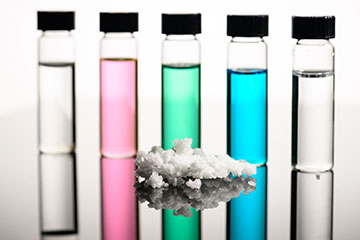
Vials of (from left) sea water, Great Salt Lake water, nickel sulfate, copper chloride wastewater, and desalinated water, along with recovered salts, shows how a new approach turns natural and industrial waters into fresh water and reusable materials. [Image: J. Adam Fenster, University of Rochester]
“If you drop coffee on a surface, eventually the water evaporates and there's a ring left at the outer edge that is the concentrated coffee particles,” Guo said. “We use that same principle to advance the salts to the passive region.”
The optimal pattern turned out to be parallel microscale grooves and ridges etched by a femtosecond laser into 200-μm-thick aluminum foil. Varying the laser power made the capillary grooves deeper and wider or shallower and narrower. A 1.2-W laser created the optimal channels for the best solar absorption, although a 1.5-W laser led to the most efficient wicking.
Converting water and finding minerals
To test the panels, Guo’s team collected salt water from the Atlantic Ocean and ran the wicking panels 24 hours a day over a simulated day–night illumination cycle. With actual ocean water, the solar to vapor conversion rate turned out to be roughly 74%—significantly higher than previous attempts at solar desalination.
With X-ray absorption spectroscopy, the researchers also assessed the elemental composition of the solid salt left behind after the creation of fresh water. Unsurprisingly, sodium was the most abundant element (roughly 40%), but the scientists also found traces of cesium, gold, bromine, uranium and lithium.
“Mining lithium from the Earth has proven to be very taxing from an energy and environmental standpoint, so pulling lithium directly from saltwater could be a very important future route,” said Guo.
