

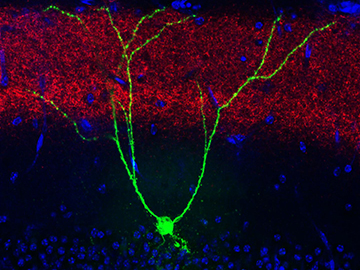
Image of a single memory engram cell in the hippocampal dentate gyrus region of a mouse model of early Alzheimer's disease. Credit: RIKEN
Researchers from the RIKEN-MIT Center for Neural Circuit Genetics, USA, report memory retrieval in mouse models of Alzheimer’s disease (AD) using optogenetics to identify and activate engram cells (Nature, doi: 10.1038/nature17172). In addition to temporarily restoring memory recall, the authors say, their procedure also seems to point a finger at impaired memory retrieval as being the source of memory loss for people with early-stage AD, rather than poor memory storage or encoding.
Digging into AD memory loss
It’s unclear what mechanisms in the brain cause memory loss in the early stages of AD—is it the result of faulty coding, or is it a recall problem? Using a mouse model of early AD, researchers led by Susumu Tonegawa say that it’s a retrieval problem, not a storage impairment problem. Specifically, they propose that a decrease in the number of dendritic spines—protrusions at the end of nerve cells that propagate electrochemical signals, which are essential for memory retrieval—brings about the kind of memory loss characteristic of AD.
The team’s recent optogenetic study focused on memory traces—engrams—in the dentate gyrus of the hippocampus in mice with Alzheimer’s-like memory loss. First, they optogenetically labeled nerve cells in the dentate gyrus so that they could identify the neurons in a specific engram from the light they emitted. A second optogenetic tag was added to nerve cells in the engram to make them sensitive to light, allowing the researchers to activate the engram with 473-nm light pulses via an implanted optical fiber.
Restoring memory with a light burst
The researchers observed that when these engrams in the AD-model mice were activated, the behavior linked to that specific engram was restored, but the effect faded within a day. When they examined the dendritic spines in these mice, they noted fewer dendritic spines. To increase the number of spines, the researchers exposed the engram to high-frequency bursts of light. The mice recovered their memory, and this time maintained recall for up to six days, leading and his colleagues to link memory loss to dendritic spine loss.
This work is an extension of the RIKEN-MIT group’s research on identifying and activating memory cells, similar to a recent study by a Geneva-based group that also used optogenetics to investigate the mechanisms that control neuron recruitment during memory formation in mouse models www.osa-opn.org/news/memoryformation.
