

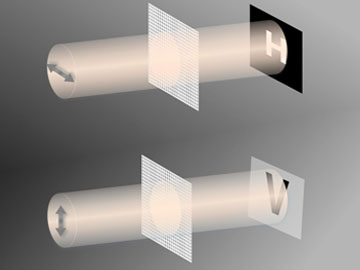
A new technique hides multiple images in a printed array of rods with varying conductivities. Depending on the polarization of the terahertz radiation impinging on the array, different concealed images appear, such as the letters H and V shown here. [Image: Ajay Nahata/University of Utah]
Need to make genuine documents easily distinguishable from their counterfeit doppelgängers? Just reach for the nearest inkjet printer. Thanks to an image-encoding technique developed at a U.S. university, it's now possible to print out hidden patterns that become visible only when placed in a beam of polarized terahertz light—all with a common piece of office equipment (Optica, doi:10.1364/OPTICA.3.001466).
The metasurface tells all
In 2014, University of Utah engineering professor Ajay Nahata and his colleagues demonstrated that an inkjet printer could fabricate metasurfaces, or horizontal arrays of plasmonic resonators. Metasurfaces are the two-dimensional version of metamaterials, and metasurfaces for optical holography are usually made of gold and silver. However, when the frequency of the impinging radiation is in the terahertz region, graphene and other semiconductors can wrangle plasmons as well.
Noble-metal plasmonic resonators require expensive, custom microfabrication techniques, while the humble inkjet printer can lay down ink with sufficient resolution—and with spatially varying electrical conductivity—to create subwavelength nanostructures.
Distinguishing the difference
In new experiments, Nahata and his team printed dipole arrays, with dimensions in the few hundreds of microns, onto clear plastic substrates. The printed dipoles looked identical to the naked eye, but contained varying proportions of silver and carbon inks. The researchers then measured the metasurfaces' responses to polarized radiation at 0.1, 0.15 and 0.3 THz.
The team then embedded random grayscale “quick-response” (QR) codes—the familiar two-dimensional smartphone-readable designs—into the same pattern. Under monochromatic illumination, a simple rectangular-dipole metasurface could distinguish among nine different levels of gray, while an array of more complicated patterns (cross-shaped resonators) could distinguish among 36 values. When the researchers designed a metasurface responsive to three different frequencies of light, with four distinct gray levels per channel, they produced an encoded image with 64 possible colors per pixel.
According to the researchers, the finer-resolution lithography process—or even a new generation of high-resolution printers—could scale up their method to optical frequencies and potentially even more security-related applications.
