

Saverio Bartalini / CNR
A new, sensitive spectroscopy instrument developed by researchers at the Istituto Nazionale di Ottica in Italy may someday enable on-site radiocarbon dioxide measurements down to a few parts per quadrillion, for applications including 14C dating and greenhouse gas measurements (Optica, doi: 10.1364/optica.3.000385). The instrument uses an approach called saturated-adsorption cavity ring-down (SCAR), which, the authors say, promises significantly faster results at nearly half the cost of standard radiocarbon dioxide detection methods.
Currently, researchers send samples for radiocarbon dioxide detection to one of a few large facilities that house an accelerator mass-spectrometer (AMS). From there, it can take a few weeks for technicians at the AMS facility to relay concentration values to the researchers. The new SCAR instrument is tabletop-sized—100 times smaller than an AMS—and uses a simple (and more affordable) heterodyne-spectroscopy system, a reference cell and a high-finesse cavity to measure radiocarbon dioxide concentrations.
How it works
Put simply, the SCAR instrument measures radiocarbon dioxide concentration by observing how laser light interacts with the gas produced when a sample is burned.
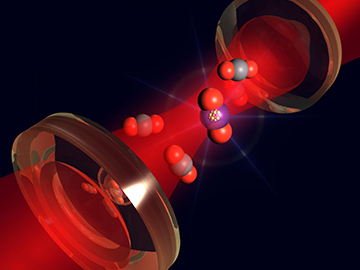
First, gas from the burned sample is placed in the instrument’s vacuum chamber. The gas is pulled into a meter-long Fabry-Pérot cavity cooled to 170 K. Here, the gas interacts with a laser beam from a quantum-cascade laser at 4.5 µm. Highly reflective mirrors at each end of the chamber lengthen the interaction path for the laser and gas from 1 m to 5.2 km. Because radiocarbon molecules in the gas absorb some of the laser light that bounces between the mirrors, the researchers can use the laser’s decay time to calculate the radiocarbon concentration in the gas sample.
The researchers conducted several runs of a sample of known composition to test the repeatability and precision of the SCAR instrument. Their results show that the instrument can measure radiocarbon dioxide concentrations with 0.4 percent precision in two hours—close to the 0.2 percent precision of AMS facilities, but in much less time.
Environmental monitoring and radiocarbon dating
The SCAR instrument can distinguish between naturally occurring carbon dioxide and carbon dioxide produced by burning fossil fuels, making it a likely tool for monitoring air pollution. And the instrument’s portability (relative to AMS facilities) makes it potentially useful to archeologists who want to date fossils without having to leave the excavation site.
The authors say further developments could result in an even smaller, even more portable commercial prototype. Giovanni Giusfredi, a coauthor of the Optica paper, says: “In principle, we can detect many other molecules, such as methane, nitrous oxide and other greenhouse gases or chemicals of interest for national security or forensics.”
