

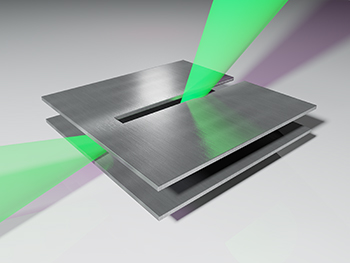
A parallel-plate waveguide works as a mux/demux device for multiple-frequency channels of Thz radiation (green). Credit: Mittleman Lab / Brown University
Terahertz frequency components and systems for future free-space wireless broadband communications has been a topic of growing interest for its potential to alleviate the crowded microwave and optical part of the spectrum. Engineers at Rice University (USA) and University of Tokyo in Japan have developed a critical component for terahertz networks—a metal parallel-plate waveguide that acts as a leaky-wave antenna for multiplexing and demultiplexing (mux/demux) of terahertz signals between 0.1 to 1.0 THz (Nat. Phot., doi:10.1038/nphoton.2015.176).
Like existing cellular and Wi-Fi networks, any future communications network will provide increased capacity by multiplexing the signal—sending independent signals in separate non-interfering streams down the same channel. OSA Fellow Daniel Mittleman, professor of electrical and computer engineering at Rice, and his group (now at Brown University) demonstrated frequency-division mux/demux over more than an octave of bandwidth, using a leaky-wave antenna architecture well-known to RF engineers but new to THz.
The parallel-plate waveguide has two open sides that reduce ohmic losses, and at 5 cm x 5 mm, is wide enough so that the edges do not interfere with wave propagation. A single 1-mm slot in one of the plates allows energy to “leak” into and out of free space at an angle matching the correct phase for coupling between the waveguide and free space. The muxed/demuxed signal can contain multiple frequencies, which each emerge at a unique angle, depending on its frequency and the plate separation. Those frequencies can then be intercepted by receivers placed at the right angles.
The terahertz mux/demux device is only a first-generation proof-of-concept as of yet, says the team, but they hope to test it in a prototype terahertz network soon. Such a terahertz network could deliver data rates up to one hundred times faster than today’s broadband and WiFi networks.
