

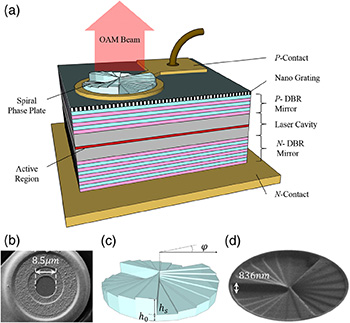
(a) Schematic of the VCSEL device; (b) SEM image of the VCSEL aperture without the added spiral phase plate (SPP); (c) modeled stepped geometry of the SPP; (d) SEM image of fabricated SPP. [Image: Li et al., Optica, doi: 10.1364/OPTICA.2.000547 (2015)]
A research team from China and the United Kingdom has devised a way to generate beams carrying orbital angular momentum (OAM)—so called twisted light—from a low-cost semiconductor laser (Optica, doi: 10.1364/OPTICA.2.000547). The scientists believe that the technique could open a window to new, compact and low-cost devices that could aid in quantum key distribution, optical communications, and other applications.
OAM-bearing light has long intrigued researchers as a possible additional multiplexing variable to expand capacity in increasingly crowded optical communication networks. One sticking point for wide use, however, lies in getting an appropriately shaped, OAM-carrying beam at reasonable cost and size. While OAM beams can be generated easily with bulk components, such as spatial light modulators, that are common in optical labs, miniaturizing this approach to the compact, cost-effective scale required for efficient beam generation in large-scale communications and other production settings has proved elusive.
To overcome that hurdle, the research team—led by Siyuan Yu of Sun Yat-sen University, Guangzhou, China, and the University of Bristol, U.K.—turned to a different approach: directly modifying a popular low-cost light source, the vertical-cavity surface-emitting laser (VCSEL), to churn out OAM-carrying beams. As semiconductor-based devices, VCSELs are highly compact, and can generate very efficient, circularly symmetric beams at low cost.
To turn those linearly polarized, Gaussian beams into twisted-light output, the team fashioned a tiny spiral phase plate (SPP) by depositing a 1- μm-thick nitride film atop the VCSEL’s 8.5-μm-diameter, and then writing the SPP’s stepped geometry into the film using focused-ion-beam etching. The resulting beam from the modified VCSEL showed the specific OAM modes that had been predicted in the team’s modeling of the structure, demonstrating that the Gaussian beam had been shaped into one carrying OAM information.
Moreover, the team showed that, by designing composite SPPs, they could create concentric beams from the VCSEL that carried “a superposition of multiple well-defined OAM states”—a key strength of the approach, in the view of the scientists, for practical applications such as quantum communications and OAM-multiplexed, high-capacity optical communications. The researchers believe that the method should be scalable to low-cost wafer manufacturing, and could prove particularly useful in short-reach data interconnects and quantum key distribution.
