

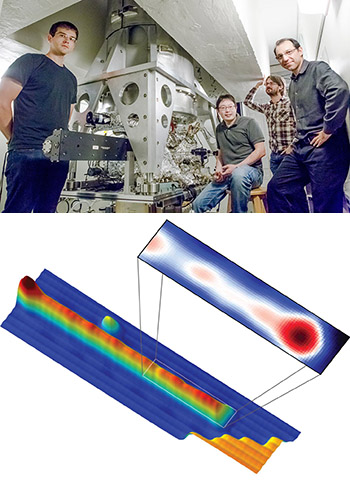
(Top) Grad student Ilya Drozdov, postdoc Sangjun Jeon, and professors B. Andrei Bernevig and Ali Yazdani. Credit: Photo by Denise Applewhite, Princeton University Office of Communications. (Bottom) The zoomed-in image depicts the quantum probability of the wire containing a Majorana fermion at the end of the wire. Credit: Yazdani Lab, Princeton University.
Researchers from Princeton University and the University of Texas-Austin, USA, have observed Majorana fermions using scanning-tunneling microscopy and a one-atom-wide iron wire on a lead crystal (Science, doi: 10.1126/science.1259327). Majorana fermions are interesting to the scientific community because the particles act as their own antiparticles, making them difficult to detect and potentially useful for quantum computing. They are also considered a “candidate” for the particles that make up dark matter.
To isolate and identify Majorana fermions, Ali Yazdani and his colleagues started with a lead crystal with atom-width ridges on its surface. Along one of these ridges, they deposited iron—one atom wide and three atoms thick—to create a wire. A magnetic field exists only on the iron wire, and combined with the superconducting lead crystal, creates a topological superconductor. Previous calculations and research have predicted that this type of matter will host spatially separated Majorana fermions that appear at each end of the wire.
After placing the crystal with its iron wire under a scanning-tunneling microscope, it was cooled to one degree above absolute zero to prevent vibration that would disturb the scientists’ observations. The researchers were able to detect a Majorana fermion at each end of the wire. The particles—matter and antimatter—did not annihilate each other. It’s this stability that makes Majorana fermions potential sources of “fault tolerant” qubits for quantum computing and potential ingredients for dark matter.
Although the scanning tunneling setup is complex, the materials used in this approach are easy-to-obtain iron and lead. The authors hope these simple ingredients will make it easy for other research groups to reproduce their findings. In the future, their system could serve as a platform for experiments on manipulating Majorana fermions.
