

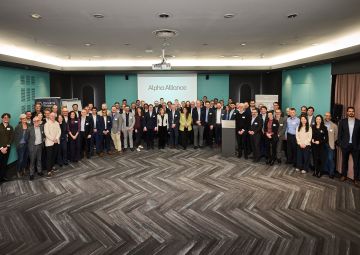
Members of the Alpha Alliance. [Image: Fabian Vogl/Proxima Fusion]
Europe’s ambition to turn fusion from world-class research into deployable power plants took a step forward in late February with the launch of the Alpha Alliance. The group brings together more than 30 international companies to deliver Alpha, a net-energy-gain fusion demonstrator based on stellarator technology to be built in Garching, Germany, by the early 2030s.
A stellarator is a magnetic-confinement fusion device that uses complex, three-dimensional magnetic fields (shaped by external coils) to confine and stabilize the hot plasma required for fusion. Unlike tokamaks, which typically depend on a strong plasma current to generate part of the confining field, stellarators are often positioned as a route to steady-state operation, although their coil geometry and engineering are demanding and costly.
The Alliance is coordinated by Munich-based startup Proxima Fusion, which has framed the collaboration as a manufacturing and supply-chain coordination effort; in other words, the goal is not just better physics, but building the industrial capability to fabricate, validate and assemble the specialized components required for large fusion hardware.
Proxima’s published member list includes major industrial names such as TRUMPF, Siemens Energy, Air Liquide, Thales, Framatome, Eni, RWE Nuclear, Pfeiffer Vacuum and TÜV Rheinland, spanning precision fabrication, vacuum systems, plant engineering and certification.
If Proxima and its partners can turn the alliance into delivered components and an operating demonstrator, Alpha could become a template for how Europe industrializes fusion.
The announcement is accompanied by a public–private push in the German region of Bavaria. Proxima Fusion has signed an agreement with the Free State of Bavaria, the Max Planck Institute for Plasma Physics (IPP) and German energy utility RWE that positions Alpha as the next major development step in the Alliance’s “two-step” roadmap. The first step would be to construct and operate the demonstration stellarator near Munich; then progress toward a longer-term commercial facility called Stellaris, a proposed fusion power-plant concept. The aim is to create a practical bridge from leading fusion research to delivered hardware and Bavaria, RWE and Proxima have discussed siting Stellaris at Gundremmingen, a former nuclear power plant location.
In communications around the partnership, an overall budget of around €2 billion has been cited for the Alpha project. The Financial Times reported that Bavaria has pledged €400 million toward the project, with additional funding expected from private investors and the German federal government.
If Proxima and its partners can turn the alliance into delivered components and an operating demonstrator, Alpha could become a template for how Europe industrializes fusion. The next step is securing the remaining funding and turning “alignment” into hardware, delivered on schedule and at scale.
