

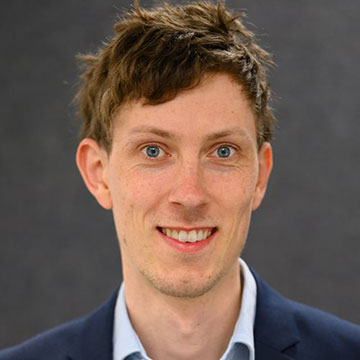
Falko Schmidt
In the latest installment of Journeys in Optics, OPN speaks with with Falko Schmidt, a senior researcher at Leipzig University, Germany, and cofounder of Lucero Bio. Falko was a 2023 Optica Ambassador. Falko talks about cofounding a startup while pursuing his Ph.D., his career trajectory and promoting sustainability in the lab.
What inspired you to specialize in active matter and optofluidic manipulation of nanoscale systems?
I have always been fascinated by creating materials from simple building blocks in imaginative ways that give them a specific functionality. As a child, that meant Lego race cars. Later, it became my research on microscopic matter built from colloidal particles, where I created miniature versions of heat engines or even self-propulsive colloidal molecules.
That first glimpse of motion under the microscope was my “aha” moment. I realized I could design tiny systems that could mimic natural processes. From there, the field of active matter became my natural playground—a place where physics, biology and engineering all meet. I was drawn to its possibilities: materials that can heal themselves, synthetic muscles that actuate upon external stimuli, or microscopic agents that can navigate complex environments without human guidance.
But I also learned that without the right tools that can simultaneously supply energy and enable precise control, these ideas would have remained only theoretical concepts. That understanding guided me toward using light as a tool, not just as a way to see these systems evolve, but as a way to interact with matter. By shaping the surrounding fluid environment with optical tools, I could guide their behavior in ways that unlocked entirely new material functionalities. In a recent publication, we showed just how powerful such an optofluidic toolbox can be, not only for advancing synthetic systems, but also for giving biologists and chemists new ways to control environments at the nanoscale.
Looking back, my academic journey hasn’t been as straightforward as it might appear. Rather, it has followed the flow of unexpected ideas nudging me into uncharted territory, much like my optofluidic tools gently steer the active matter systems I study. One of those unexpected turns came when that curiosity for new tools and real-world applications carried my work beyond the lab and into the world of entrepreneurship.
Suddenly, we weren’t just studying cells—we could automate the preparation of well plates filled with miniature organ models, something notoriously difficult to achieve for pharmaceutical companies.
Can you discuss cofounding your startup Lucero Bio while completing your Ph.D.?
Even while doing fundamental research, I knew I wanted my work to reach beyond the lab and become something that could change how an industry operates. That’s why I cofounded Lucero Bio with a colleague at the University of Gothenburg, Sweden. We began with a simple idea: automate the use of optical tweezers, a technique I had relied on extensively during my Ph.D., for aging studies in cells.
Like many entrepreneurial adventures, it didn’t go exactly as planned. Once we built a diverse team of researchers and business minds, together we discovered something even bigger. By combining optical tweezers with machine learning and integrating them into microfluidic systems, we had a platform that could transform pharmaceutical workflows.
Suddenly, we weren’t just studying cells—we could automate the preparation of well plates filled with miniature organ models, something notoriously difficult to achieve for pharmaceutical companies. Our system could identify, move and isolate viable organoids into individual wells, enabling them to test new compounds more quickly, accurately and cost-effectively.
For me, the most valuable part of this journey wasn’t just the technology, but the shift in perspective it demanded. We moved from a “core-technology first” mindset to a “customer-problem first” mindset. That lesson—to start with the problem, not just the tool—has reshaped how I approached my Ph.D. research as well. Now, my first question is always: Who will this help, and how will it be used?
You’ve worked as a research coordinator and cofounded a company, and now you’re a postdoctoral researcher—how have these roles differed? Do you see your career as following an academic or industry trajectory?
I have deliberately explored different career tracks because I wanted to understand not only how my work could help others, but also which path would let me contribute most meaningfully. Each role I’ve had has offered a unique perspective on how I could make such a contribution.
As a research coordinator, I learned how companies, universities and political stakeholders think and how to bring them together in a collaborative environment that makes a project succeed. In a startup, the focus shifts: You’re finding your place in the market, building partnerships and turning an idea into a practical solution. As a researcher, your energy goes into pushing the boundaries of knowledge and developing cutting-edge methods that open entirely new possibilities.
From those experiences, I realized I wanted to be at the forefront of innovation through an academic path—but with a holistic approach to how I do science. I’m excited to keep exploring the fundamental physical principles of materials that can form the basis for the next generation of transformative technologies. At the same time, teaching and mentoring allows me to share knowledge with the next generation of professionals, equipping them with the right tool sets and skills to make their own impactful contributions to society.
If your home institution doesn’t offer career events, conferences organized by scientific societies can be an incredible resource.
Can you talk about founding the Optica student chapter at Gothenburg University?
Exploring different career tracks was not an easy choice, and not knowing what’s out there can stop us from even taking the first steps. That is why a group of us Ph.D. students began organizing informal lunchtime events. We invited professionals from very different career paths to share their own journeys, their career choices and the lessons they learned along the way. Those conversation gave us, and many others, a much clearer picture of the possibilities beyond academia.
The response was so positive that we wanted to take it further, creating more focused opportunities for students. That’s how the Optica student chapter was founded—as a space where optics and photonics students could connect, learn from experts and explore career options they might never have considered otherwise, but also socialize with others over pizza.
How have professional societies and community influenced your professional growth?
If your home institution doesn’t offer career events, conferences organized by scientific societies can be an incredible resource. They have been that for me; not only as a place to share my research, but also as a forum to exchange ideas and connect with people tackling similar challenges. I’ve attended several career sessions for early-career researchers and always come away inspired and energized.
These meetings aren’t just about science in the narrow sense, they’re also where important conversations happen about how we do science. For me, topics like open science and laboratory sustainability are deeply important, and they need exactly this kind of community engagement to make progress. Being part of these societies has shown me that growth isn’t only about advancing your own work, it’s also about contributing to a culture that will help everyone move forward.
What advice do you typically share with early-career researchers during webinars like “From Ph.D. to CEO?”
There are a few key lessons I often share from my own experience starting a company. First, build a team with diverse skills, perspectives and backgrounds. That diversity creates a balanced, supportive environment, which becomes essential when you inevitably encounter the next challenge. Second, manage conflicts proactively by setting clear personal and professional expectations from the start.
But the most important lesson is about mindset. As researchers, we are often driven by our methods, focused on advancing knowledge that might, someday, be adopted by industry. As the CEO of a company you’ve founded, you’re suddenly in the driver’s seat. You can take the tools and insights you’ve developed and apply them directly to solving real-world problems, accelerating that transition to impact.
This mindset isn’t limited to for-profit ventures. The same approach can empower nonprofits tackling societal challenges. The core idea is the same: You have the power to steer your work toward meaningful change, rather than waiting for someone else to make it happen.
You were nominated as a My Green Lab ambassador. Can you share a few practices you’ve implemented to promote sustainability in the lab?
I usually start with simple, high-impact changes that anyone can make: turning off devices when they’re not in use, switching to greener chemicals, placing collective orders to reduce packaging, and sharing equipment within the department. These steps are straightforward, but the real challenge is encouraging the whole lab to adopt them.
Not everyone is equally aware of the urgency to reach net-zero goals by the end of the decade. For some, change feels natural; for others, it takes convincing. One example I often share is ultra-low temperature freezers. Today, −80°C is standard, but just a couple of decades ago most operated at −70°C with no harm to sample preservation. Raising them back up can save up to 30% of their energy use, which is roughly the annual consumption of 2.5 four-person households. That’s a huge impact from a single adjustment.
I’ve found that people are far more willing to make changes when there’s clear scientific evidence behind them. That’s why, as a My Green Lab ambassador, I focus on building awareness and making incremental, evidence-backed improvements that help laboratories to reduce their environmental footprint.
How do you manage to maintain a work–life balance and why is that important to you?
Many people view work–life balance as a strict separation between professional duties and personal time, which makes sense. But for those of us who are passionate about science, the boundaries are often more fluid—we willingly spend long hours in the lab or thinking about experiments, even while recognizing the less enjoyable parts of the job. For me, work–life balance isn’t just about hours; it’s about managing the mix of things I love doing and the tasks I have to get done, so both can be sustainable and productive.
My advice is simple: Take time off when you need it. If you push through when you’re exhausted, you’ll rarely produce your best work, and you might just have to redo it later. I personally take short walks in the park near the university to clear my head before continuing writing a grant application or starting a new experiment.
In the end, you’ll know what you need when you start listening to yourself instead of simply following other people’s advice—including mine.
