

It is difficult to believe that lasers have been around for so long. As a theorist who uses lasers for optical imaging, I often reflect on a keynote talk given by 1964 Nobel laureate in Physics Charles H. Townes at Georgia Tech about two decades ago. Townes had been asked to speak at the event to mark the establishment of two endowed chairs in optics, and I had the honor of holding one of those chairs, in electro-optics.
Although many years have passed, something he said that day has stayed with me. Townes and his team had the rare freedom to explore an idea without knowing exactly where it would lead. They were not setting out to create a particular product or solve a narrowly defined problem. They were following the science.
Today, no matter where you work, obtaining research funding almost always requires the researcher to identify a problem to solve or have an application or end product in mind. If this had been the environment at the time when the laser was invented, I wonder how different our world might look. Townes’ story is a reminder that we should always leave room for curiosity.
That spirit of exploration comes through in this month’s feature marking 50 years of the excimer laser. A technology developed decades ago has found its way into semiconductor manufacturing, medicine and many other applications.
Another article in this issue takes me back to a much earlier source of curiosity. When people asked early in my career why I had chosen to study optical turbulence and imaging, I would respond, “I want to understand the twinkling of the stars.”
So I was especially interested in our feature on the dark-skies movement, which traces its roots to Flagstaff 25 years ago. Preventing light pollution may begin with our desire to see the stars, but its implications extend far beyond that—to astronomy, wildlife, energy use and even the way we illuminate our cities.
These two stories may seem unconnected but, to me, they share an important message: Discovery often begins with curiosity—asking why something happens or what may be possible, without knowing exactly where the answer will lead.
We need to keep that curiosity alive and continue giving scientists the freedom to follow unexpected paths and push the boundaries of what we know.
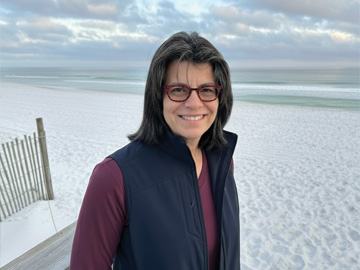
—Gisele Bennett,
Optica President
