

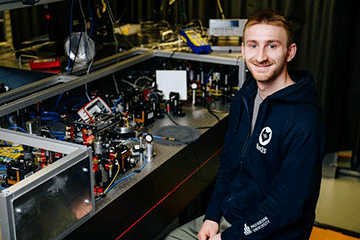
Paderborn University physicist Timon Schapeler was part of the research team that developed the new approach, which extends photon counting to larger numbers of photons. [Besim Mazhiqi, Paderborn University]
How many photons can a photon counter count? The question might sound like a riddle, but in quantum optics experiments, most single-photon detectors can only register the presence or absence of photons without tallying them.
Now, researchers based in Germany have figured out how to make a precise count of individual photons, from zero to more than 9,000 (Optica, doi:10.1364/OPTICA.604389). Their technique uses both spatial and temporal multiplexing to feed a single light pulse through eight superconducting nanowire single-photon detectors (SNSPDs) into 1,024 separate detection channels. A conventional multiplexed system would need about 37,000 detector elements to achieve the same precision.
“Our approach extends photon counting to larger numbers of photons, bridging the gap between single-photon measurements and high-sensitivity optical power meters,” Timon Schapeler, Paderborn University, said in a statement.
Bridging the gap, reducing the noise
Previously, some scientists have tried multiplexing single-photon detectors, which would work over an infinite number of pixels. In the real world, however, statistical noise gets in the way of enumerating photons. Other devices, such as transition edge sensors and photodiodes, get saturated easily—the former by as few as 20 photons.
In its experiments, the Paderborn team fed a single laser pulse into a temporal multiplexer network of beam splitters and optical-fiber delay lines, thus splitting the light evenly into 256 sub-pulses. Next, a spatial multiplexing system divided each of the 256 sub-pulses into four spatial bins for a total of 1,024 channels. “This enables precise measurements, while multiplexing expands the range of photon numbers the system can measure,” said Tim Bartley of their methods.
The original laser pulses going into the experimental setup consisted of anywhere between 1 and 15,000 photons to give the scientists an idea of the precision of the technique. A mathematical model of each detector element helped them understand the system’s response.
“We wanted to know how high we can push the number of photons that can be counted with SNSPDs,” said Schapeler. “This led to a detector system that uses multiplexing and the intrinsic photon-number resolution of SNSPDs. Although these technologies have been individually studied, there has not previously been a demonstration of using both approaches together at this scale, which is an order of magnitude larger than previous multiplexed single-photon counting systems.”
Counting more photons
The researchers were able to count up to 276 photons with measurement uncertainties of less than one photon. Other recent efforts have tallied only 8 to roughly 100 photons with that level of uncertainty.
While the experiments counted photons precisely, certain detector imperfections still limit the accuracy of the results. However, the research group plans to expand its efforts to other bright quantum states of light, not just laser pulses, and to use improved SNSPDs as they become available.
