

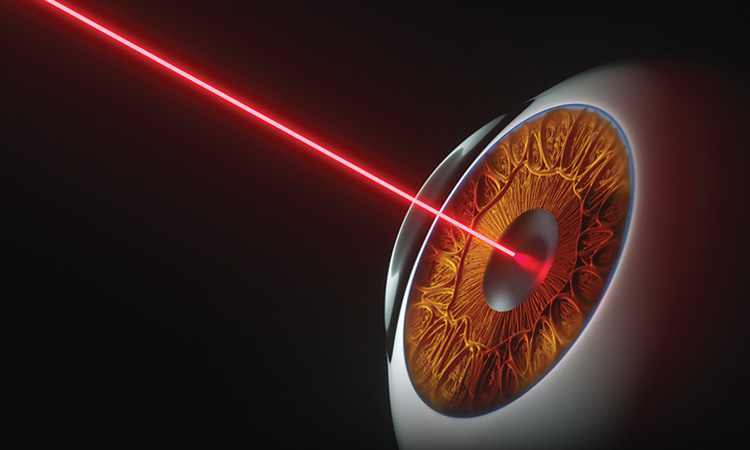
 3D-rendered illustration of a laser scanning of the human eye. [S. Myshkovsky / Getty Images]
When they were first demonstrated in 1975, excimer lasers filled an important gap in the laser spectrum: a gas laser able to deliver brief, high-power pulses at short wavelengths. After 50 years, excimer lasers are still at work delivering precise ultraviolet pulses to sharpen people’s vision and their smartphone screens, with more to come.
By the early 1970s, the absence of high-power lasers at short wavelengths from blue to the vacuum ultraviolet had become obvious. Carbon monoxide, carbon dioxide and chemical lasers could deliver high power, but only in the infrared. Developers of high-energy lasers for military use and for inertial fusion wanted higher-energy photons. Among the many ideas considered was a 1960 proposal by German-Swiss physicist Fritz Houtermans: forming diatomic molecules, or dimers, in states that remained excited until they dropped into the ground state where they almost instantly fell apart, releasing a high-energy photon. Could dumping the transition energy straight through the ground state deliver a powerful pulse of high-energy laser photons?
When they were first demonstrated in 1975, excimer lasers filled an important gap in the laser spectrum: a gas laser able to deliver brief, high-power pulses at short wavelengths.
That was a big question when J.J. Ewing arrived at the Avco Everett Research Laboratory near Boston, MA, USA, in 1972. At the time, the most powerful and efficient lasers were gas lasers powered by electron beam systems, electric discharges or chemical reactions emitting at 3 to 10 µm. Avco Everett, founded in 1955, was a leader in gas dynamics and had recently invented the gas-dynamic carbon dioxide laser used in laser-weapon tests.
At a 1974 chemical laser conference in St. Louis, MO, USA, Ewing’s Avco colleague Charlie Brau saw Setser show spectra of two dimers, one containing two atoms of the rare gas xenon and another containing one atom of xenon and one atom of the halide chlorine. Setser’s results puzzled Ewing. “Why on Earth were Xe2 dimers emitting at 170 nm while xenon chloride was emitting at 300 nm if they are the same kind of molecules?”
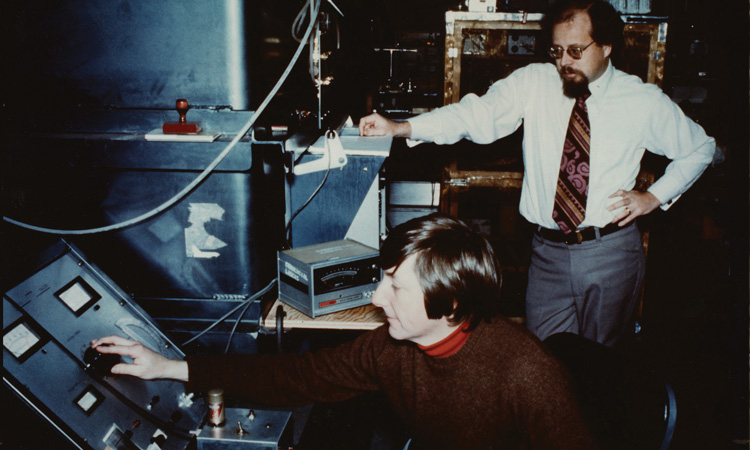 J.J. Ewing (right) and Charlie Brau in 1975 experimenting with early excimer lasers at the AVCO Everett Research Laboratory in Everett, MA, USA. [Courtesy of C. Brau and AVCO Research / Textron Systems]
The answer, Ewing says, was “The chemistry of rare-gas halides is weird.” Xenon dimers bind as Xe2 in an excited state that lasts a few tens of nanoseconds, then radiate a vacuum-ultraviolet (VUV) photon and dropping to a ground state that lasts only a small fraction of a nanosecond before falling apart. Setser’s spectra suggested that a mixed dimer like XeCl should dissociate at the same extreme speed as Xe2 or Kr2. Yet the rare-gas halide emitted at a much longer wavelength. Why should the difference of only one electron between the xenon dimer and the rare-gas halide make such a large wavelength difference in their emission? It turned out that the rare-gas halides essentially lacked a significant ground state, reducing loss on the laser transition and making them exceptionally efficient lasers that came to be called “excimers.”
Meanwhile, other groups charged ahead with their own studies of rare-gas-halide excimers. Among the first to get rare-gas-halide laser action were S.K. Searles and G.A. Hart, who used an electron-beam generator at the US Naval Research Laboratory (NRL) to lase xenon bromide around 1 May 1975—a bit of luck, because XeBr is inefficient. Ewing and Brau rebuilt their system to increase its power and succeeded in lasing xenon fluoride about 15 May, and xenon chloride, which was less efficient, about a week later. Krypton fluoride produced the brightest fluorescence, but their 248-nm mirrors were not efficient, so it took them until about 5 June to make KrF lase. Using a 7.7-KJ electron-beam generator at Sandia National Laboratories, A. Kay Hays and G.C. Tisone later raised KrF pulse energy by a factor of 20 and demonstrated the first 193.3-nm argon fluoride laser.
From e-beams to practical lasers
Electron-beam pumping produced big excimer pulses, but it came at a high cost. Lambda Physik cofounder Dirk Basting called e-beam machines “huge, expensive and troublesome.” One lab had to knock down an outside wall to install a new e-beam machine for excimer experiments. More-practical pump sources were needed.
In early September 1975, Ralph Burnham and Nick Djeu at NRL found a prospect: a discharge-pumped transversely excited atmospheric-pressure (TEA) CO2 laser made by a small company called Tachisto. By replacing the original discharge electrodes with band-saw blades and filling the laser cavity with a xenon fluoride mix, they produced XeF emission at 351 nm. Switching to better electrodes and ultraviolet pre-ionization boosted XeF efficiency to 1%. Hundred-millijoule pulses and multimegawatt peak power followed in XeF, KrF and ArF. Achieving avalanche discharge pumping “was a very, very significant thing” in developing practical excimer lasers, says Ewing.
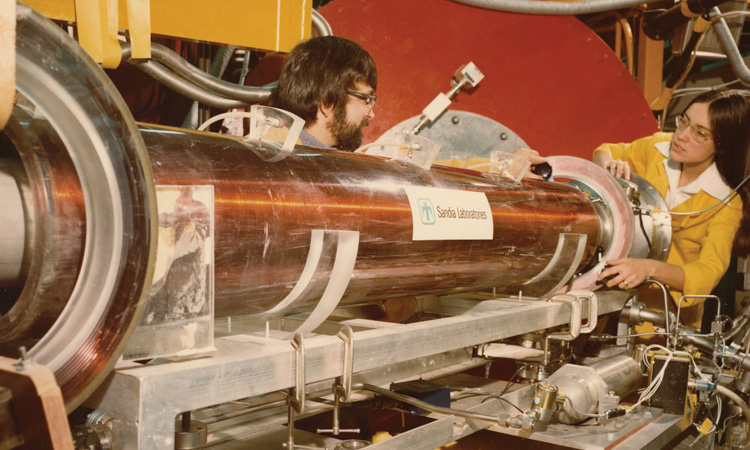 A. Kay Hays (right) and G.C. Tisone with the electron-beam generator at Sandia National Laboratories where they demonstrated the first 193.3-nm argon-fluoride laser and a 20-fold increase in power of krypton-fluoride laser pulses. [Sandia National Laboratories]
Modifying Tachisto’s CO2 discharge lasers to excite rare-gas-halide lasers gave spectroscopists the chance to pump dye lasers with higher ultraviolet powers than ever had been available. Ewing says Tachisto sold about a hundred of its discharge-powered excimer lasers to eager spectroscopists. However, Basting and Bernd Steyer, who had launched Lambda Physik to sell tunable dye lasers and nitrogen pumps, shifted gears and adapted their discharge-pumped nitrogen lasers to operate at higher power with excimer lasers. By 1977, Lambda was selling an excimer laser that could fire KrF pulses with energies above 220 mJ, along with a dye laser to pump with it.
By 1980, excimer lasers were products offered by companies including Tachisto, Lambda Physik, Lumonics and Oxford Lasers. The 1980 Laser Focus Buyer’s Guide listed excimer prices around US$20,000, equivalent to about US$80,000 in 2026 dollars. The magazine’s January 1981 issue estimated 1980 sales of excimer lasers around US$3.6 million, suggesting that nearly 200 lasers were sold that year. Not bad for a newcomer to the market.
Like most newly discovered lasers, excimers were first used in research. Their ultraviolet pulses pumped dye lasers to widen the spectrum and deliver more power for spectroscopy. Excimer lasers were scaled up to pump dye lasers that could be tuned to the precise wavelengths needed to separate uranium isotopes to fuel nuclear reactors in experiments at the Lawrence Livermore National Laboratory. NRL built a big krypton fluoride laser to test how its 248-nm pulses could compress hydrogen isotopes for laser fusion. Various types of excimers were at work in laboratories around the world.
Reshaping vision with UV pulses
The first step toward using excimers to reshape eyes came at a meeting on photochemistry sponsored by the North Atlantic Treaty Organization (NATO), where Basting met Rangaswamy Srinivasan, a research fellow at the IBM Watson Research Center in Yorktown Heights, NY, USA. Srinivasan was interested in ultraviolet effects on materials, and their discussion led to Basting shipping him an excimer laser.
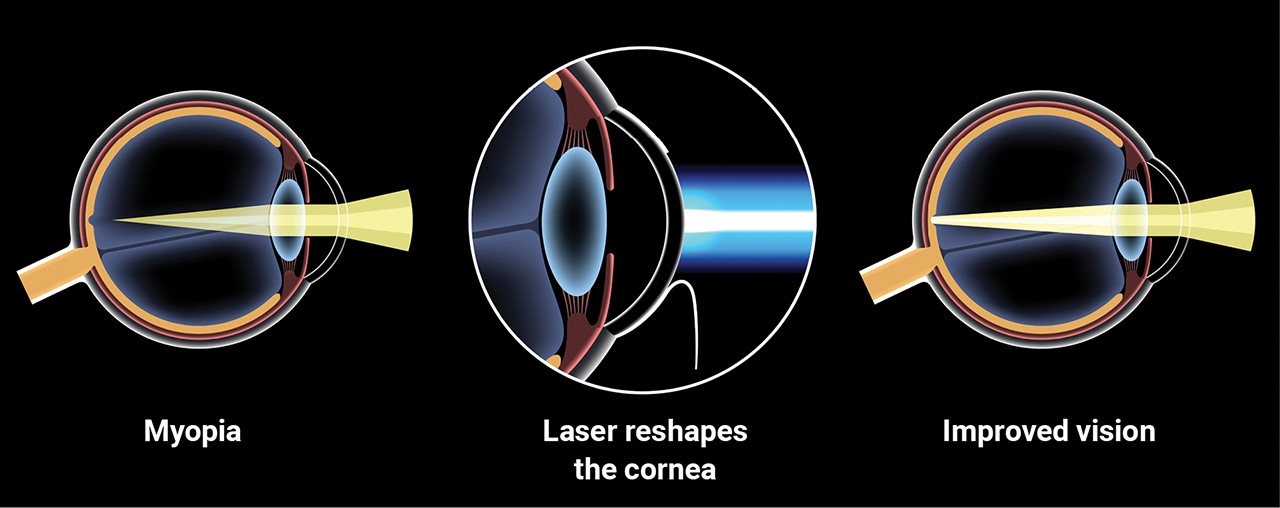 [Enlarge image]How excimer lasers reshape the cornea to improve vision. Left: Light (yellow) in a myopic eye focuses at a point in front of the retina at back. Center: The white beam from an excimer laser ablates a thin layer from the surface of the cornea. Right: The reshaped lens focuses light (yellow) onto the retina, correcting patients’ myopia so they no longer need spectacles. [Pikovit44 / Getty Images]
The experiment that started Srinivasan’s interest in eye surgery came the day after Thanksgiving in 1981, when he brought leftover turkey to work to test with the laser. Zapping the leftovers with 10-ns pulses from the 193-nm ArF laser left a very clean, knifelike incision. When his colleague James J. Wynne fired 10-ns pulses from a 532-nm Nd:YAG laser for comparison, the longer wavelength burned the tissue.
At CLEO in 1983, Wynne reported that the ArF pulses cleanly sliced tissue that the longer wavelength charred. That caught the ear of Stephen Trokel, an ophthalmologist at Columbia University’s Harkness Eye Institute, who thought clean cuts might be used for refractive surgery. After Trokel tested the laser on live rabbits in November 1983, he and another Columbia ophthalmologist, Francis L’Esperance, separately developed different approaches to excimer-based refractive surgery.
Trokel’s approach helped lead to laser-assisted in situ keratomileusis, or Lasik, in which a knife or laser tool first opens a flap in the cornea, which is folded back to expose the underlying stroma. Then the ArF laser ablates the surface to the desired shape, and the flap is replaced. L’Esperance patented photorefractive keratectomy (PRK), in which the epithelium, or surface layer, is removed, the cornea reshaped with the ArF laser, and the remaining corneal surface heals.
The photolithographic fabrication of electronic circuits has become a major application for excimer lasers.
Developing and testing the delicate surgery and addressing concerns about laser exposure to the eye took years to meet requirements of the US Food and Drug Administration (FDA), which approved PRK in 1995 and Lasik in 1999. The procedures remove little tissue from the eye and can correct myopia, or nearsightedness; hyperopia, or farsightedness; and astigmatism. Tens of millions of people have had refractive surgery since the procedures were approved, and excimers remain widely used for refractive surgery.
Etching Moore’s law in UV light
The photolithographic fabrication of electronic circuits has become a major application for excimer lasers. The process started with arc lamps illuminating step-and-repeat cameras that exposed photoresist on the silicon, which was then etched away to form the integrated circuit. The mercury lamps used in the early 1980s emitted on the 436- nm g line, with resolution of 1 µm. When industry wanted to fit more transistors onto chips, they moved to the 365-nm ultraviolet mercury i line, which had 0.5- µm resolution.
Kanti Jain at the IBM Almaden Research Center recognized the potential of the shorter wavelengths of excimer lasers and began testing them in 1980. His big concern was whether laser speckle would blur the image on the photoresist. In 1982, he reported both 308-nm XeCl and 248-nm KrF lasers had low coherence that would allow resolution below 1 µm.
Developers targeting the semiconductor industry picked KrF lasers because of their shorter 248-nm wavelength and higher average power, pulse rate and efficiency. Development was slow, and the first commercial excimer-laser photolithography systems were introduced in 1994.
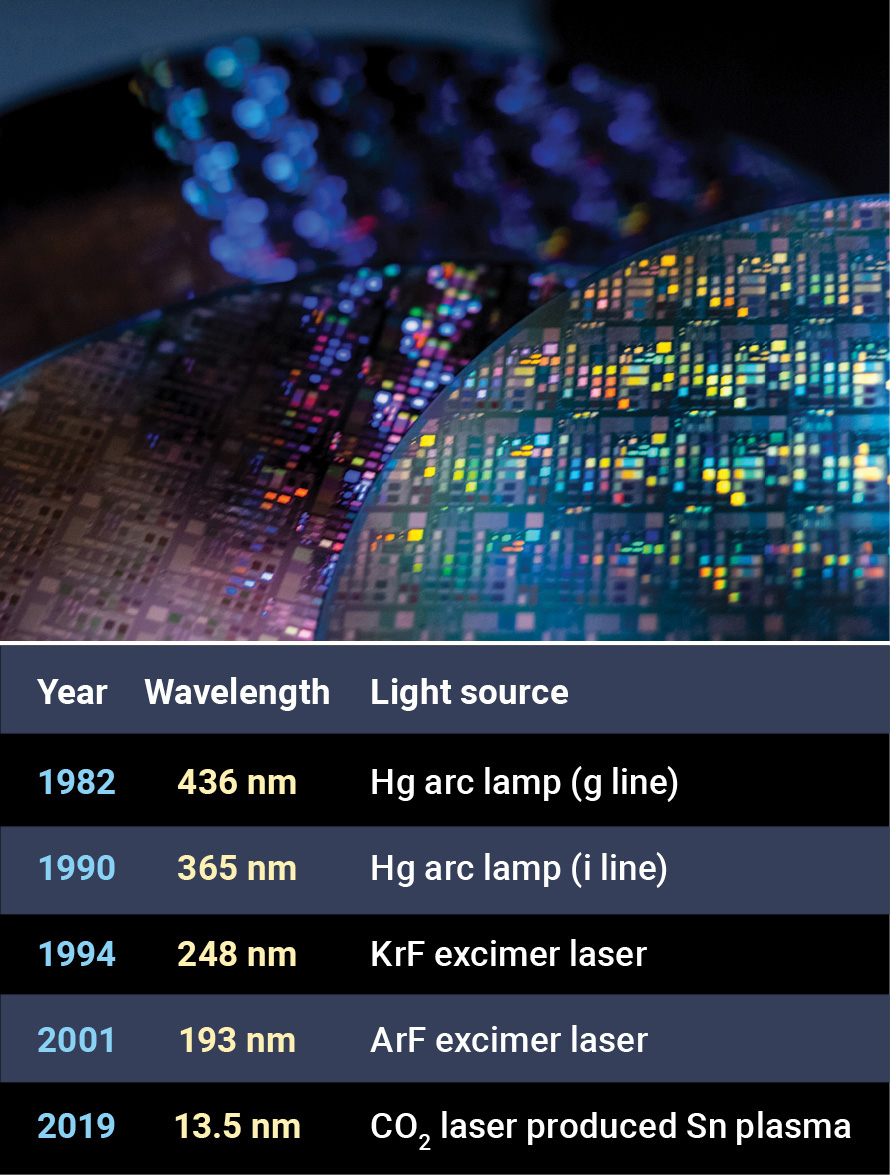 [Enlarge image]How wavelengths used for semiconductor photolithography changed over the years, starting with mercury arc lamps in 1982 and reaching the 13.5-nm tin plasma introduced in 2019. [Table by J. Hecht / Photo by N. Cooper, Getty Images]
The sophisticated excimer lasers used in photolithography systems were expensive and the systems more so. But the internet was booming, pushing the semiconductor industry for more-powerful chips. A January 1997 story in Laser Focus World reported sales of more than 150 KrF-laser photolithography systems in 1996—double the previous year—at prices averaging circa US$400,000, equivalent to about US$850,000 today. The semiconductor industry was already thinking of how to feed Moore’s law with a new generation of photolithography that could double the number of transistors on a chip every two years.
The next advance came with the 193-nm emission line of the argon fluoride laser. Initially, the efficiency and output power of ArF excimers were below those of KrF. New optical materials were needed for the shorter wavelength optics. Nonetheless, the new generation of ArF excimer fabrication systems reached the market in 2001. Then the next challenge was to build the next generation of photolithography chips to sustain Moore’s Law, steaming ahead with only a minimal increase in cost.
Pushing optical lithography to its limit
The 193-nm ArF line is the shortest wavelength possible for any rare-gas halide laser. Developers had high hopes for photolithography with molecular fluorine (F2), a diatomic molecule with physical properties similar to the rare-gas halides and strong laser emission at 157 nm.
They knew the compound’s extreme reactivity could make it a troublemaker, but the showstopper was the lack of optical materials usable for lenses in a 157-nm system. Engineers at the Dutch lithography-machine manufacturer ASML initially considered calcium fluoride lenses to be “challenging yet feasible.” Yet their tests revealed that double-refraction effects inherent in calcium fluoride far exceeded the maximum levels that could be tolerated in imaging. It was the end of the road for molecular fluorine.
Developers at ASML turned to immersion lithography to stretch the life of 193-nm ArF laser systems. The trick is to fill the gap between the focusing optics and the wafer being etched with water rather than the air normally used. Water has a higher refractive index than air, so the focal spot formed by immersion lithography is smaller than in air, roughly doubling its resolution over that of ArF lithography in air. But that was as small down the scale as excimer-laser lithography could go.
Saving Moore’s law required reaching further down the wavelength scale to extreme ultraviolet (EUV), beyond the range of excimer lasers. The EUV pulses used for the smallest-scale transistors are made by firing short intense pulses from a 10-µm carbon dioxide laser to vaporize droplets of tin. This produces tin plasma emitting strongly at 13.5 nm for fabs yielding nanometer-scale transistors. Introduced in 2019, that technology is very expensive and is used to fabricate the most critical, highest-performance layers in cutting-edge chips.
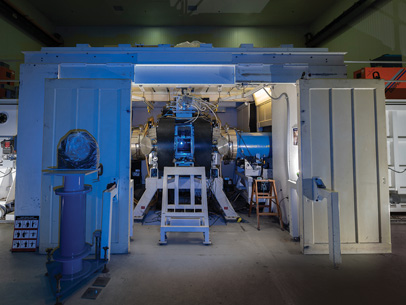 The US Naval Research Laboratory’s Electra argon fluoride laser. [J. Steffen, US Navy]
Excimers in the laser fusion quest
The US Naval Research Laboratory (NRL) in Washington, DC, USA, demonstrated the first rare-gas-halide excimer laser in mid-1975, and its high peak power and short wavelength soon caught the eyes of laser fusion researchers at the Lawrence Livermore National Laboratory. Their research showed that short wavelengths were advantageous for target compression, and in the early 1980s, the NRL fusion program directed by Stephen E. Bodner built the 56-beam Nike krypton fluoride laser, which could generate 3-KJ pulses from krypton fluoride at 248 nm that yielded important data on the impact of wavelength on target compression.
In the early 2000s, after Bodner retired, NRL built a 700-J e-beam pumped KrF excimer laser called Electra to continue research on high-energy excimer lasers. Stephen Obenschain, who succeeded Bodner, says, “We shifted the focus to ArF from KrF because it had the potential for higher wall-plug efficiency (10% for ArF versus 7% for KrF) and to broaden the laser bandwidth on target” to suppress laser–plasma instabilities. Electra was converted to ArF by 2019 as part of research on ArF for inertial confinement fusion and is still used for military research.
One company pursuing that path is LaserFusionX, which Obenschain founded in 2022 after retiring from NRL. It draws on NRL’s long-term investment of more than US$200 million in high-energy excimer lasers and laser fusion. He says the company’s simulations show that direct-drive fusion with ArF lasers firing megajoule pulses at high repetition rates could be enough to drive a fusion power plant. So far, LaserFusionX’s efforts have concentrated on designing ArF lasers and developing dry-wall chambers with high rates of tritium breeding. “We are seeking public and private investment to build hardware,” says Obenschain. Edwin Cartlidge described direct-drive laser fusion in detail in an article for OPN (see “Fusion’s Direct Drive,” OPN June 2023).
The second company is Xcimer Energy, also founded in 2022 and headquartered in Denver, CO, USA. Its system is based on e-beam KrF lasers and a novel and complex “hybrid” direct-drive (HDD) version of inertial fusion, in which two asymmetric laser beams collide to produce the fusion reactions to generate fusion efficiently. The firm has already completed a small-scale demonstration system called Phoenix, which includes a pair of e-beam-pumped KrF amplifiers: one designed to produce 100-J pulses, the other designed to generate pulse energies over 1 kJ. It’s an ambitious project that got off to a fast start by lining up US$165 million in private funding and US$13 million from the US Department of Energy.
Making retina phones and micro-LEDs
If you focused only on the highest-performance digital electronics, you might think the advent of EUV photolithography meant excimer lasers were headed for the scrap heap. Not so, says consultant Magnus Bengtsson. Excimer photolithography remains a workhorse in semiconductor electronics.
Bengtsson points out that the highest-performance chips are complex structures with multiple layers stacked atop each other during fabrication. The expensive EUV fab is used to etch the most finely detailed features on the surface layer, where the chip is connected to other chips. Interior layers are less detailed and can be etched by less-costly fabs based on excimer lasers, including older fabs that have been refurbished.
Excimer fabs are needed to meet the demand in smartphones and other displays because those devices are made for the human eye, and features fabricated on an EUV scale are too small for our eyes to see. What users want is sharp and readable screens. To provide better mobile-device screens, manufacturers began in the mid-2010s replacing liquid crystal displays (LCDs) with brighter organic LEDs (OLEDs), whose production relies on excimer-laser processing in key steps.
In 2017, Apple introduced its first OLED smartphone: the iPhone X (or iPhone 10). To highlight the OLED’s benefits, Apple called it a “Super Retina” screen, an improvement over the older “Retina” LCD smartphone screens introduced on the iPhone 4 in 2010. What made Apple’s OLED display possible, says Oliver Haupt of Coherent Inc., was “a new processing step in the manufacture of every mobile OLED display.” That step transforms a layer of amorphous silicon into polycrystalline silicon, improving electron mobility through the silicon, which acts as a substrate.
The strength of the excimer laser for many tasks is the precision with which it can deliver the proper amount of energy and move small objects accurately and without damage.
That step, Haupt says, “is made with our biggest lasers.” Coherent recognized the opportunity in display processing for excimer lasers and now offers a wide variety of excimer lasers ranging from 5 to 3600 W and emitting at 193, 248 and 308 nm. That variety reflects the broad range of applications that have emerged over the past decade.
Coherent is using excimers to perform multiple tasks in producing microLEDs, an emerging display technology based on inorganic 50 µm × 50 µm red, green and blue LEDs. The company developed a three-step fabrication process that starts with using a laser pulse to release microscopic LEDs from the wafer on which they were made, uses a single laser pulse to move multiple LEDs to a transfer substrate, and then transfers each tiny LED to its proper place in the red, green or blue matrix on the final substrate.
The strength of the excimer laser for such tasks is the precision with which it can deliver the proper amount of energy and move small objects accurately and without damage. Those properties are valuable for many tasks.
Making superconducting tapes for fusion
Excimers are also producing tapes of high-temperature superconducting materials for a small magnetic-confinement fusion reactor being built by Commonwealth Fusion Systems in Devens, MA, USA. A key innovation is a high-temperature superconducting material called VIPER, made of yttrium-barium-copper-oxide and designed to conduct electric currents and produce magnetic fields higher than have yet been demonstrated successfully.
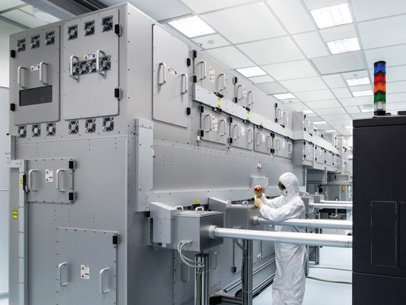 LineBeam system that performs low-temperature laser annealing of polysilicon backplanes for OLED and LCD high-resolution displays. The system can use either 355-nm or 308-nm excimer laser beams depending on the material annealed. [Courtesy of Coherent]
In 2021, Commonwealth Fusion demonstrated a 10-ton test magnet containing 16 layers of the tape, a total of 265 km. Next on its agenda is a test reactor called SPARC that is to contain 18 similar magnets. Coherent has already made about 1000 km of the tape using a XeCl excimer emitting 600 W at 308 nm, the highest power ever reached at that wavelength.
Fusion energy has been an elusive goal but an important one, and Haupt is excited to be involved. “It’s a big, big, big topic for us now,” he says. Kilometers of tape are coming out of the company’s roll-to-roll machine. Commonwealth Fusion says SPARC is expected to begin operations in 2027 and demonstrate net energy generation. It’s something to watch for.
Jeff Hecht (jeff@jeffhecht.com) is an Optica Fellow and a technology and science writer based in Auburndale, MA, USA.
For references and resources, visit: optica-opn.org/link/excimer-lasers.
