

Feature
Powering Chemistry with Light
Photon-driven reactions could offer a lower-energy alternative to some heat-intensive chemical processes, but scaling them from the lab to industry remains a formidable challenge.
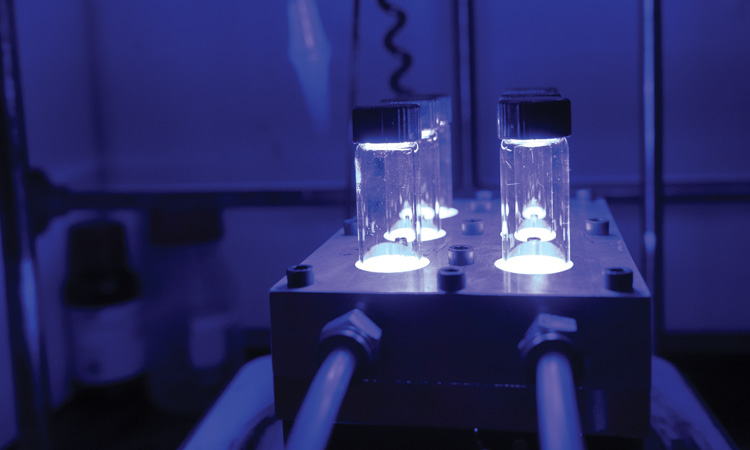 Chemical reactions irradiated with light. [J. Cline / Colorado State University Photography]
The chemical sector is the largest industrial energy consumer and the third-largest source of industrial direct CO2 emissions, according to the International Energy Agency (IEA). That makes decarbonization of chemical processes a critical step toward achieving net-zero goals by 2050. One emerging solution—the use of light, rather than heat, to power chemical reactions—is garnering significant attention as a highly promising technological innovation in the field of green chemistry.
…Log in or become a member to view the full text of this article.
This article may be available for purchase via the search at Optica Publishing Group.
Optica Members get the full text of Optics & Photonics News, plus a variety of other member benefits.
