

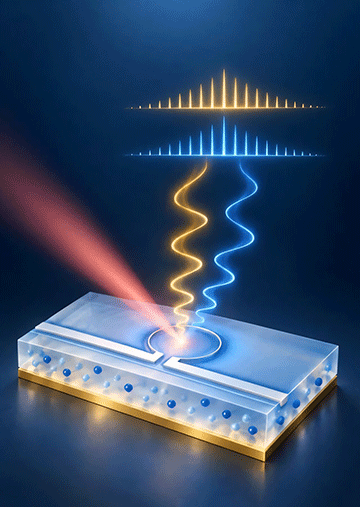
A crystal doped with ytterbium ions can be made to emit synchronized pulses of laser light at both microwave and optical wavelengths. [Image: AI-generated artwork by Andrei Faraon]
Researchers in the United States have created a frequency comb that produces narrow pulses of light at both microwave and infrared wavelengths at the same time (Nature, doi: 10.1038/s41586-026-11289-7). Exploiting the quantum effect of superradiance, such coordinated emission of pulsed laser light could offer a new way to connect optical fibers to the superconducting circuits used in quantum computers.
An unexpected behavior
The researchers first noticed in 2024 that shining a laser into a crystal doped with ytterbium produced regular flashes of light. “Remarkably, the atoms were flashing in two very different kinds of light at once—microwaves and infrared light—in perfect step with each other,” says Andrei Faraon, California Institute of Technology. “That had not been observed before.”
This unexpected behavior is the result of superradiance, a quantum phenomenon in which atoms become coupled together to act like a single coherent system. Such a synchronized system can emit a coordinated burst of radiation that is much more intense than could be produced by the same number of atoms acting independently. First predicted in 1954, superradiance has been observed in many different experimental systems and has recently been used to create lasers with ultranarrow linewidths.
Toward ultrastability
In this new work, Faraon and colleagues were investigating whether superradiant emission could be used to create an ultrastable frequency comb. They used a crystal doped with ytterbium ions, which possess coherent energy transitions at both microwave and optical wavelengths. Laser light can excite the ytterbium ions into a two-level spin state, while the transitions between these spin states can be controlled by microwaves produced by a superconducting circuit.
For laser powers above a critical threshold, enough ytterbium ions populate the excited spin state to trigger collective quantum behavior. Continuous superradiant emission is produced with a linewidth of around 30 Hz, about three orders of magnitude narrower than would be produced if the ions were acting independently. But higher pump powers disrupt this steady-state emission, instead producing a regular train of superradiant pulses in the microwave regime.
What’s more, this periodic emission can be transferred to the optical domain through coherent Raman scattering. The shared dynamics generate synchronized laser pulses at both microwave and optical wavelengths, which the researchers call a dual-rail frequency comb.
The team is now working to achieve more control over the pulsed emission, which should be possible by increasing the optical pumping rate and upgrading the superconducting circuit to the latest technology. Such combined control could yield a programmable light source not just for frequency combs but also for quantum interconnects and synthesizing bespoke waveforms. “Being able to tune each emission strength, pulse separation and emission format would be very useful to suit each specific application,” says Faraon.
