
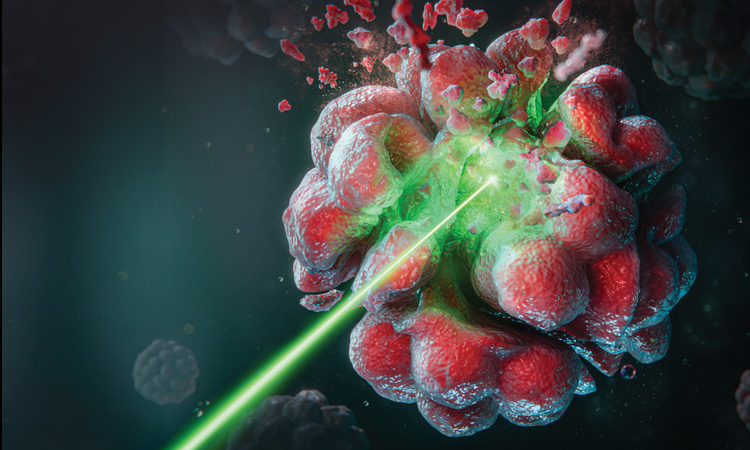
Illustration of single-point laser photodynamic therapy. [C.S. Carrizo et al. Adv. Therap. 8, e00541 (2025)]
A stele on display at the Egyptian Museum in Cairo, Egypt, depicts King Akhenaten, Nefertiti and their three daughters exposing themselves to healing rays of sunlight. [A. Blomqvist / Getty Images]
Since antiquity, humanity has sought to harness the healing power of light. The Ebers Papyrus—a compilation of Egyptian medical texts dated to about 1550 BCE—contains a remedy for vitiligo that combines sun exposure with ingestion of a fruit extract. Hippocrates and other physicians of Ancient Greece promoted the use of sunlight to restore overall health, a practice termed “heliotherapy.” Other civilizations across the world applied sunlight to treat conditions ranging from psoriasis and rickets to skin cancer and psychosis.
These early practices are the roots of modern photodynamic therapy (PDT), a technique that combines a light source with light-absorbing molecules, known as photosensitizers, to treat a wide range of ailments. In PDT, a non-toxic photosensitizer is administered intravenously to the patient, where it selectively accumulates in a tumor, or is applied to a target site in the body. When the photosensitizer is exposed to light of a specific wavelength, it can trigger photochemical or photophysical reactions with oxygen that result in locally toxic products and kill diseased cells.
The concept behind PDT was discovered in 1898 by medical student Oscar Raab, who observed that the combination of acridine red (a fluorescent dye) and light killed a species of paramecium. The first clinical applications of PDT didn’t appear until the mid-1970s, when hematoporphyrin derivatives were used to treat bladder and skin cancers.
Photodynamic therapy timeline
Major advances in photodynamic therapy (PDT) and related engineering approaches since the first application of PDT in patients in 1976.
1976: First in-human study of haematoporphyrin derivative-PDT for bladder cancer [clinical]
1983: Antibody–haematoporphyrin conjugates for photoimmunotherapy (PIT) / Delivery of liposomal porphyrins to tumors in animal models [pre-clinical]
1992: First in-human study of PIT using antibody-targeted phthalocyanine for ovarian cancer [clinical]
1997: Development of fragment antigen-binding region–PS conjugates for PIT [pre-clinical]
1999: Photochemical internalization (PCI) discovered [pre-clinical] / 5-aminolevulinic acid-PDT approved by FDA for actinic keratosis [clinical]
2000: Visudyne PDT approved by FDA for age-related macular degeneration [clinical]
2001: Foscan PDT approved in the EU for head and neck cancer [clinical]
2006: Nanoscintillators introduced for X-ray-PDT [pre-clinical]
2009: First in-human use of PCI [clinical]
2011: Porphysome nanovesicles developed [pre-clinical]
2012: Radionuclide for PS activation [pre-clinical]
2013: Talaporfin PDT approved in Japan for glioma [clinical]
2014: Nanobody-PS PDT [pre-clinical]
2016: Photoactivable multi-inhibitor nanoliposomes [pre-clinical]
2017: First in-human use of 5-aminolevulinic acid-PDT for glioblastoma / Ru(ll)-based photosensitizer to enter a clinical trial for PDT / Tookad PDT gains European approval for prostate cancer / Virus-like drug conjugate enters PDT clinical trial [clinical]
2020: PIT for head and neck cancer approved in Japan [clinical]
2023: Photoimmunoconjugate nanoliposomes for PIT of metastatic cancer [pre-clinical]
[Adapted from G. Obaid et al. Nat. Rev. Bioeng. 2, 752 (2024)]
Today, PDT is approved by the US Food and Drug Administration and other regulatory agencies for several oncological (lung, esophageal and skin cancers) and non-oncological indications (Barrett’s esophagus, actinic keratosis, wet macular degeneration). However, despite its proven efficacy and strong safety profile, the adoption of PDT in the clinic remains slow and significantly limited.
“PDT has shown that it’s very effective, there are hardly any side effects, and it’s inexpensive. Why isn’t it a greater part of the medical practice?” asked Tayyaba Hasan, professor of dermatology at the Wellman Center for Photomedicine, Harvard Medical School, and Massachusetts General Hospital, Boston, MA, USA. “To me, that is the big question.”
As a result, PDT researchers like Hasan have moved beyond searching for new photosensitizers and light sources into exploring less conventional approaches that could help bring the technology into mainstream clinical practice. Novel techniques, such as photodynamic priming, interstitial PDT and single-point laser irradiation PDT, represent attempts to breathe new life into a technique with more than a century of scientific history.
“I’m optimistic when it comes to the future of PDT,” said Gal Shafirstein, professor of oncology and director of photodynamic therapy clinical research at Roswell Park Comprehensive Cancer Center, Buffalo, NY, USA. “There’s a large community of researchers who work on PDT worldwide, and people are now starting to really push the envelope.”
The promises and pitfalls of PDT
PDT relies on combining three individually non-toxic components (a photosensitizer, light and oxygen) to induce therapeutic effects. When light hits the photosensitizer, it becomes activated from a ground to an excited state. As it returns to the ground state, it transfers energy either to surrounding biomolecules or molecular oxygen to generate reactive oxygen species (ROS). ROS, such as singlet oxygen and free radicals, cause irreversible damage to target tissue inducing cell death.
PDT is largely considered a local treatment that only affects cells proximal to the area of ROS production, meaning clinicians can ideally minimize damage to healthy tissue. For reasons not entirely understood, photosensitizers also tend to selectively accumulate in tumor tissues, further enhancing selectivity. Unlike conventional cancer drugs, PDT can also be repeated as needed on a given patient without concerns about developing resistance to treatment or long-term toxicity.
Photodynamic therapy’s unique advantages could position it as a powerful medical tool with the potential to transform how certain diseases are treated.
However, several challenges continue to limit PDT’s broader clinical impact. PDT commonly uses light in the 600–800 nm range, where absorption and scattering in biological tissues limit its penetration to superficial areas or organs accessible by catheters or endoscopes, meaning deep-seated tumors and tissues cannot be reached when the light is administered by an external source.
“What used to be PDT’s biggest virtue—it damages only where you shine light, where the sensitizer localizes and where there’s also some oxygen—became a disadvantage,” said Hasan, who has worked in the field of PDT for 40 years. “It’s generally thought of as being limited to a localized treatment.”
Photosensitivity is another issue. Traditional photosensitizers can still accumulate in non-malignant tissues, causing harmful photothrombotic reactions or prolonged sensitivity to sunlight. Advanced targeting mechanisms are needed to further increase selectivity.
In many cases, PDT alone often cannot completely eliminate tumors for reasons that include limited ROS generation, treatment penetration depth and hypoxic tumor microenvironments. PDT dosimetry also remains a major challenge, as achieving clinically effective tumor-control doses can be hindered by differences in tumor physiology, photosensitizer distribution and other patient-specific factors.
“PDT with Photofrin has been used in the clinic to treat patients with inoperable non-small-cell lung cancer and esophageal cancers using Photofrin as a photosensitizer,” explained Shafirstein. “But it’s not been regularly used, and one of the reasons is the photosensitivity that lasted up to 30 days. Patients have to protect themselves from light by avoiding sun exposure and bright indoor lights for a month, which is cumbersome.”
He also cites the recent price hike of Photofrin (the first clinically approved photosensitizer) from US$2,700 to US$20,000 for a single vial. Patients typically need two to three vials for treatment, and that cost coupled with light delivery has led to scarce adoption of the technology, especially in economically challenged countries.
Photodynamic priming: preparing the tumor for treatment
Despite these hurdles, many researchers believe PDT will eventually become an established part of modern medicine. By targeting the right clinical applications and building on decades of research worldwide, PDT’s unique advantages could position it as a powerful medical tool with the potential to transform how certain diseases are treated.
Photodynamic priming is an emerging method that uses PDT to alter the tumor microenvironment to improve the therapeutic efficacy of immunotherapy drugs for cancer.
Photodynamic priming (PDP) exemplifies this shift. PDP is an emerging method that uses PDT to alter the tumor microenvironment to improve the therapeutic efficacy of immunotherapy drugs for cancer. PDP represents one of many possible ways that PDT could extend the treatment potential of other, more established therapies.
Beyond the zone of PDT-induced tissue death, known as the ablative zone, low light fluences combine with the photosensitizer to create a finite priming volume characterized by transient loosening of stroma, the supportive tissue surrounding a tumor, as well as more permeable vasculature. Essentially, this area of the tumor, and beyond, can become more sensitive to treatment modalities such as chemotherapy, radiation and immunotherapy.
[Enlarge image]Photodynamic manipulation of tumor architecture. Light irradiation creates a fluence gradient that produces a core zone of PDT-induced tumor death and a surrounding photodynamic priming (PDP) region marked by transient stromal loosening, vascular permeabilization and enhanced immune responses. PDT and PDP drive local tumor destruction and can affect metastases. [Adapted from G. Obaid et al. Nat. Rev. Bioeng. 2, 752 (2024)]
“When you talk about PDT, people think it’s only a local effect. But because of this phenomenon of photodynamic priming, it will also start causing remote effects,” said Hasan. “Low-dose PDT starts happening in that area, which generates cytokines and other agents that then diffuse away and go to remote sites, affecting metastases.”
Cytokines are proteins that play a crucial role in the immune system and can help boost anti-cancer activity. When released, cytokines send signals to the immune system that affect the growth of immune and blood cells. Lab-made cytokines are clinically approved to treat kidney cancer, melanoma and other conditions.
Hasan’s group is currently investigating the possibilities of PDP for pancreatic cancer, one of the deadliest cancers and the third leading cause of cancer-related deaths in the United States. The malignancy is highly resistant to existing therapies due to a dense stroma that blocks drug delivery, as well as an immunosuppressive tumor microenvironment.
“Pancreatic cancer is particularly silent to any kind of immune effects because the immune cells that are in the body cannot penetrate the tumor,” Hasan said. “Photodynamic priming breaks the stromal barrier and the vascular barrier so that, for a small window of time, the immune cells and drug can rush into the tumor.”
A 2021 study from her group show promising results: PDP improves enhanced T-cell priming followed by increased T cell–mediated tumor killing in a 3D model of human pancreatic ductal adenocarcinoma (PDAC) cells. They had also previously demonstrated the ability of PDP to remodel fibrous stroma in mice, allowing more potent and sustained anti-tumor chemotherapeutic effects, even at reduced doses.
Recent work using photosensitizer Verteporfin (trade name: Visudyne), a benzoporphyrin derivative that is currently in clinical use for the treatment of age-related macular degeneration, showed that PDP can enhance more acute local and systemic immune responses while modulating the stromal barriers in a mouse model of PDAC. After Verteporfin injection, PDT was performed on tumors using a 690 nm diode laser delivered at an irradiance of 100 mW/cm2 to achieve fluence of 75 J/cm2.
The results indicated that PDP induced changes in the tumor microenvironment that mitigate immunosuppressive mechanisms and promote greater permeability. For example, post-PDP alterations included the reduced formation of blood and lymphatic vessels and decreases in collagen content. The effects of PDP also went beyond the local tumor site of irradiation, as shown by adaptive immune activation in spleens and memory T-cell expansion in mice.
A phase 2 clinical trial is now recruiting patients with pancreatic cancer to test Verteporfin-PDT/PDP plus immunotherapy and chemotherapy in humans. The study aims to enroll 25 participants and has the primary objective of evaluating the overall response rate in pancreatic cancer patients treated with a combination of PDP and pembrolizumab.
“The results so far are quite promising. In some cases, there has even been a decrease in metastases,” Hasan explained.
Interstitial PTD: shining light where it matters
Roswell Park Comprehensive Cancer Center has long been a central site in PDT history, hosting several foundational milestones, including the first controlled clinical study in humans and the development of Photofrin. In 1975 at Roswell Park, Thomas Dougherty, widely regarded as the inventor of modern PDT, demonstrated the technique’s potential by successfully treating cancer in mice using a hematoporphyrin derivative activated by red light. Just three years later, he led one of the earliest clinical trials in humans with skin cancer, achieving complete responses in 98 of 113 tumors.
Today, as Roswell Park’s director of Photodynamic Therapy Clinical Research, Shafirstein is extending this legacy with his work on interstitial PDT, in which optical fibers are inserted into the target tissue to deliver light. While conventional or external beam PDT has an effective depth of light penetration and treatment limited to less than 10 mm, interstitial PDT can be employed for deeply seated tumors or those thicker than 10 mm. The fibers are either inserted via needles or placed in catheters that were previously inserted into the tumor.
“Most of the work that’s been done in PDT thus far has been focused on developing new photosensitizers,” Shafirstein said. “At this point there are enough photosensitizers out there, and what we really need to do is to improve the way we’re delivering the light.”
Specifically, his team developed computer-optimized, image-guided interstitial PDT for patients with cancer who fail to respond to standard therapies or have no effective treatment options. He believes that PDT could fill the gap for such individuals as an additional treatment option, with the goal of improving their quality of life and survival.
One such application involves malignant central airway obstructions (MCAOs), a severe complication most commonly caused by locally advanced bronchogenic lung cancer. The prognosis for MCAO patients is extremely poor, with median overall survival times of 1 to 7 months.
[Enlarge image]Image-based treatment plan for interstitial PDT of inoperable non-small-cell lung carcinoma with a malignant central airway obstruction. Top: 3D CT reconstruction of the tumor (left) and tumor geometry with planned insertion sites (right). Bottom: Simulated irradiance indicating 99% of the tumor will reach a 8.6 mW/cm² threshold (left) and simulated fluence showing 91.6% of the tumor will reach a 45 J/cm² threshold. [N.W. Ivanick et al. JTO Clinical and Research Reports 3, 100372 (2022)]
A 2022 first-in-human phase 1 clinical study evaluated the safety and efficacy of interstitial PDT in eight patients with MCAOs. Shafirstein’s team had previously developed a novel high-spatial-resolution image-based treatment planning system for interstitial PDT of tumors next to critical organs in the head, neck and central airways. The system uses computer simulations to guide the placement of cylindrical light diffuser fibers, and to calculate patient-specific irradiance (mW/cm2) and fluence (J/cm2).
“When you’re doing interstitial PDT with image-based treatment planning and light dosimetry, you can insert multiple fibers to treat very large tumors,” said Shafirstein. “You can precisely control the laser light delivered from each fiber to optimize treatment efficacy within the tumor while protecting adjacent normal tissues and structures. But for that, you need to use computer models to simulate the light propagation in tissue because now you’re talking about nonlinear complex light distribution in the tumor and normal tissue.”
To that end, a high-resolution computed tomography (CT) image was obtained in the days before the I-PDT procedure, and the target tumor, surrounding central airway and major vasculature were marked to generate a computer model that mimics the tumor shape, major blood vessels and surrounding anatomy. This model was then imported into finite element analysis software for computing the light dose rate and dose in the tumor and adjacent tissues. The image-based treatment planning system was used to personalize the light dose rate and dose for each tumor.
Porfimer sodium, currently the only photosensitizer approved by the FDA for treating endobronchial non-small-cell lung cancer, was administered via intravenous injection approximately 48 hours before light delivery. On treatment day, the team used linear endobronchial ultrasound (EBUS) to guide the placement of the cylindrical light diffusers within the tumor. The EBUS scope and EBUS needle enabled precise insertion of each diffuser, which was followed by needle retraction while the fiber remained in position within the tumor.
[Enlarge image]Left: Endobronchial ultrasound (EBUS) setup for fiber insertion into the target tumor. The inset shows the custom fiber holder mounted onto a standard transbronchial needle with an attachment through where the laser fiber is inserted. Right: The EBUS transbronchial needle is used to position the diffuser fiber for intratumoral illumination (top). A second insertion is made by pulling the fiber into the needle and then placing it in another location (bottom). Multiple insertions can be made during a procedure. [Printed with permission from © Roswell Park Comprehensive Cancer Center]
The phase 1 study concluded that interstitial PDT was safe, and three patients were alive at 26.3, 12 and 8.3 months after receiving the treatment—durations significantly longer than typical survival times for MCAO patients. The therapy also had a positive effect on the immune response, as measured by an increase in levels of certain immune markers found in blood.
The next phase of this study now includes a phase 1/2 clinical trial to evaluate the safety and efficacy of interstitial PDT in combination with low-dose radiotherapy in as many as 42 patients with MCAOs.
“Doing PDT as part of a combination therapy is the way to go, and the key is to focus on patients who do not have any good treatments right now,” said Shafirstein. “Unfortunately, there are still quite a few cancer patients who have tumors that are just refractory to all the current therapies.”
Single-point laser irradiation: targeting once cell at a time
Another type of cancer—a fast-growing, aggressive brain tumor called glioblastoma—desperately needs new therapies, and PDT is being actively explored as a possible treatment option. The long-term prognosis for glioblastoma remains poor, and it can result in death in as little as 15 months after diagnosis. Glioblastomas are incredibly difficult to treat because they can infiltrate nearby brain tissue and resist therapies due in part to the blood–brain barrier.
The current standard of care consists of a combination of several approaches, including surgery, chemotherapy, targeted therapies and radiation therapy. The first step is usually surgery, and a complete resection of glioblastoma is critical for patient survival. Neurosurgeons leverage fluorescent markers to visualize the tumor’s borders, improving the precision and effectiveness of glioblastoma resection and increasing the chances of patient survival.
While conventional PDT induces cell death via apoptosis or necrosis, single-point laser irradiation PDT selectively destroys the cancer cell plasma membrane with a single-point laser.
Sebastian Thompson and his colleagues at the Madrid Institute for Advanced Studies in Nanoscience (IMDEA Nanociencia), Spain, are taking advantage of the fluorescent dyes already used clinically in the tumor to investigate a new PDT approach. While conventional PDT induces cell death via apoptosis or necrosis, single-point laser irradiation PDT selectively destroys the cancer cell plasma membrane with a single-point laser.
“Usually, when you irradiate a tumor, you irradiate the whole tumor,” said Thompson. “Now, we have the technology to single-point irradiate the compound, so we can activate one single point where we make a hole in the plasma membrane. In this way, we induce necrosis.”
[Enlarge image]Plasma membrane impairment after laser bleaching in U87 cells treated with fluorescein or protoporphyrin. Post-irradiation images of control (top, left) and NaF treated cells (bottom, left) with plasma-membrane marker labeling (center). [C.S. Carrizo et al. Adv. Therap. 8, e00541 (2025)]
A 2025 study demonstrated that single-point laser irradiation PDT induces plasma membrane damage in 2D and 3D glioblastoma cells using two clinically approved fluorescent markers: Protoporphyrin IX (PPIX), which localizes to the plasma membrane, and sodium fluorescein (NaF), which remains in the extracellular space in contact with the membrane. The plasma membrane disruption resulted in selective necrotic cancer cell death.
Notably, when applied to 3D spheroids treated with PPIX or NaF, the approach induced cell death from the center of the spheroids outward, destroying the tumor mass. Thompson believes it is the “bystander effect” at work, a phenomenon that occurs when unirradiated cells exhibit irradiated effects as a result of signals received from nearby irradiated cells.
“The bystander effect is where you kill only one cell, but the other cells get stressed or even die,” he said. “We induced the bystander effect inside the spheroid and destroyed it from the inside out.”
Next, Thompson and his colleagues plan to test single-point laser irradiation PDT in mouse models of glioblastoma. They will also explore the use of two-photon microscopy, where fluorescent markers can be activated at the laser focus, further enhancing the selectivity of cell death.
“The advantage of this technique is that you will never irradiate normal tissue,” he said. “When you are using single-point irradiation, you will only irradiate the tumor or even a single cancer cell.”
A field poised for renewal
Other innovations in PDT are attempting to drive the field forward by overcoming the technique’s inherent challenges in selectivity, penetration or clinical workflow. Carrier systems such as antibodies, liposomes and nanoparticles have been employed to improve the biodistribution of existing photosensitizers. Methods like two-photon excitation, bioluminescence-activated PDT and X-ray-induced PDT are being developed to solve the issue of limited penetration depth. And vascular-targeted PDT is an approach that is performed with the intention of disrupting tumor vasculature rather than killing tumor cells.
“We need some new breakthrough in the fundamental nature of photodynamic therapy,” Thompson said. “If these recent innovations present good results, we are going to have a comeback of photodynamic therapy in the clinic.”
Meeri Kim is a freelance writer based in Los Angeles, CA, USA.
For references and resources, visit: optica-opn.org/link/PDT.