

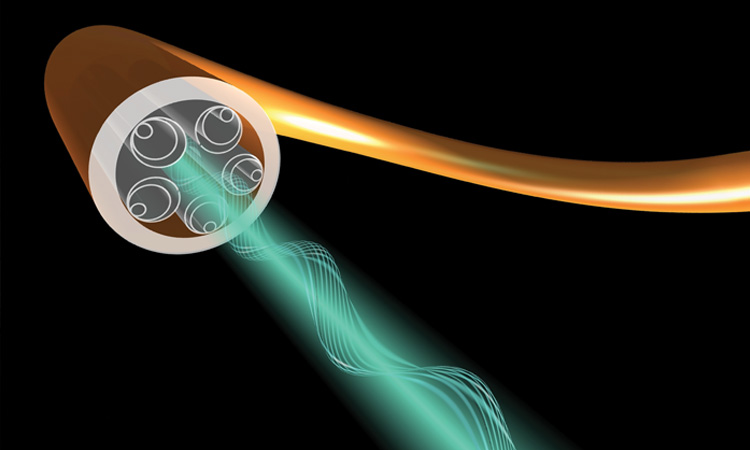
 Illustration of nested glass tubes inside a hollow-core optical fiber. [University of Southampton]
“‘Nothing’ is better than silica ... But no glass at all is even better. ”
—Sir David N. Payne, University of Southampton, UK
Over the past half century, pure silica optical fibers have become the backbone of global telecommunications. What makes pure silica a great material is its durability, its ability to be drawn into strands many kilometers long, and its extraordinary transparency (within the right wavelength window, it absorbs remarkably little light). Yet silica has its limits. It is most transparent in a narrow range around 1550 nm, where its attenuation is limited to 0.14 dB/km, and it slows photons to about two-thirds of the speed of light in vacuum. As the communications industry chases ever more bandwidth and lower latency, “better than silica” has become a moving target.
The photonics community has responded by producing hollow-core fibers, in which light propagates through air-filled (or gas-filled) central voids inside nanostructured glass tubes. As Susan Curtis previously described in OPN (see “The Light at the End of the Tunnel,” OPN March 2025), the newest hollow-core fibers have reached loss levels and latency levels below those of solid fibers and are being installed in new long-haul networks.
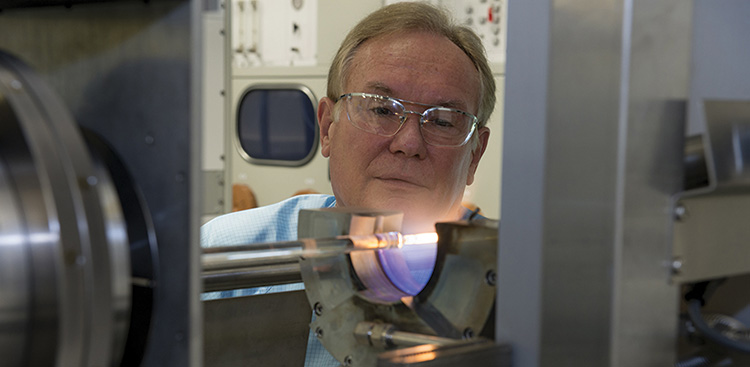 Sir David N. Payne in the lab. [University of Southampton]
Now, researchers are finding other uses for these remarkable fibers. Hollow-core fibers can also deliver high-power laser beams over kilometer distances. In recent demonstrations, teams have sent kilowatts of light squeezed into a 30-µm beam through more than 2 km of an advanced hollow-core fiber, with as much as 95% of the input power emerging at the end. This is an eye-opening result for anyone used to the limits of solid-core fiber.
But that’s not all hollow fibers can do. In addition to their application in communications, they can be used as long-path gas cells for trace-gas sensing and to build gas-based fiber lasers in spectral regions where solid silica is opaque. By directing light through the hollow core rather than through a solid glass fiber, they can reduce optical nonlinearity almost to nothing. It seems like new results are being published every day. This article highlights several of the most promising developments emerging from the world of hollow-core fibers.
Remote delivery of high-power beams
One of the most striking new applications for hollow-core fibers is to deliver kilowatt-class laser beams with 1-µm wavelengths across kilometer distances through a central empty core only about 30 µm wide—a feat beyond conventional solid-core fibers.
Solid-core fiber lasers have become a multibillion-dollar business because they can deliver high power for industrial applications. The key technologies behind this success are high-power diode pump lasers emitting at wavelengths well-matched to the absorption lines of fiber lasers doped with ytterbium emitters in the 1-µm range. For example, an indium-gallium-arsenide pump diode emitting at 976 nm can pump ytterbium atoms doped into a silica fiber to a transition emitting at 1080 nm with a quantum defect of only about 10%. Combining the high electric efficiency of the pump diodes and high optical efficiency of diode pumping can yield wall-plug efficiency up to about 50%.
However, silica is not equally transparent at all wavelengths. In the ytterbium band near 1 µm (the workhorse wavelength range for the highest-power fiber lasers), the loss of solid-silica fiber rises from about 0.7 dB/km at 1080 nm to about 1.4 dB/km at 950 nm—much higher than in the telecom window. This poses a problem for applications that require beam delivery to a remote operation.
Early experiments showed that even multimode fiber (which is often desirable for high powers because its larger core spreads heat through a larger region) cannot transmit a 5-kW class beam much beyond 20 m or an 800-W beam beyond 100 m without running into unacceptable loss and damage limits. That constraint could hobble the use of fiber lasers for projects that require remote operations, including cleanup of toxic waste sites, disassembly of nuclear reactors and deep drilling for petroleum mining.
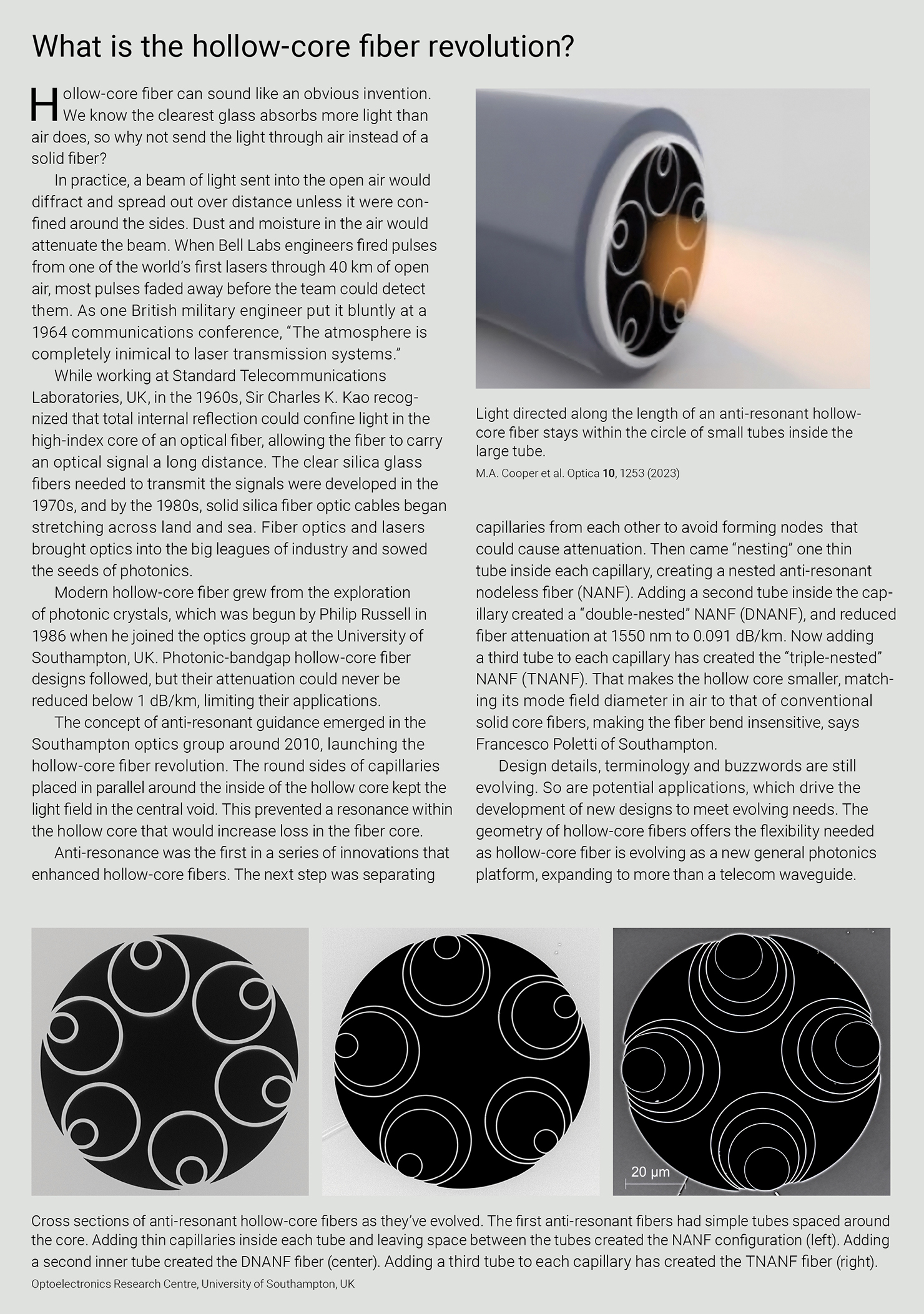
In 2023, a team led by Rodrigo Amezcua Correa of the University of Central Florida College of Optics and Photonics (CREOL), USA, decided to test transmission of a kilowatt-class, single-mode laser beam through a length of anti-resonant hollow-core fiber. In an Optica paper published that same year, they reported sending a single-mode 2.2-kW beam through 104.5 m of anti-resonant hollow-core fiber with attenuation of 0.79 dB/km at 1080 nm. Using a five-capillary NANF structure, they transmitted about 95% of the input power through the fiber, an encouraging result.
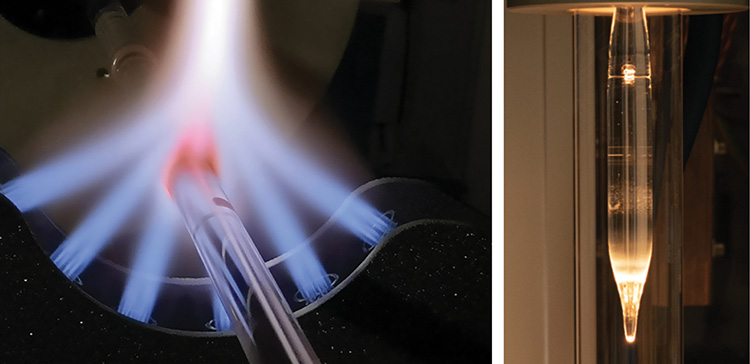 Examples of hollow-core fiber during the manufacturing process. [Courtesy of Microsoft Azure]
The internal structure of the NANF confined the guided beam to a diameter of 23 µm, and the output retained roughly 95% of the power that entered the fiber. Amezcua Correa’s group recognized the potential importance, writing that the results “could pave the way for high-brightness, narrow-linewidth fiber delivery systems for a broad range of applications.” They noted that hollow-core fibers’ preservation of both the spatial and spectral attributes of the multi-kW entry beam could make such fibers valuable in improving throughput for laser manufacturing. The team also suggested that the NANF fiber design could be “instrumental in power scaling narrow-linewidth fiber laser amplifiers” and could help avoid the need for the complex free-space optics typically required to transport multi-kilowatt beams.
A 2025 paper by Jing Shi and colleagues at NUDT in Changsha, China, reported all-fiber efficient delivery of a 2-kW laser beam over 2.45 km of hollow-core fiber.
A 2025 paper published in Nature Communications shows how quickly this technology is maturing. Jing Shi and colleagues at the National University of Defense Technology (NUDT) in Changsha, China, reported all-fiber efficient delivery of a 2-kW laser beam over 2.45 km of hollow-core fiber, an encouraging advance from the 100-m-class demonstrations reported two years earlier.
Like the CREOL group, the NUDT team used light from a 1080-nm fiber laser and a five-tube nested anti-resonant hollow-core design. Their structure, however, adds complexity. Each of the five tubes contains two internal tubes (one large and one small), rather than a single nested tube. The intent is to reduce loss and suppress unwanted coupling into the surrounding silica microstructure.
The authors claim two important advances toward maturing the technology. One is assembling an all-fiber system rather than relying largely on free-space optics, which is an important consideration for stability and robustness outside the lab. The second is detecting stimulated Raman scattering arising within the nested silica tubes—and finding a way to suppress it. Doing so would address a nonlinear effect that can become a bottleneck at high power.
They also report a record low attenuation in the hollow-core fiber: only 0.168 dB/km at 1080 nm, roughly a quarter of the loss in the earlier CREOL experiment at a similar wavelength. However, only 85.4% of the input power passed entirely through the full fiber length, compared with 95% in the shorter CREOL test.
The group says its demonstration “marks a significant breakthrough […] that is potentially useful for industrial manufacturing, nuclear decommissioning, laser drilling in oil” and other applications. Based at China’s largest military-affiliated public research university, the team appears to be in a good position to access further funding.
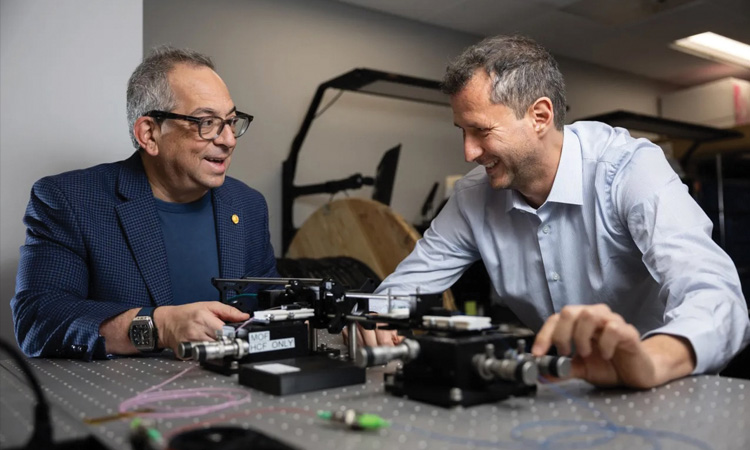 Optica Fellow Jason Eichenholz (left) and Rodrigo Amezcua Correa founded Relativity Networks, in Winter Park, FL, USA, to commercialize hollow-core fiber technology. [Courtesy of Relativity Networks]
In the United States, Amezcua Correa and Optica Fellow Jason Eichenholz have founded Relativity Networks (Winter Park, FL) to commercialize hollow-core fiber technology. Selim Habib of the Florida Institute of Technology, who is also involved with the startup, says that the output beam quality in their current tests is near diffraction-limited, with less than 0.1% of the light in the silica part of the fiber and 99.9% guided in the hollow core. Those are impressive results but have yet to be published.
Hollow-core fiber lasers
The low attenuation of hollow-core fibers makes them an attractive foundation for developing new types of lasers. For example, mid-infrared fiber lasers can be made in hollow-core fibers at wavelengths where solid silica fibers have high infrared loss.
Silica fibers make good hosts for rare earth dopants, including ytterbium and erbium, that emit in the near-infrared, where silica absorption is very low. However, silica absorption increases outside this region (at both higher or lower wavelengths), making laser operation increasingly hard to sustain. Beyond 4000 nm, silica attenuation can exceed 1000 dB/meter, making the material functionally opaque. Other glass families, such as chalcogenide compounds, are more transparent in the mid-infrared and can serve as fibers and hosts for mid-infrared sources, but the compounds are toxic, fragile and hard to draw into fiber.
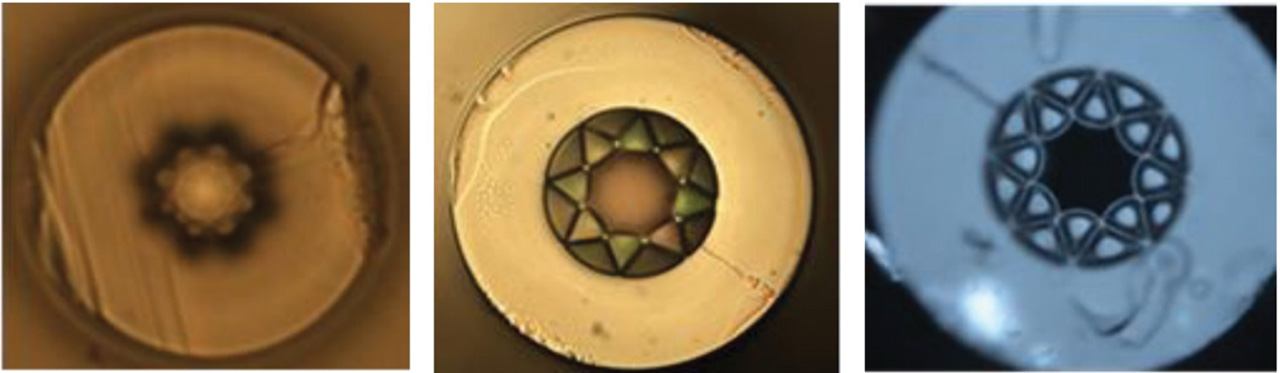 [Enlarge image]The complex structure of hollow-core fibers makes splicing them an important challenge. These are stages of splicing anti-resonant hollow-core fibers to end caps to seal gas in a cavity at the end of a fiber by Zefeng Wang of NUDT. [Photonics 2021, 8(9), 371; CC-BY-4.0]
Looking to make mid-infrared fiber lasers, Zefeng Wang, also at NUDT, explored prospects for filling the holes in hollow-core silica fibers with gases that emit in the mid-infrared. The team’s best results came from carbon monoxide, which emitted up to 46 milliwatts at wavelengths from 4466 to 4824 nm. Loss of the hollow-core fiber was only 0.73 to 1.81 dB/m, compared with 13,000 dB/m for silica at these wavelengths. Wang’s group expects to extend the operation of what it calls its “hollow-core fiber gas laser (HCFGL)” beyond 5 µm.
More unconventional lasers also have been demonstrated in hollow-core fibers. Weihua Song and colleagues at the Beijing University of Technology, China, demonstrated picosecond Raman lasers. Other groups have reported other exotic emitters, including frequency combs and supercontinuum sources spanning from 200 nm to 4000 nm.
Hollow-core fiber sensing
Another promising application for hollow-core fibers is sensing, where the sample is placed inside the hollow core of the fiber. “If we’re looking for greenhouse gases like carbon dioxide, we can actually detect the gas inside the [hollow] fiber using absorption spectroscopy,” says Habib. In this configuration, the fiber acts as a compact long-path gas cell, enabling interaction between light and analyte over meter- to kilometer-scale distances.
Hollow-core fibers can be filled with gases including argon, krypton, neon and hydrogen to detect the gases down to parts-per-million concentrations. Many important molecular gases have strong fundamental vibrational lines in the mid-infrared, where hollow-core fibers may open low-loss guidance in the 4 to 5 µm band, which has been hard to reach with conventional instruments. Ultraviolet nonlinear optics are highly tunable and can provide very flexible sources in the 200 to 300 nm range, which may pair well with hollow-core platforms for specialized spectroscopy.
Ultralow nonlinearities
Hollow-core fibers also offer another potentially useful property: They have ultralow levels of nonlinearities because most of the light field is in the hollow areas, which can be valuable in both signal transmission and measurement systems. Yang Hong (formerly at Nokia Bell Labs, now at Microsoft Azure Fiber) and colleagues found that a circulating loop experiment using hollow-core fiber was free of nonlinearities up to a launch power of 23.5 dB/m.
Optical tweezers
The guiding modes in hollow-core fibers can also generate optical forces sufficient to offset the force of gravity on particles, trapping them within the hollow core. In some configurations, the levitating force can propel particles along the length of the fiber, making it a waveguide that can trap and transport particles.
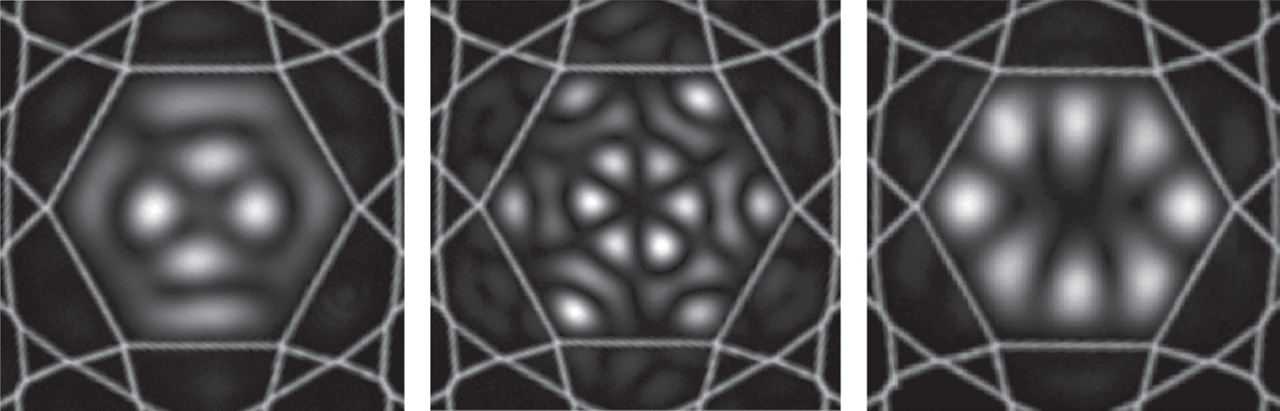 [Enlarge image]Higher-order modes in hollow-core fiber, like those shown here, can be used to trap mesoscale particles and atoms and guide them along the fiber, report Rui Wang and colleagues at the Key Laboratory of Photonic Technology at the Beijing Institute of Technology. [Light Sci. Appl. 14, 146 (2025); CC-BY-4.0]
The generated force can move particles farther than conventional optical tweezers, extending the range of the technique first reported by Arthur Ashkin of Bell Labs in 1970. Optical tweezers have become a valuable tool across many areas of research because of their sensitivity and precision, and Ashkin received the 2018 Nobel Prize in Physics for their development.
On one hand, hollow-core fibers can act as optical tweezers, picking up tiny particles with great delicacy. On the other, they can concentrate laser energy into a thread of intense power.
From “nothing” to a new photonics platform
What began as an attempt to guide light through “nothing” is evolving into a practical photonic platform with an exceptionally wide range. On one hand, hollow-core fibers can act as optical tweezers, picking up tiny particles with great delicacy. On the other, they can concentrate laser energy into a thread of intense power, carrying kilowatts of energy in filament just 30 µm wide. The contrast is striking, and it invites a simple question: What else can we do with it?
At the same time, the technology still has a long way to go. Hollow-core fibers are built from glass capillaries so thin that it’s hard to imagine they could steer kilowatts of power anywhere, much less across kilometers, outside a lab. Turning today’s demonstrations into robust tools is a challenge that awaits the developers. How do you make fibers strong enough for real-world environments? How do you assemble and package them reliably? How do you manufacture them at scale without losing performance? For now, the field is still in the discovery stage, but the pace of progress suggests that engineering advances are not far behind. We have a lot to look forward to.
Jeff Hecht is an Optica Fellow and a technology and science writer based in Auburndale, MA, USA.
References and Resources
-
S.F. Gao et al. “From Raman frequency combs to supercontinuum generation in nitrogen-filled hollow-core anti-resonant fiber.” Laser Photonics Rev. 16, 2100426 (2022).
-
M.A. Cooper et al. “2.2 kW single-mode narrow-linewidth laser delivery through a hollow-core fiber.” Optica 10, 1253 (2023).
-
X. Li et al. “4.8-μm CO-filled hollow-core silica fiber light source.” Light Sci. Appl. 13, 295 (2024).
-
Y. Hong et al. “Demonstration of Beyond Terabit/s/λ Nonlinearity-free Transmission over the Hollow-core Fibre.” arXiv:2409.00058 (2024).
-
S. Curtis. “The Light at the End of the Tunnel.” Opt. Photon. News 36, 42 (2025).
-
R. Wang et al. “Optical trapping of mesoscale particles and atoms in hollow-core optical fibers: principle and applications.” Light Sci. Appl. 14, 146 (2025).
-
J. Shi et al. “All-fiber highly efficient delivery of 2 kW laser over 2.45 km hollow-core fiber.” Nat. Commun. 16, 8965 (2025).
-
M.S. Habib and R. Amezcua Correa. “Hollow-core breakthrough.” Nat. Photon. 19, 1160 (2025).
