

Ideas
Ultraintense Lasers: Reaching for the Brightest Light
NSF OPAL is a next-generation NSF research infrastructure for studying ultrahigh-intensity laser–matter interactions.
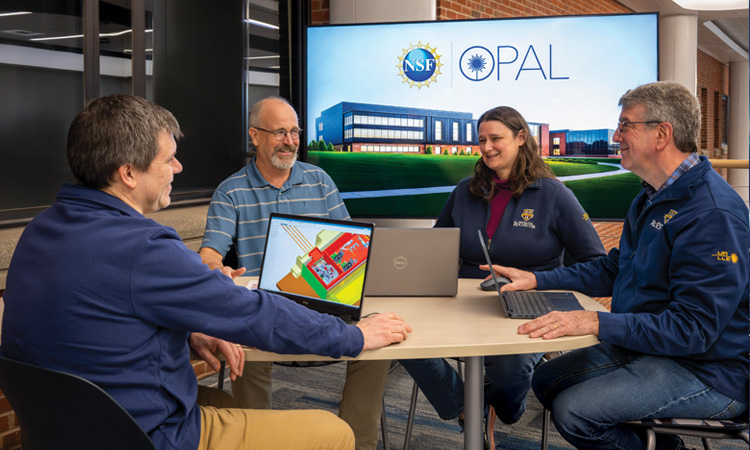 NSF OPAL team members (from left) Matthew Barczys, David Nelson, Elizabeth Hill and Jon Zuegel look at a rendering of the facility. [University of Rochester Laboratory for Laser Energetics photo / J. Deats]
In September 2023, the US National Science Foundation (NSF) awarded a midscale research infrastructure (RI-1) project to design and prototype technologies for NSF OPAL, a next-generation, high-power laser user facility. This multi-institutional project, led by the University of Rochester, USA, envisions two 25-petawatt laser beamlines employing chirped-pulse amplification—a technique developed for the generation of very powerful, ultrashort laser pulses that was recognized by the 2018 Nobel Prize in Physics. It will use optical parametric amplifier line (OPAL) technology to reach this world-leading performance.
…Log in or become a member to view the full text of this article.
This article may be available for purchase via the search at Optica Publishing Group.
Optica Members get the full text of Optics & Photonics News, plus a variety of other member benefits.
