

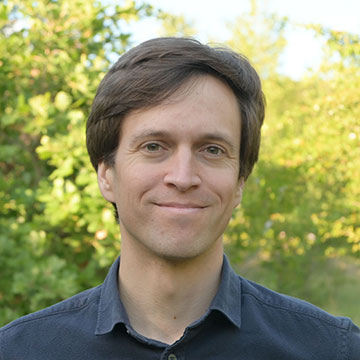
Václav Hanus
In the latest installment of Journeys in Optics, OPN spoke with Václav Hanus, a postdoctoral research fellow at the HUN-REN Wigner Research Center for Physics, Hungary. Hanus was awarded the Bernard J. Couillaud Prize in 2024 for his plans to advance solid-state carrier-envelope phase (CEP) detection and its commercial applications. Hanus talks about his career path, advice for students and early-career researchers and working on science-themed music.
Can you tell us about your career path?
My career trajectory wasn’t so straightforward. As a student finishing high school, I actually wanted to be a programmer. But I also liked physics because we had a good teacher, and I always found it very natural to see the world through the lens of physics. After high school I chose a school that was focused on physics and mathematics, the Czech Technical University in Prague, but my program was working toward a career in IT, like engineering informatics. But I enjoyed physics classes and started mixing more of them into my studies, and I ended up choosing to do a bachelor’s thesis in computational study of some physics phenomena.
Then I met professor Ladislav Drska, which was game-changing for me. I did my bachelor’s thesis and master’s thesis with him. He very much motivated me in physics and lasers because he was very enthusiastic, and he introduced me to great books on the subjects that got me excited as well.
After completing my master’s, I went to Erasmus in Bordeaux, France, which not only changed my point of view but also opened my eyes. At that point, my experience was in computational physics. At the Erasmus program, I learned how science is done, and I saw how much opportunity there was in the world. It was a great experience and helped me realize that I wanted to get a Ph.D.
At the Erasmus program, I learned how science is done, and I saw how much opportunity there was in the world. It was a great experience and helped me realize that I wanted to get a Ph.D.
When I finished those studies, I met some people who were involved with DESY, the laser-plasma wakefield acceleration program in Hamburg, Germany. I started by helping them with calculations and then at some point was able to negotiate doing lab work—I didn’t want to just work on simulations; I wanted to understand how things were happening, to confront the theoretical work with the experiment and the technology.
The program at DESY had a lot of bottlenecks that caused a lot of delays and I was not happy, so after two years I interrupted my Ph.D. there. I wasn’t sure I wanted to do science anymore. I figured I’d do something in the automotive industry or in computing.
But then a friend from my time at Erasmus, who was a postdoc at TU Wien in Vienna, Austria, called me to let me know they had a Ph.D. position opening. This convinced me that I should try to restart my Ph.D. studies.
At TU Wien, I ended up having a wonderful supervisor, Markus Zeiler. He trusted me and believed that I could do well in the lab even though I had limited experimental experience, which gave me confidence. Working with him was a wonderful time, and I learned to operate an ultrafast laser and had the opportunity to operate it for my own experiments.
Can you talk about your current project, and the impact of funding from Optica’s Bernard J. Coiullaud Prize, which supports an innovative project with potential for meaningful impact on ultrafast lasers?
The project I’m working on focuses on CEP (career-envelope phase), which is the basic characteristic of few-cycle laser pulses. I think that this field of physics is slightly neglected, and there are more opportunities in this area than are resonating in the community. Mostly the work involves controlling reactions, controlling currents in matter and so on.
So when I won the Couillaud Prize, I chose a path that would push this field forward, and I was motivated to go even further and write an ERC (European Research Council) proposal. I didn’t end up getting an ERC project, but I resubmitted my proposal to a national-level program here in Hungary, and I got it funded!
Don’t be afraid to admit failure. I don’t feel like the two years I spent in Hamburg, during my Ph.D. that I ended up leaving, were a waste of life. It was just a part of the process.
What advice do you have for students and early-career researchers applying to similar programs and grants?
I would tell people to be completely honest. I just wrote what was on my mind and what I thought I could really do without exaggerating. Once you get the grant, you have to take the path you laid out and then do the work. So be realistic, but at the same time don’t have small goals—if your goals don’t stress you out, they’re not large enough.
Can you talk a bit about the importance of music in your life, and how it relates to your work?
I’m someone who seeks creativity—music is a part of my life and serves as a way to soothe my soul. I did a few songs related to my career and to physics. One song I wrote is about conferences. And then I wrote one where I tried to turn a laser into music—I imagined how I could turn some properties of an ultrafast laser oscillator into a melody or harmony. If you listen to my laser song, you will hear a bouncing of light off mirrors and scattering of the light in the air.
Is there anything you know now that you wish you had known as a student or earlier in your career?
I think my current self and my younger self would understand each other because I haven’t changed much. I usually tell my students not to rush their studies at university. I made my time in school longer by one year, and it was only good. It made my studies very relaxed.
And don't be afraid of changing your mind or realizing that something you have been doing didn't lead anywhere. Don’t be afraid to admit failure. I don’t feel like the two years I spent in Hamburg, during my Ph.D. that I ended up leaving, were a waste of life. It was just a part of the process.
