

Light Touch
The Crystal Cubes of Henry Swan
A look at the invention and rise and fall in popularity of the first autostereoscopic viewer.
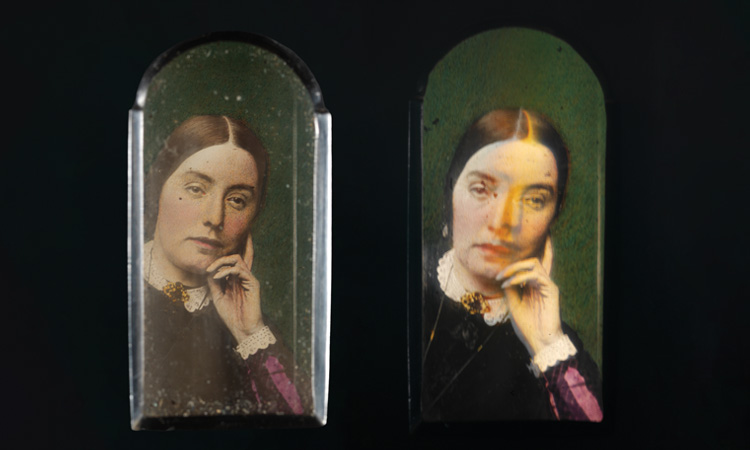 Autostereoscopic and “spectral” views of “Portrait of Sarah Anne Bennett,” Casket Portrait Co. Ltd., ca. 1865. [© Victoria and Albert Museum, London; Given by Margaret Bennett]
The Great Exhibition of 1851 at the Crystal Palace in London’s Hyde Park was a showcase of the latest science and technology. It featured scientific instruments of all kinds, including one exhibit that took the fancy of Queen Victoria, a version of David Brewster’s stereoscope. Looking into its twin lenses, one for each eye, the viewer saw a daguerreotype image that had the unmistakable, almost-tangible quality of three dimensionality. It was a unique novelty that became a major fad for the rest of the Victorian era, both in the United Kingdom and elsewhere.
…Log in or become a member to view the full text of this article.
This article may be available for purchase via the search at Optica Publishing Group.
Optica Members get the full text of Optics & Photonics News, plus a variety of other member benefits.
