

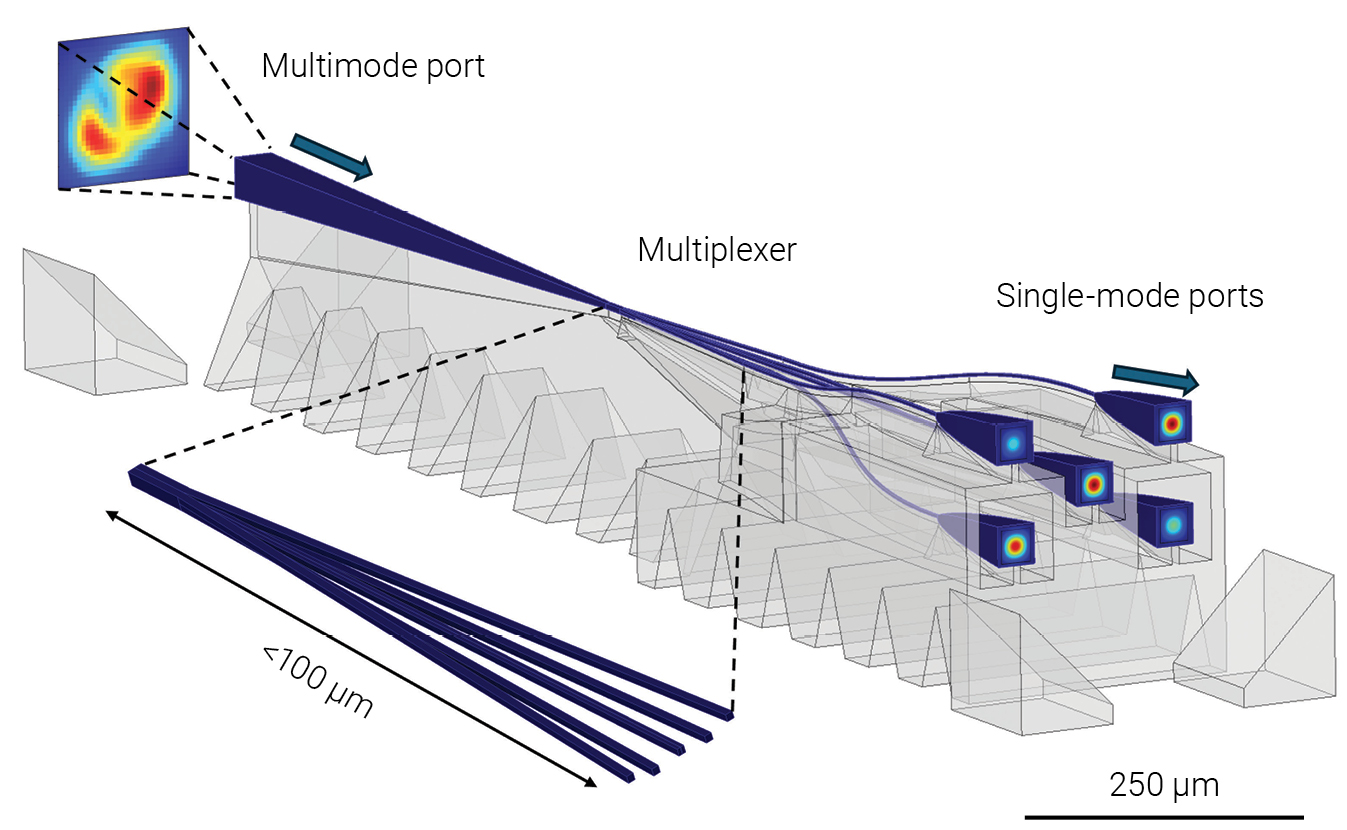
 [Enlarge image]Design of the standalone 1 × 5 photonic lantern component. The optical parts are pictured in blue. The support and fiber alignment structures are in grey. The multiplexer region is magnified for better visualization.
Photonic lanterns (PLs) are impressive mode (de-)multiplexing components that enable complex functions in optical systems such as mode management, efficient light collection and multimodal wavelength filtering.1 Over the last decade, the development of cutting-edge PL devices has proven their invaluable benefit in state-of-the-art photonics applications, especially in the fields of astrophotonics and optical interconnects.
Traditionally, PLs are made using fiber technology, but the trend toward miniaturization and integration of photonic components into compact and highly scalable systems encourages researchers to find new fabrication platforms that are compatible with integrated photonics technology. A promising fabrication platform for this purpose is two-photon polymerization–based direct laser writing (TPP-DLW), a 3D-polymer-additive manufacturing technique offering great freedom of design and fast development cycles. In previous work, TPP-DLW has proved its ability to realize low-loss 3D waveguides and interconnect components.2
In our recent publication,3 we demonstrate a simple approach for the design and fabrication of TPP-DLW 3D-printed PLs. Our proposed methodology enables fast and computationally efficient simulations of a versatile 1 × 5 PL design, showcasing low insertion loss (≤ 0.5 dB) and mode-dependent loss (≤ 0.4 dB). This first prototype, designed for single-mode multi-core fiber to multimode fiber connection, was fabricated using TPP-DLW and characterized with promising results.
We highlight a low insertion loss of ≤ 6.9 dB for the complete component, including the multiplexer region where the mode(s) processing occurs, fiber-polymer mode interfacing tapers, 3D-printed S-bend waveguides, and a robust supporting structure with minimal impact on the optical performance of the PL component. Owing to the supporting structure, our design is inherently standalone, meaning that the PL component stands on its own and does not depend on the substrate material. This allows for flexible integration of the PL onto fibers, chips and other advanced platforms for ultra-compact and custom solutions.
In future work, this first demonstrator can be further upgraded using our methodology to lower-loss, higher-port-count designs, enabling disrupting applications in fields such as astrophotonics, where efficient light collection and dense mode management are critical for next-generation astronomical instrumentation.
Researchers
Arié Nacar (arie.alain.i.nacar@vub.be), Koen Vanmol, Tigran Baghdasaryan and Jürgen Van Erps, Vrije Universiteit Brussel, Belgium
References
1. N. Jovanović et al. J. Phys. Photonics 5, 042501 (2023).
2. T. Baghdasaryan et al. J. Phys. Photonics 3, 045001 (2021).
3. A. Nacar et al. IEEE J. Sel. Top. Quantum Electron. 32, 1 (2026).
