

The judges in OPN’s 21st annual contest selected among a wealth of memorable images, with standouts ranging from a Tesla coil exciting low-pressure gas to adhesive tape between polarizing sheets to broadband supercontinuum bright squeezed vacuum emission. We thank them for their insight: Alvaro Casas Bedoya, Antigone Marino, Yoshitomo Okawachi, Andrea Liliana Pacheco Tobo, Anca Sala and Susanna Thon.
You can see all of this year’s contest entries at optica-opn.org/contest/2026.
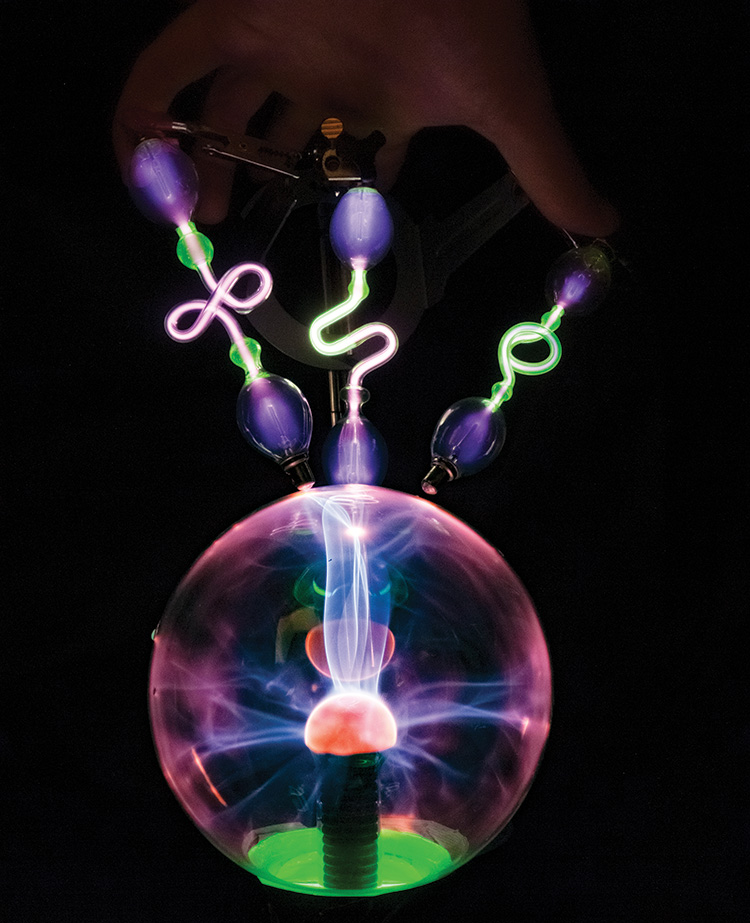
FIRST PLACE
A Tesla coil excites low-pressure gas in curved Geissler tubes, producing vivid violet discharges that trace the tubes’ intricate glass paths. The contrasting green glow and luminous plasma illustrate the interaction of high-frequency electromagnetic fields with matter.
—Borislav Simonović, Gimnazija Čačak, Serbia
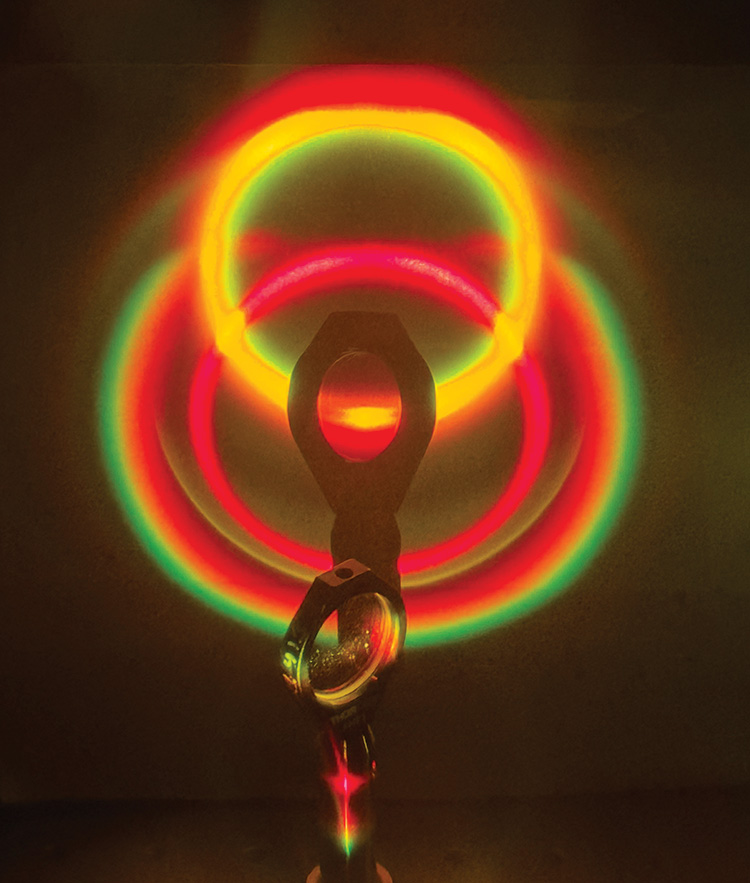
SECOND PLACE
Concentric rings of color surround an optical setup used to generate broadband bright squeezed vacuum (BSV) light from a 4-mm beta-barium borate crystal. A dichroic mirror reflects the 515-nm pump beam. The picture shows BSV rings centered on the pump and displaced sum-frequency generation rings from non-conjugate BSV pairs. The detected spectral range of 200–2100 nm is measured using UV-visible and shortwave-infrared spectrometers. Image captured through YL-780 CYAG safety goggles at Liao Lab, Indiana University, USA, using an iPhone 15 Pro Max with no editing.
—Amr Hossameldin, Indiana University, Bloomington, IN, USA
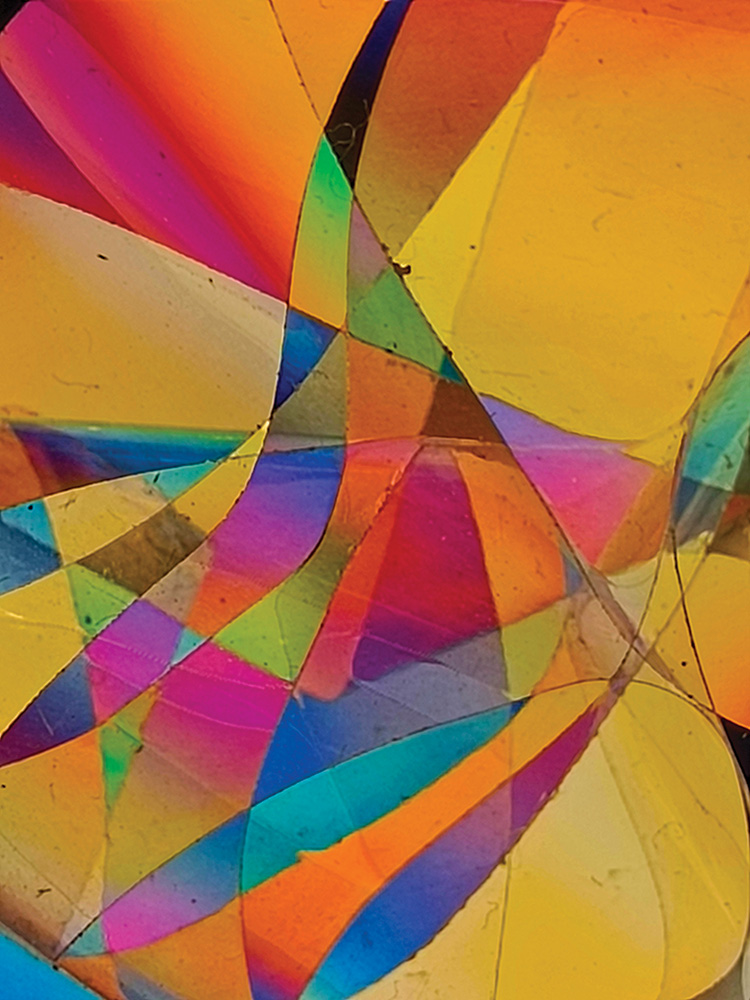
THIRD PLACE
A transparent strip of adhesive tape, folded and twisted into a 3D knot, reveals vivid interference colors when placed between two linear polarizers and illuminated by sunlight. Stress-induced birefringence combined with the multiple folds, layers and varying degrees of deformation creates spatial variations in the optical path and phase retardation, giving the structure an appearance reminiscent of a crystalline formation. Image captured directly through the polarizing arrangement with a smartphone camera under natural sunlight. No digital effects were used to create the colors.
—Ana Karen Reyes, Universidad Tecnológica de Tulancingo, Tulancingo de Bravo, Mexico
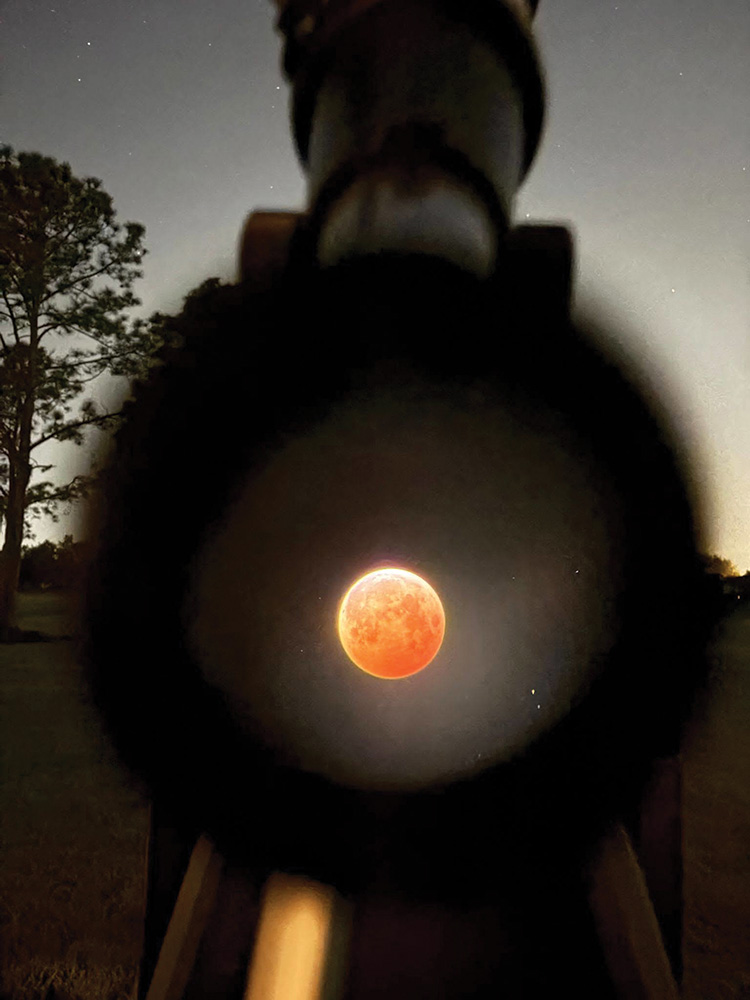
HONORABLE MENTION
A total lunar eclipse, captured using a smartphone camera aligned with a consumer telescope, illustrates the optical phenomenon known as Rayleigh scattering. During totality, the Earth blocks direct sunlight from reaching the moon. Instead, Earth’s atmosphere filters and bends the light, scattering short blue wavelengths while allowing longer red wavelengths to pass through and illuminate the lunar surface. In the foreground, the blurry silhouette of the telescope’s eyepiece frames the deep red moon glowing in the night sky, showing the perspective of a backyard astronomer. The background blends the dark sky with the soft shapes of the natural landscape below, connecting the cosmic event to our view from Earth.
—Javier A. Gonzalez, University of Central Florida, Orlando, FL, USA
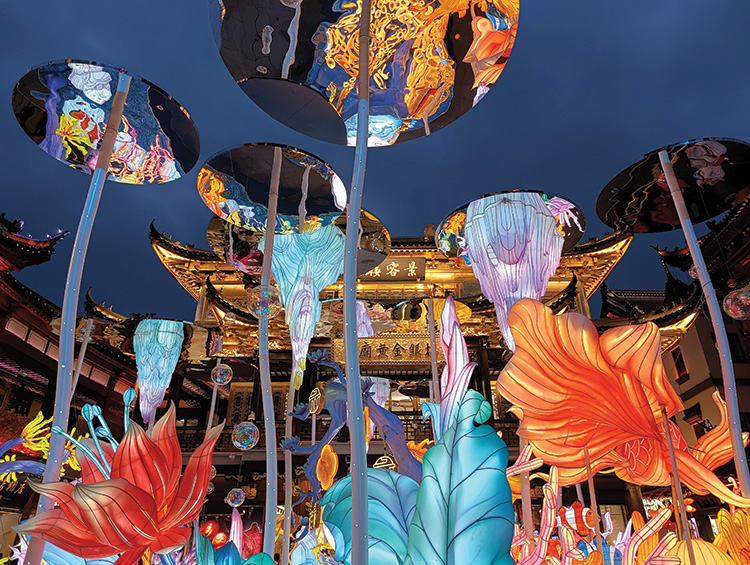
HONORABLE MENTION
In the area around Yu Garden, Shanghai, China, light becomes both structure and story. Vivid lanterns bloom into flowers and abstract forms, transforming the night into a landscape shaped entirely by glow. The installation highlights how communities use illumination to create shared spaces of wonder, where cultural heritage and modern optics meet. The photograph captures that encounter: light as technology, as culture and as a moment of connection.
—Pasquale Ercolano, University of Naples Federico II, Italy

HONORABLE MENTION
A footprint pressed into beach sand appears to rise above the surface due to an optical illusion created by the interplay of illumination and shadow. This phenomenon, known as shape-from-shading, occurs because the human visual system infers 3D structure from brightness gradients and typically assumes that light originates from above. Under this assumption, the shadow pattern within the footprint can be misinterpreted, causing the concave depression to be perceived as a convex protrusion.
—Achini Ovitigala, Mississippi State University, MS, USA

HONORABLE MENTION
A green glow illuminates the optical components of a two-crystal optical parametric oscillator developed at the Physical Research Laboratory, Ahmedabad, India. The shared-cavity design generates two signal pulses in the near-IR with controllable wavelength, polarization, temporal separation and repetition rate, offering a versatile platform for ultrafast pump–probe spectroscopy.
—Anirban Ghosh, PRL Ahmedabad, India

EDITORS’ CHOICE
A weaver ant reaches toward a suspended water droplet. In this striking macro photograph, the droplet acts as a tiny lens, refracting light through its curved surface.
—Sai Krishna, saipixels - macro photographer india, civil engineer, Hyderabad, India
