

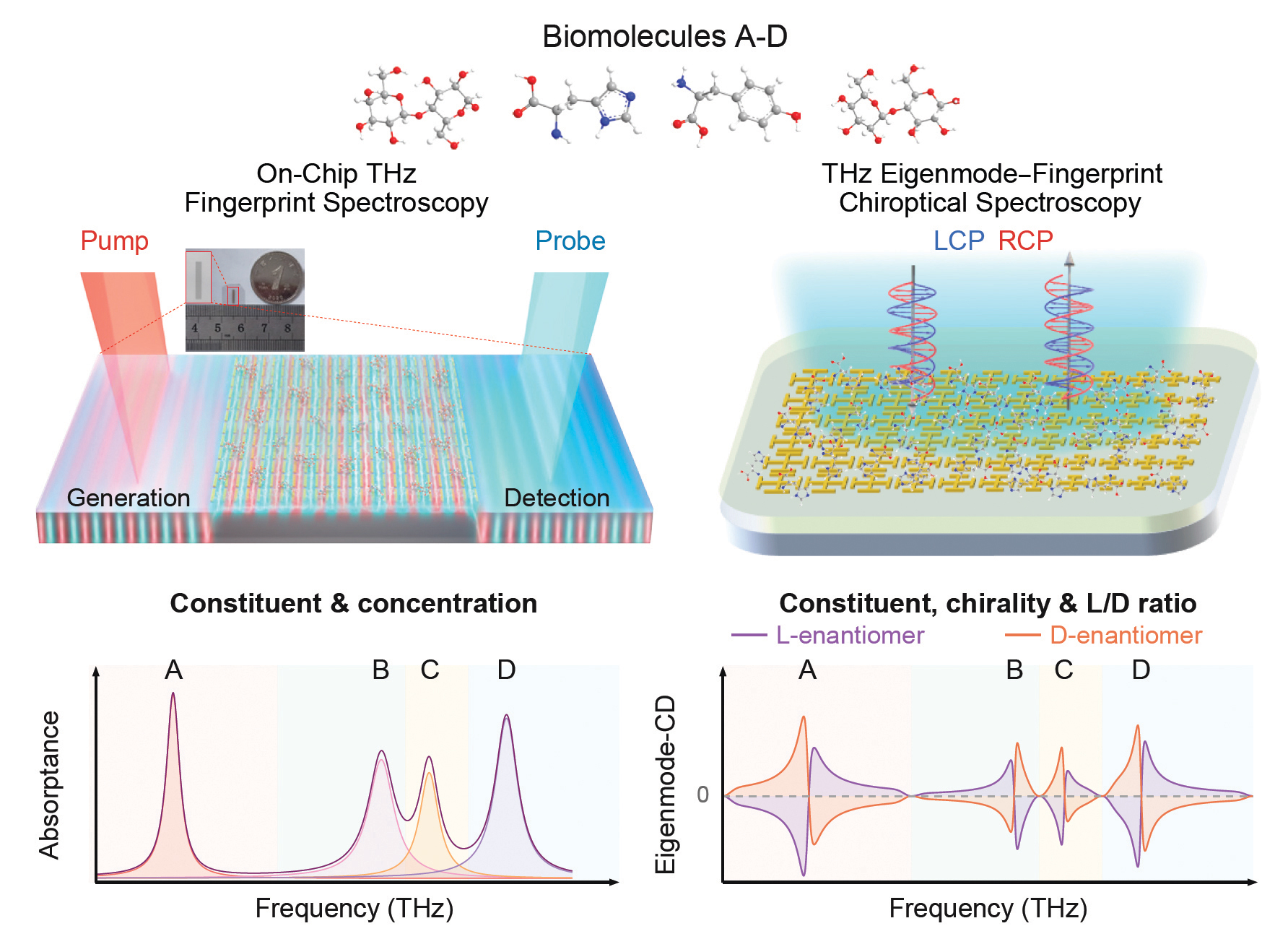
 [Enlarge image]Top left: Monolithic THz metasensor on a 4 mm × 8 mm lithium niobate (LN) chip integrating THz generation, biomolecule interaction and detection. Inset: Chip photograph beside a Chinese one-yuan coin. Bottom left: Fingerprint absorption spectra identify constituents and quantify concentrations. Top right: Achiral gradient metasurface enhances molecular chiral vibrations through photon–phonon coupling. Bottom right: Eigenmode–fingerprint circular dichroism (CD) spectra resolve constituents, chiralities and L/D enantiomer ratios. Both spectra are schematic. LCP and RCP denote left- and right-handed circular polarization, respectively.
Terahertz waves have low photon energies, are nonionizing and nondestructive, and resonate with the vibrational modes of biomolecules, making THz spectroscopy a label-free probe of intrinsic molecular fingerprints.1,2 Applications ranging from pharmaceutical quality control to clinical diagnostics have long awaited a THz molecular analyzer. Yet the vision of a handheld THz molecular analyzer remains distant: Conventional THz time-domain spectroscopy (THz-TDS) relies on bulky, spatially separated sources, propagation paths and detectors, while weak light–matter interactions limit sensitivity, especially for complex and chiral mixtures.
Recently, we proposed a fully integrated THz metasensor on a monolithic lithium niobate (LN) chip.3 Exploiting the exceptional optical nonlinearity of LN, a single 4 mm × 8 mm chip serves simultaneously as THz source and detector. A femtosecond pump pulse generates the THz wave, and a probe pulse reads out the transmitted field. A periodic metasurface converts the THz wave from a subwavelength waveguide mode into broadband, surface-confined spoof surface plasmon polariton modes, concentrating the field at the chip surface where the molecules reside and strongly enhancing light–matter interaction. The result is a five-order-of-magnitude reduction in the size of the THz functional module relative to conventional THz-TDS systems.
The chip accurately identifies and quantifies mixtures of four biomolecules, L-histidine, L-tyrosine, α-lactose and maltose, which are critical to support essential body functions, metabolism and nutrition, with relative errors below 3.6%. This marks a transition of THz fingerprint sensing from bulky, qualitative systems toward portable, quantitative biomolecular analyzers on a chip.
Meanwhile, in a companion work, we demonstrated an achiral gradient metasurface (AGM).4 Its broadband hybridized plasmonic resonances are engineered to spectrally overlap the chiral-phonon modes of biomolecules.5 The resulting resonant photon–phonon coupling directly amplifies the molecules’ intrinsic chiral vibrations. From the augmented eigenmode–fingerprint circular dichroism spectra, the constituents, chiralities and enantiomer ratios of chiral mixtures are resolved with two orders of magnitude higher sensitivity than conventional THz chiral-phonon detection. This capability could transform THz chiral spectroscopy from a largely qualitative probe of molecular handedness into a more powerful analytical tool for simultaneous molecular identification, chirality determination and quantitative enantiomeric analysis, with particular potential for pharmaceuticals, biomolecular analysis and complex chemical mixtures.
Together, these advances map a complete route for THz biosensing: monolithic integration for compactness, polariton-enhanced coupling for performance. With further gains in bandwidth, coupling efficiency and machine-learning-assisted analysis, chip-scale THz platforms could move label-free molecular identification from laboratory benches to clinical, pharmaceutical and point-of-care applications.
Researchers
Yao Lu, Yijia Zang, Xitan Xu, Qiang Wu (wuqiang@nankai.edu.cn) and Jingjun Xu (jjxu@nankai.edu.cn), Nankai University, China
Baohua Jia (baohua.jia@rmit.edu.au), RMIT University, Australia
References
1. M. Tonouchi. Nat. Photon. 1, 97 (2007).
2. X. Yang et al. Trends Biotechnol. 34, 810 (2016).
3. X. Xu et al. Light Sci. Appl. 15, 345 (2026).
4. Y. Zang et al. Adv. Mater. 38, e73026 (2026).
5. W.J. Choi et al. Nat. Photon. 16, 366 (2022).
