

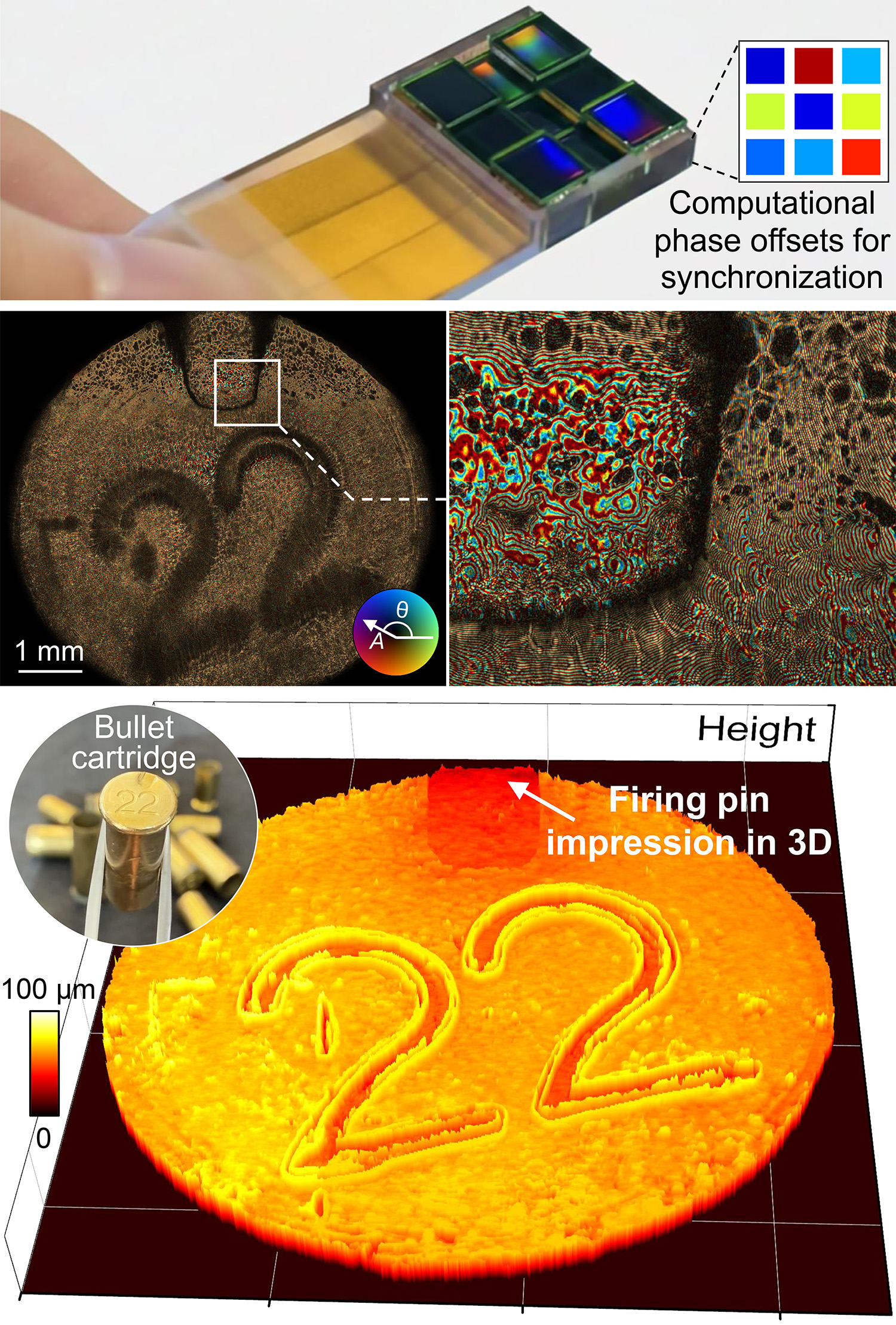
 [Enlarge image]Top: Multiscale aperture synthesis imager (MASI), with each sensor’s computationally recovered phase offset shown as a color block. Middle: Synchronized complex field of a bullet cartridge, with brightness encoding amplitude and hue encoding phase. Bottom: 3D reconstruction computed from the synchronized complex field, resolving the firing-pin impression without axial scanning.
In 2019, the Event Horizon Telescope (EHT) produced the first image of a black hole.1 It did so using synthetic-aperture imaging, which coherently combines measurements from separated receivers to simulate an aperture far larger than any one of them—in this case, the size of Earth. Coherent combination requires those receivers to be synchronized to a small fraction of a wavelength. At radio wavelengths, that tolerance is loose enough for atomic clocks to hold, so the dishes need no physical connection. Visible light has wavelengths orders of magnitude shorter, and no clock comes close. Optical synthetic-aperture imaging has therefore depended on interferometry,2 which requires reference waves to be maintained across the whole array to within a fraction of a wavelength.
The multiscale aperture synthesis imager (MASI) moves that synchronization out of the hardware and into the reconstruction.3 Nine lensless image sensors, each with a disorder-engineered coded surface in place of its cover glass, record diffraction patterns independently, with no reference wave, no interferometer and no overlap between neighboring sensors. Each sensor recovers a complex field of the object on its own, but the nine fields carry unknown phase offsets, precisely what the EHT’s clocks exist to pin down. One sensor is held as the reference while the other eight are tuned until the fused field reaches maximum energy, following the same principle used in adaptive optics to shape a wavefront. The process converges within a few iterations.
In reflection at a 2-cm working distance, a single sensor resolved 2.19-µm linewidths, while the synchronized fusion of all nine reached 780 nm, a scale conventional optics typically achieves only at submillimeter working distances. Diffraction also carries information beyond the detector footprint, so padding one sensor’s wavefield before backpropagation expanded the reconstructed area 16-fold, resolving an entire mouse brain section that does not appear in the raw data. The recovered field encodes depth, yielding 3D maps of a firing-pin impression without axial scanning.
The independence of the sensors enables the approach to scale. Optimizing one global phase per sensor, rather than one per pixel, keeps the parameter space small enough to converge even though each sensor recovers hundreds of megapixels. For far-field imaging, the array has no intrinsic size limit. Like the EHT, MASI leaves gaps between apertures and therefore misses the spatial frequencies those gaps would carry. Unlike the EHT, each aperture it adds requires only another phase-offset parameter for optimization, not another atomic clock.
Researchers
Ruihai Wang, Qianhao Zhao (qianhao.zhao@uconn.edu) and Guoan Zheng, University of Connecticut, USA
References
1. K. Akiyama et al. Astrophys. J. Lett. 875, L4 (2019).
2. S.A. Alexandrov et al. Phys. Rev. Lett. 97, 168102 (2006).
3. R. Wang et al. Nat. Commun. 16, 10582 (2025).
Visit optica-opn.org/optics-in-2026 to view the video that accompanies this article.
