

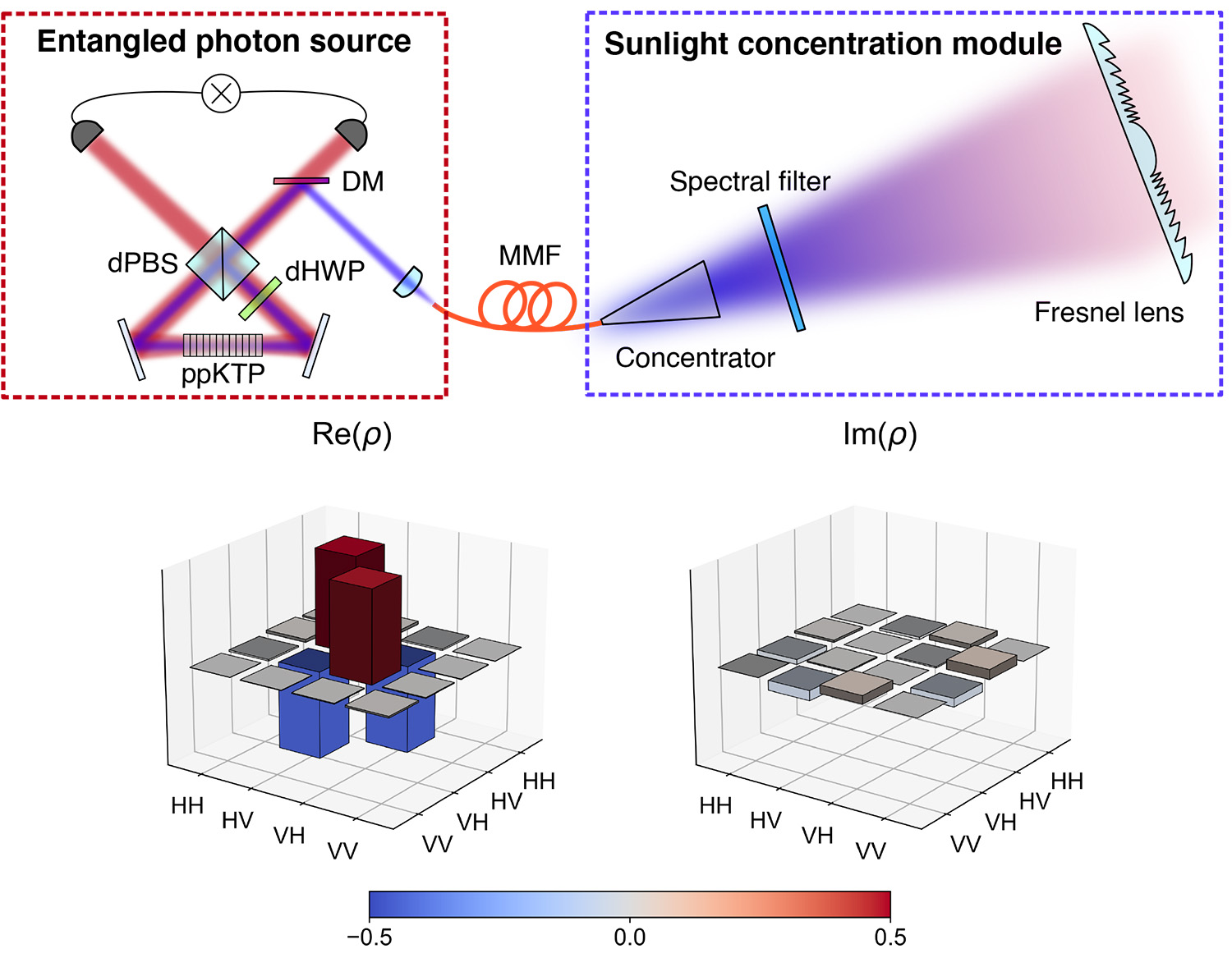
 [Enlarge image]Top: Sunlight is collected using a Fresnel lens, guided into a multimode fiber (MMF) using a custom-made tapered conical concentrator and focused into a ppKTP-crystal Sagnac interferometer to generate polarization-entangled photon pairs. Bottom: Reconstructed real and imaginary parts of the two-photon density matrix.
Quantum information applications have promised secure communication, precision sensing and efficient computation, but their energy costs have raised concerns.1 In photonic quantum technology, a considerable portion of the energy overhead comes from lasers. A crucial case is the generation of quantum-entangled photons via spontaneous parametric down-conversion (SPDC). Traditionally, lasers are used to pump nonlinear crystals to induce SPDC. While lasers have long been considered indispensable for entanglement generation due to their high coherence and intensity, they add optical, electrical and thermal-management requirements. In recent work,2 we have shown, for the first time, that natural and incoherent sunlight can directly generate high-quality polarization-entangled photons.
The key principle is that the pump beam does not need to be coherent in every degree of freedom; it only needs to preserve coherence in the same degree of freedom as the desired entanglement (in our case, polarization). Experiments using LEDs showed that spatiotemporally highly incoherent light can generate polarization-entangled photon pairs.3,4 Moreover, a separate demonstration showed that focused sunlight can be strong enough to induce SPDC and produce photon pairs.5
In our experiment, we introduced a well-defined polarization to the sunlight while allowing it to remain highly incoherent in space and time. To efficiently deliver the solar irradiance to a millimeter-scale nonlinear crystal, we developed a solar concentration system combining a window-sized Fresnel lens with a tapered conical glass concentrator, guiding sunlight into a fiber. The concentrated sunlight pumped a periodically poled potassium titanyl phosphate (ppKTP) crystal in a Sagnac interferometer to generate polarization-entangled photon pairs.
The reconstructed two-photon density matrix yielded a Bell-state fidelity of 0.939 ± 0.027 and concurrence of 0.905 ± 0.053. We further measured a Clauser-Horne-Shimony-Holt (CHSH)-type Bell parameter of S = 2.5408 ± 0.2171, exceeding the classical bound of 2 and demonstrating nonclassical correlations. Also, the achieved pair-generation performance is comparable to laser-pumped systems after accounting for the phase-matching bandwidth.
These results show that sunlight-driven quantum light sources could be a viable alternative to laser-driven ones and may ultimately reduce the optical and energy overhead of photonic quantum systems. This work marks the first step toward energy-efficient and sustainable quantum technologies. Our results could be particularly relevant for expanding quantum technology for satellites, remote platforms and future deep-space missions.
Researchers
Cheng Li, University of Ottawa, Canada, and Lawrence Berkeley National Laboratory, USA
Jasvinder Brar, Michael Küblböck and Hanieh Fattahi (hanieh.fattahi@mpl.mpg.de), Max Planck Institute for the Science of Light, Germany, and Friedrich-Alexander-Universität Erlangen-Nürnberg, Germany
Jeremy Upham, University of Ottawa, Canada
Robert W. Boyd (rboyd@uottawa.ca), University of Ottawa, Canada, and University of Rochester, USA
References
1. A. Auffèves, PRX Quantum 3, 020101 (2022).
2. C. Li et al. Optica 13, 1508 (2026).
3. C. Li et al. Phys. Rev. A 107, L041701 (2023).
4. C. Li et al. Phys. Rev. A 112, 053726 (2025).
5. Y. Xing et al. Adv. Photonics 8, 036011 (2026).
