

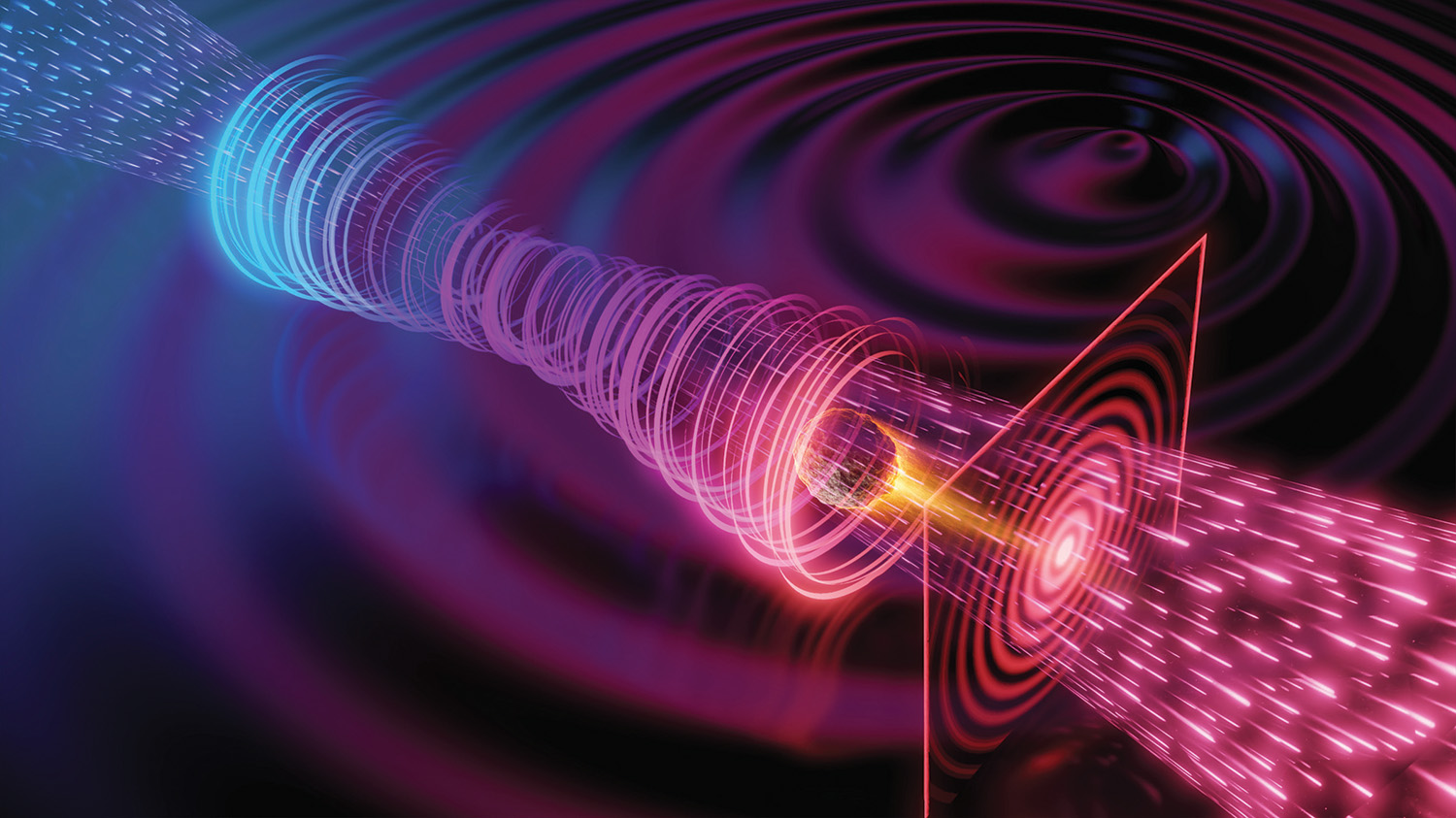
 [Enlarge image]Structure-shearing Doppler effect (SDE).
A beam’s shape can change how motion shifts its frequency.1,2,3 For nearly two centuries, the Doppler effect has connected motion with frequency, underpinning measurements from stellar velocities to laser velocimetry. Yet its standard optical formulation generally treats the probe as a plane wave. That approximation overlooks a defining property of real and structured beams, which is that spatial confinement spreads their wave vectors across the transverse plane. A fundamental physics question has gradually emerged: How does the spatial structure of a light field influence the Doppler shift?
We recently showed that the transverse structure of a light field modifies the Doppler shift.4 Each off-axis component has a reduced longitudinal wave vector, so a structured beam reflected from a longitudinally moving target acquires an additional redshift relative to the plane-wave prediction. We call this general correction the structure-shearing Doppler effect (SDE). It builds on the broader recognition that spatial structuring can modify a beam’s propagation velocity and phase evolution.5 This effect is universal, applicable not only to structured light waves and photons but also potentially to sound waves and other wave phenomena. This discovery implies that in any practical optical system, due to the finite size and diffraction effects of the beam, the conventional Doppler shift formula can be corrected using SDE theory.
This physics has enabled a new measurement architecture, namely reference-free structural Doppler velocimetry (SDV). Conventional laser Doppler velocimeters usually mix a Doppler-shifted signal with a separate reference or second probe path. In SDV, two coaxial spatial modes are carried by one structured probe beam and acquire different Doppler shifts after reflection. Their inter-mode beating is detected locally or through spatial-mode filtering, eliminating the external reference path. The common-path design simplifies alignment and suppresses differential environmental disturbances. Experiments demonstrate that SDV has lower measurement uncertainty and exhibits a better signal-to-noise ratio in obstacle-avoidance measurements. In addition, when monitoring varying motion such as vibration, its linear operating range is six orders of magnitude greater than that of traditional laser velocimeters, effectively resolving the wavelength ambiguity.
The implications extend beyond one beam family. For fields with broad or irregular wave vector spectra, such as optical speckles, the SDE predicts a statistical distribution of additional redshifts and a broadened Doppler spectrum. The framework may refine Doppler analysis in astronomy, laser cooling and confined light–matter interactions. Technologically, the reference-free interferometric implementation of SDV demonstrates unique value in target monitoring for supporting robust industrial, biomedical, underwater and shock-physics sensing, opening new paths for the development of high-performance optical metrology technologies. More broadly, the work shows that sculpting light can reshape not only what a beam looks like, but also how it measures motion.
Researchers
Zhenyu Wan, Ziyi Tang and Jian Wang (jwang@hust.edu.cn), Huazhong University of Science and Technology, China
References
1. M.P.J. Lavery et al. Science 341, 537 (2013).
2. L. Fang et al. Nat. Commun. 12, 4186 (2021).
3. Z. Wan et al. Light Sci. Appl. 14, 88 (2025).
4. Z. Wan et al. Nat. Commun. 16, 10004 (2025).
5. D. Giovannini et al. Science 347, 857 (2015).
