

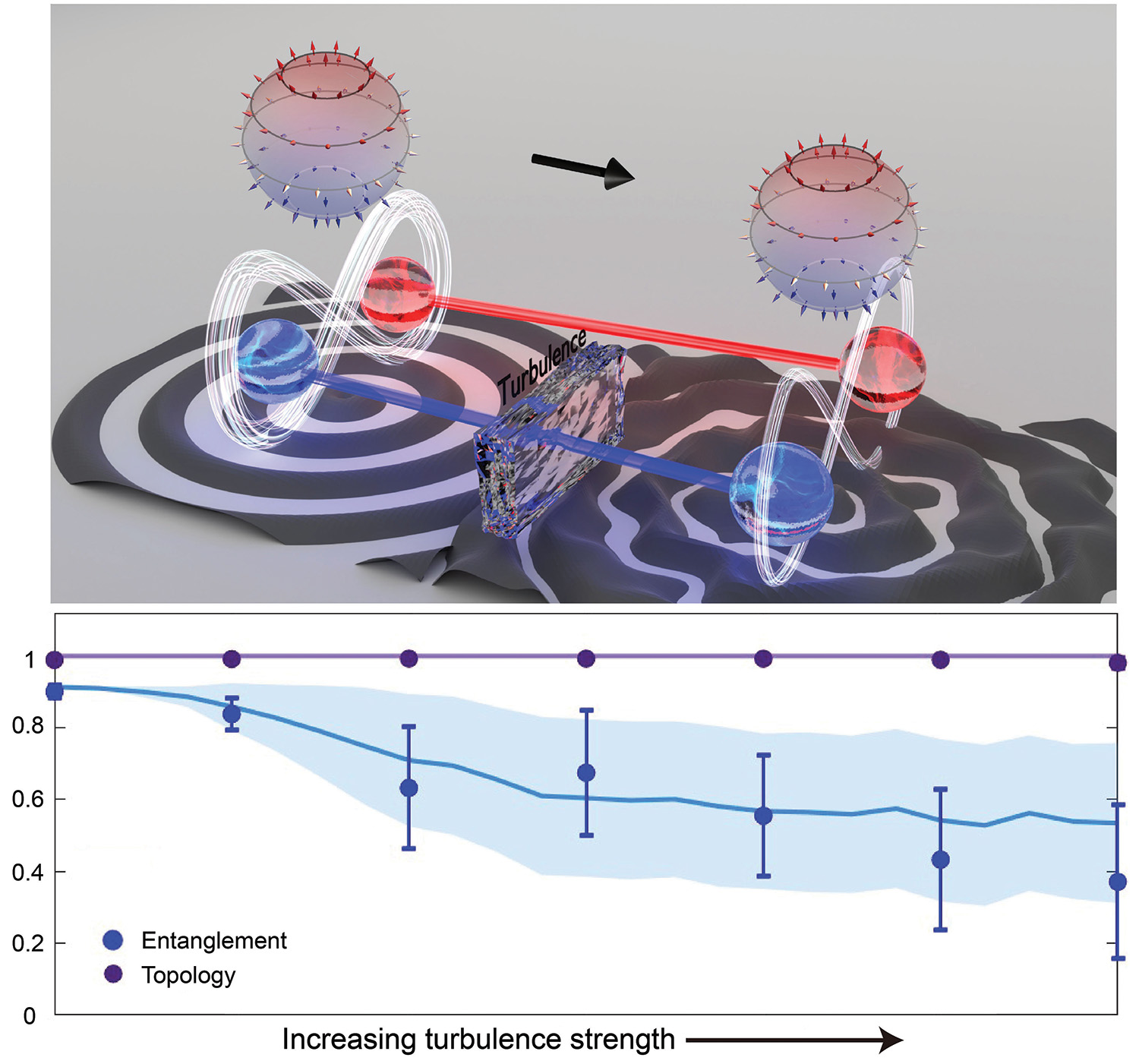
 [Enlarge image]Quantum entangled optical skyrmions under atmospheric turbulence. Top: Turbulence deforms the spatial mode and reconstructed skyrmion texture. Bottom: With increasing turbulence strength, the entanglement decays, whereas the skyrmion number remains intact.
For light propagating through the atmosphere, random refractive-index fluctuations scramble the beam’s intensity, phase and spatial structure, posing a fundamental challenge to free-space communication and satellite links. Many spatial optical encodings rely on local features that become difficult to recognize once they are distorted. Topology offers a different strategy: Information can instead be encoded in a global property that remains unchanged under smooth deformations.
One realization in structured light is the optical skyrmion, a particle-like texture in which the optical field continuously maps the transverse plane onto the entire parameter sphere. The texture may bend and distort, but its total winding, quantified by the skyrmion number, can remain intact. Optical skyrmions can be formed in both classical1 and quantum regimes,2 within a single beam or shared through the entanglement between two photons. We have now shown that this topological robustness extends to complex atmospheric channels.3 To do so, we engineered quantum and classical skyrmions and passed them through turbulence. In the quantum version, the spatial mode of one photon was entangled with the polarization of another, fulfilling a topological map; classically, spatial mode and polarization were coupled in one beam. After sending the spatial component through programmable turbulence, we reconstructed the textures through classical and quantum Stokes projections.
We found that the local spatial structure of the photons changed markedly, but the topological label remained stable. Increasing turbulence warped the quantum texture and reduced the entanglement, while the skyrmion number stayed close to unit. Classical beams behaved similarly: Although their intensity and polarization patterns became heavily distorted, integer labels from 1 to 5 remained distinguishable across a broad range. Wave-optics simulations extended this to a 100-m channel with five distributed phase screens, where the labels remained recoverable. This prediction has since been verified for classical optical skyrmions in an outdoor experiment over 270 m, confirming the potential of topology in real-world settings.4
Why does the number remain stable when the picture doesn't? Picture the transverse plane as a rubber sheet mapped onto the Poincaré sphere. Turbulence can stretch and wrinkle the sheet, but if the mapping remains continuous and preserves orientation, the number of wraps can't change. The same mechanism explains the shared topological response of the quantum entangled and classical textures. These results position optical topologies as a design principle for information transmission through complex channels. Questions include how finite apertures, loss, detector noise and stronger distributed turbulence determine the useful operating range, and how topological labels can be combined with conventional modulation and error correction. Exploring these directions could advance optical skyrmions toward free-space classical links, turbulence-resilient quantum comms and satellite-to-ground photonic systems.
Researchers
Zhenyu Guo, Nilo Mata- Cervera, Anton N. Vetlugin, Ruixiang Guo and Yijie Shen (yijie.shen@ntu.edu.sg), Nanyang Technological University, Singapore
Pei Zhang (zhangpei@mail.ustc.edu.cn), Xi’an Jiaotong University, China
Cade Peters and Andrew Forbes (andrew.forbes@wits.ac.za), University of the Witwatersrand, South Africa
References
1. Y. Shen et al. Nat. Photon. 18, 15 (2024).
2. P. Ornelas et al. Nat. Photon. 18, 258 (2024).
3. Z. Guo et al. Nat. Commun. 17, 2085 (2026).
4. C. Peters et al. Sci. Adv. 12, eaee2671 (2026).
