

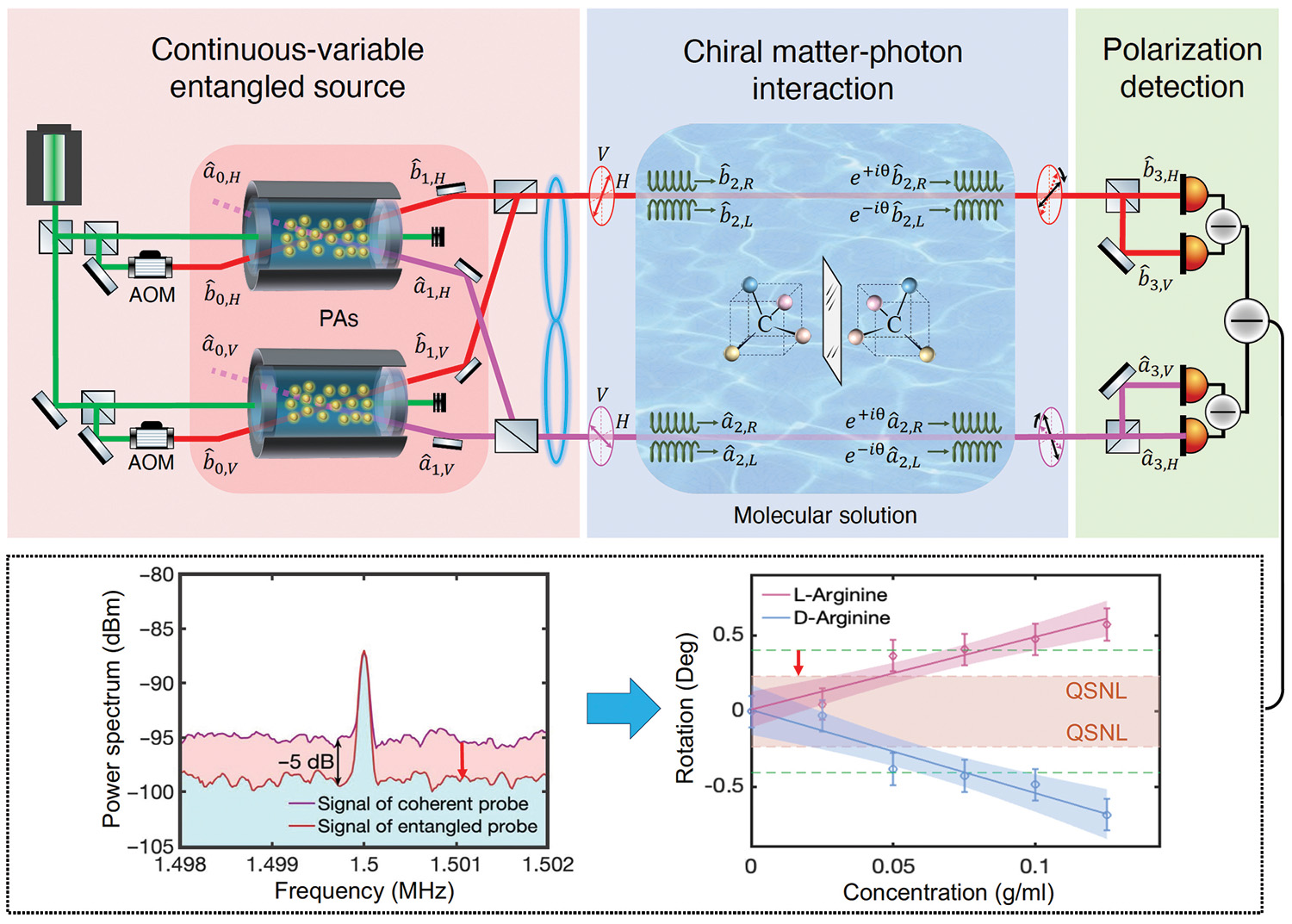
 [Enlarge image]Top: Polarization-entangled probe derived from quantum twin interferometry for chiral discrimination. Bottom: A measured 5-dB enhancement over a coherent probe at the same photon flux corresponds to a three-fold increase in signal-to-noise ratio and, consequently, in chiral-discrimination capability.
The coherence of laser light has revolutionized modern optical metrology. Yet even an ideal laser beam exhibits photon shot noise—the random variation in detected photon number—which sets the standard quantum limit (SQL) for phase sensitivity. With classical probes, more photons improve absolute sensitivity, but excessive power can cause measurement back-action or photodamage. Practical quantum sensing therefore requires a suitable photon flux together with quantum enhancement beyond the classical limit.1
A promising approach beyond the SQL is the SU(1,1) interferometer (SUI). After demonstrating quantum-noise cancellation in a parametric amplifier in 2013,2 we realized a quantum-enhanced optical SUI in 2014.3 Yet photon-correlated interferometers still operate far below practical sample-damage thresholds, leaving the available photon budget underused and absolute sensitivity too low for applications. The challenge is therefore to scale sensing power toward the sample-compatible limit while preserving quantum advantage, thereby gaining sensitivity beyond what further increases in power can safely provide.
To overcome this limitation, we reconsidered how phase information is extracted from quantum-correlated fields. Many schemes rely on homodyne detection, in which the sensing field interferes with a much stronger reference beam, or local oscillator. The resulting power imbalance leaves most photons in a reference field that does not probe the phase. We therefore developed the quantum twin interferometer (QTI), which employs two pairs of entangled twin beams as equally bright sensing and reference fields.4 Joint detection adds the phase signals while canceling correlated fluctuations, creating a balanced, high-visibility configuration that uses photons efficiently. The QTI maintained a 3-dB quantum enhancement in signal-to-noise ratio as the phase-sensing power increased from below 1 µW to the milliwatt level, while increasing the absolute signal-to-noise ratio by three orders of magnitude over previous photon-correlated interferometers.
This advance moved photon-correlated sensing into an application-relevant power regime and extended it from phase interferometry to molecular sensing. Building on the QTI architecture, we reconfigured the interferometer to mix polarizations, creating a polarization-entangled probe that combines moderate photon flux with quantum-noise suppression for molecular chirality. Joint polarization detection preserved the weak optical rotation produced by left- and right-handed molecules while suppressing quantum fluctuations. We used this probe to demonstrate a 5-dB quantum enhancement in the discrimination of L- and D-arginine in solution.5
Together, these advances transform photon-correlated interferometry from low-power demonstrations into a scalable, application-oriented platform that combines practical probe power with quantum enhancement over classical probes at the same photon flux.
Researchers
Wei Du, Yiquan Yang, Shuhe Wu, Xiaolong Hu, Dong Zhang, Jun Chen, Peiyu Yang, Jinxian Guo, Guzhi Bao (guzhibao@sjtu.edu.cn) and Weiping Zhang (wpz@sjtu.edu.cn),School of Physics and Astronomy, and Tsung-Dao Lee Institute, Shanghai Jiao Tong University, Shanghai, China
References
1. L. Pezzè et al. Rev. Mod. Phys. 90, 035005 (2018).
2. J. Kong et al. Phys. Rev. Lett. 111, 033608 (2013).
3. F. Hudelist et al. Nat. Commun. 5, 3049 (2014).
4. W. Du et al. Sci. Adv. 11, eaea0816 (2025).
5. Y. Yang et al. Sci. Adv. 12, eaea8201 (2026).
