

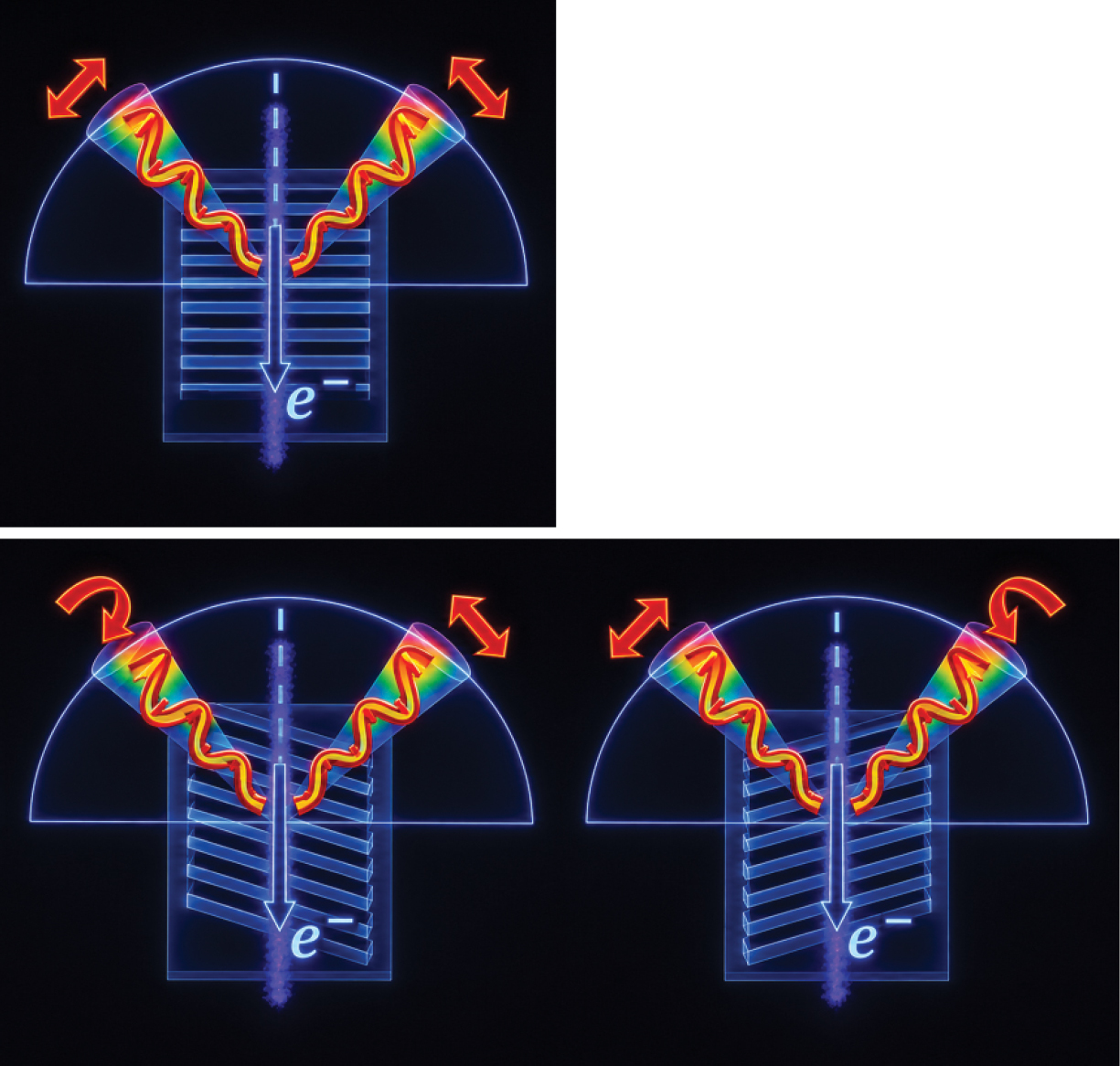
 [Enlarge image]Controlling the polarization of Smith–Purcell radiation through grating orientation. The regular grating (top) produces symmetric linear polarization, whereas the ±20° gratings (bottom) generate elliptical polarization of opposite handedness at opposite azimuthal angles.
Smith–Purcell radiation (SPR) is coherent radiation that occurs when an electron beam travels close to a periodic grating. Since its first observation in 1953, SPR has enabled light generation across broad spectral regimes, from X-rays to terahertz frequencies.1 SPR research has focused mainly on controlling its spectrum and emission direction through electron energy and grating geometry. This emphasis has established SPR as a promising compact and broadband light source but has left its vectorial polarization largely unexplored.
Karnieli and his collaborators theoretically proposed simultaneous wavefront and polarization control of SPR using a split-ring-resonator metasurface,2 but the complete angle-dependent polarization state had not been observed experimentally until now.
In 2026, we reported the first experimental angle-resolved full-Stokes characterization and deterministic polarization control of SPR.3 We measured visible and near-infrared emission at wavelengths of 700 nm and 1000 nm from 200-nm-period silicon gratings excited by a 30-keV electron beam. A calibrated parabolic mirror polarimetry system reconstructed all four Stokes parameters, S0–S3, as well as the polarization ellipse at each emission angle. The measurements were in excellent agreement with finite-difference time-domain simulations, which connected the far-field polarization to the vectorial electron-induced near field.
To demonstrate this effect, nearly identical silicon gratings with duty cycle of 60% were fabricated by focused-ion-beam milling at three different angles: 0°, +20° and -20°. For the unrotated grating at 0°, S0 and S1 are approximately mirror symmetric around the azimuthal angle of φ = 0°, whereas S2 and S3 are antisymmetric. The ±20° rotations break this symmetry, enhance circular-polarization components and reverse the azimuthal redistribution of the Stokes parameters. The mirror-related structures exhibit similar ellipticity but approximately opposite linear-polarization orientation angles, corresponding to opposite extrinsic handedness of the electron–grating coupling geometry.
While this parameter is set during grating fabrication, SPR offers an additional unique control parameter: varying the location of the electron beam with respect to the periodic structure.2 This effect occurs because the nanoscale size of the electron beam is much smaller than the typical grating unit cell. Specifically, translation of the electron beam over a cross-shaped unit cell changes the excitation symmetry and produces position-dependent handedness.
These results demonstrate the flexibility of shaping SPR polarization, with potential applications in generating coherent light at different wavelengths for both classical and quantum optics systems.
Researchers
Feiyan Zhao (feiyanz@mail.tau.ac.il), Zahava Barkay and Ady Arie (ady@tauex.tau.ac.il), Tel Aviv University, Israel
References
1. S.J. Smith and E.M. Purcell, Phys. Rev. 92, 1069 (1953).
2. A. Karnieli et al. Nano Lett. 22, 5641 (2022).
3. F. Zhao, Z. Barkay and A. Arie. ACS Photonics 13, 5318 (2026).
