

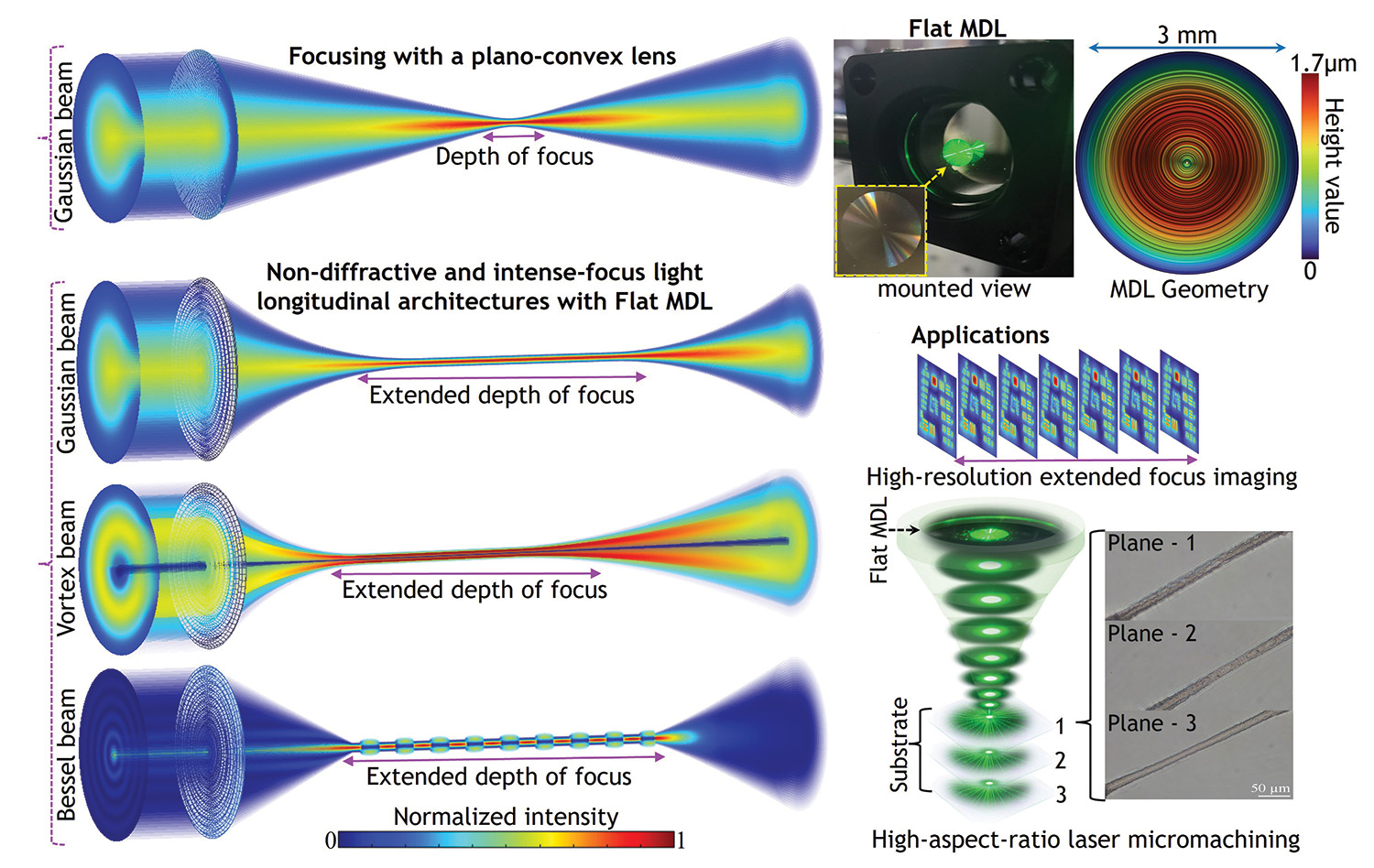
 [Enlarge image]Top left: Conventional focusing of a Gaussian beam with a plano-convex lens. Bottom left: A flat multilevel diffractive lens (MDL) extends the depth of focus for both Gaussian and structured light, including optical vortex and Bessel-bottle beams, functionalities that are challenging to achieve with conventional optics. Top right: Photograph of a flat MDL with engineered height profile. Bottom right: High-resolution extended-focus imaging and high-aspect-ratio laser micromachining enabled by laser focusing through the flat MDL. Together, the panels demonstrate the MDL’s adaptability and innovative capabilities in beam shaping and applications.
Conventional plano-convex lenses focus a Gaussian laser beam only within a limited depth of focus; beyond the focal plane, diffraction rapidly causes the beam to diverge. This fundamental limitation restricts applications that require lasers to remain tightly focused and propagation-invariant over extended distances. Flat diffractive lenses offer a powerful alternative to overcome these limitations. Unlike conventional lenses that rely primarily on refraction, these ultrathin, lightweight, high-NA and highly transparent lenses exploit engineered interference and diffraction to achieve optical functionalities that are difficult to obtain with traditional optics.
These flat lenses are meticulously designed through numerical inverse-design methods, where the desired optical response is defined first, and the necessary structure to achieve that response is determined computationally. This inverse method, used across many fields, enables unconventional, counterintuitive optical designs that are hard to achieve with first-principles modeling.1 The resulting multilevel diffractive lens (MDL) is fabricated via grayscale lithography and incorporates multiple diffractive surfaces, with spatially varying phase retardation optimized to control light propagation precisely, provide broadband achromatic focusing and extended focus, and mitigate temporal broadening of femtosecond pulses.1,2,3
Recently, these flat diffractive lenses have demonstrated multifunctionality and outperformed traditional lens-based methods. To demonstrate these exotic features, optical vortex beams with various topological charges carrying orbital angular momentum were shaped and remained tightly focused over longer propagation distances exceeding 5 cm.4 Such optical vortex needle beams are non-diffracting, unlike conventional optical vortices that rapidly expand due to diffraction.4 The platform also enables the generation of customized optical bottle beams, which are challenging to generate without intricate, alignment-sensitive optical systems.
In our recent work combining a binary axicon with a flat diffractive lens, a compact hybrid architecture generates non-divergent, propagation-invariant Bessel-bottle beams composed of alternating high-contrast bright and dark regions that remain stable over distances exceeding 5 cm, greatly broadening their applications.5 These lenses enable high-resolution imaging1,2 and produce laser filamentation with long plasma channels from femtosecond pulses, enabling high-aspect-ratio laser micromachining.3 Ultimately, we view MDLs as treasured optical tools that deliver compact, cost-effective, high-performance beam shaping and imaging for scientific, industrial, medical and aerospace applications.
Researchers
Andra Naresh Kumar Reddy (naarereddy@gmail.com), Quantlight and High Harmonics Lab Pvt. Ltd., India, and Chiba University, Japan
Vishwa Pal and Sunny, Indian Institute of Technology Ropar, India
Tina M. Hayward and Apratim Majumder, University of Utah, USA
Rajesh Menon, University of Utah and Oblate Optics, Inc., USA
References
1. M. Meem et al. Optica 7, 252 (2020).
2. R. Menon and N. Brimhall, ACS Photonics 10, 1046 (2023).
3. A.N. Jena et al. Opt. Lett. 50, 4670 (2025).
4. A. Kumari et al. J. Appl. Phys. 136, 113105 (2024).
5. A.N.K. Reddy et al. ACS Photonics 13, 1354 (2026).
